
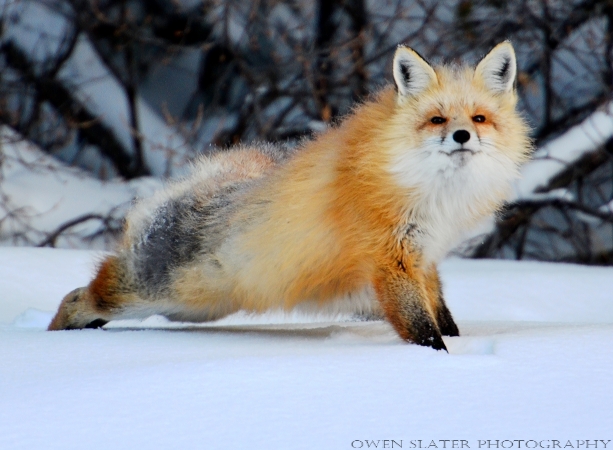
After waking up from a nap, this female red fox stretched out and struck a pose as if she were competing for best in show. She gets my vote!
After waking up from a nap, this female red fox stretched out and struck a pose as if she were competing for best in show. She gets my vote!
 Happy New Year! Thanks for stopping by and for those returning, thanks for your support in 2012! It was my best year to date with visits from over 110 different countries! I had several amazing wildlife experiences resulting in a few of the photos you see here. It will be hard to top 2012, but I’m looking forward to seeing what develops in 2013 and sharing my photos and stories with you here.
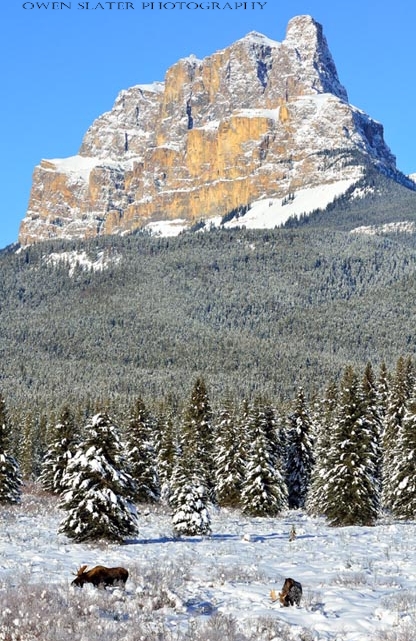
On one of my recent trips to the mountains I watched a pack of wolves slowly wander along a frozen river and took in a beautiful sunrise as the moon set over the mountains. I also came across these two bull moose in a large meadow surrounded by mountains. Moose in the Bow Valley ecosystem are the hardest of the ungulates to find and it’s even more rare to see more than one adult together at a time. However, this past year I have seen more moose than ever before and there is evidence to suggest that their numbers will steadily increase in the park over the next decade (as long as rail and vehicles strikes can be minimized).
These two large males just came through the rutting season. Just before the start of the rut, their testosterone levels surge and they essentially become the human equivalent of an Olympic caliber athlete on performance enhancing drugs. For over a month they battled other males, wander large distances to find reproductively active females and hardly eat a thing, all for the opportunity to breed. The end of the season is marked by a gradual decrease in their testosterone levels. They no longer view each other as competition but instead, periodically seek out the company of other males and forage together. These two spent the day trying to replenish their energy reserves by eating and resting together in a large meadow. The mountain in the background is known as Castle Mountain, which on its own is one of my favourite mountains to photograph in Banff National Park. Add in a sunny day with clear skies, a great vantage point and a couple of moose and it was the perfect recipe for getting a good photograph.
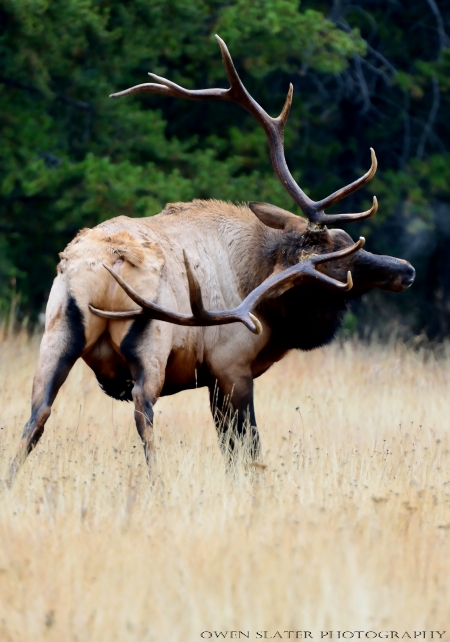
When not using his antlers to fight over breeding rights, this elk delicately used his antlers to scratch a hard to reach spot!
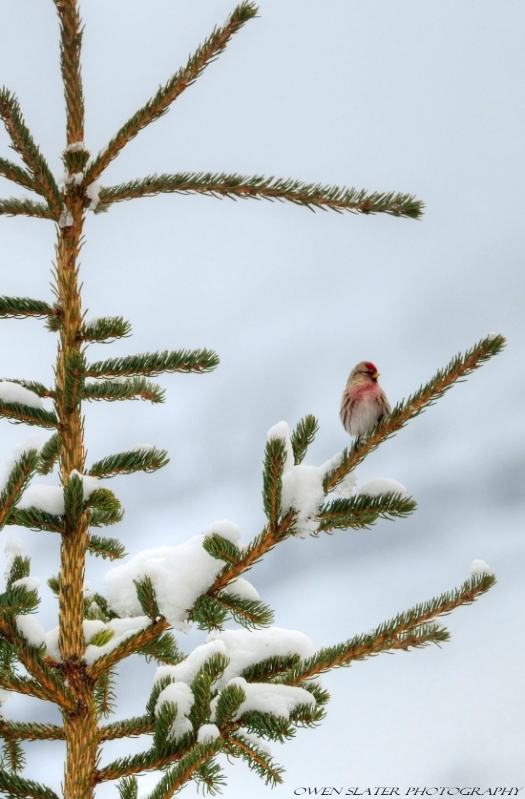
A male red poll (males have crimson breast feathers in addition to the red cap) sits on snow covered fir tree in Banff National Park

The Bow Valley is dominated by human presence and infrastructure that the wolf pack must navigate on a daily basis. Of the 7 pups born into the pack last year, 6 died due to either train or motor vehicle accidents. As the summer has progressed, this years litter of wolf pups are now spending all their time on the go with their parents and the yearling sibling, learning the ropes of the Bow Valley ecosystem. It won’t be easy for them to survive in this environment but so far four have managed to make it past the first few months and are quickly learning the lessons required to survive.

Shortly after the 4 month old pup howled I heard rustling in the bushes just ahead of me. Peering up the avalanche chute, through all the bent aspen saplings I spotted the movements of another wolf. As it entered a clearing it was clear that it was the mother. She was making her way through the trees carrying the back end of a lamb in her mouth! She made her way to the pup hiding in the forest and shortly afterwards I heard the excited cries of the reunion and then growls over the meat. If you look closely you can see the hooves of the lamb near the base of the radio-collar. Survival of the fittest in its purest form.
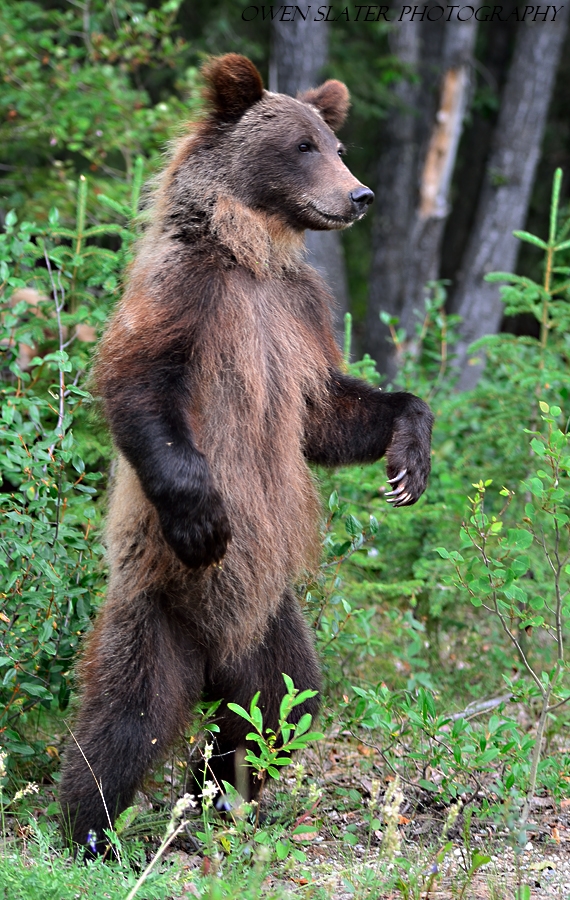
A one and half year old grizzly cub stands up to get a better vantage point of his surroundings. This year has produced a bumper crop of buffalo berries which when coupled with the high snow fall at higher elevations has resulted in the bears staying in the valleys for longer than normal. Having such long and powerful claws is of no use when feeding on the small berries. Instead, they use their very dexterous lips to grasp the berries off the stems. In an average day, an adult grizzly can consume about 200,000 berries!

I have watched this nest periodically over the summer, hoping to catch the fledglings as they take to the air. I lucked out, as I saw each one of them practice their newly discovered flying abilities. This particular bird did a low fly by over the heads of the two others, who ducked to get out of the way as they watched it soar past.

It is relatively common to see black wolves in North America, but that was not always the case. In fact, the black colouration is actually, in evolutionary time, a recent coat colour inherited from none other then the domestic dog some 10,000 to 14,000 years ago. Genomic studies have shown that prior to this time there were no black wolves. However, this trait was common in dogs and through breeding between the two, this gene has since been incorporated into the North American wolf genome and has provided these wolves with an adaptive advantage. What that advantage is no one really knows. Theories include improved camouflage, which doesn’t hold a lot of weight when you consider that wolves are not ambush predators. Another is that black colouration is linked to other genes that enhance immune function, which would provide these individuals with an obvious advantage. However, this theory has holes as well because there aren’t any black Arctic wolves, which you would expect if black colouration provided such a clear immune advantage but. Whatever the reason, Banff National Park has one of, if not the highest proportion of black wolves anywhere. This black wolf pup is one of six pups born this spring in Banff National Park. Of those six pups, five are black.

A three month old wolf pup peers out from behind a small hill in Banff National Park. This pup is one of six born this spring in Banff National Park. He is one of the bold ones, and as such tends to wander off from the den area without parental supervision to explore his new surroundings. Already, the parents are taking the pups on long hunting excursions, swimming across fast flowing rivers, avoiding grizzly and black bears, navigating the roads and railways all the while searching for their next meal. If the family is lucky, half of the pups will survive through their first year.

The mountain parks have received a tremendous amount of rain this year, resulting in very high rivers and even mudslides that have caused numerous road closures. Here, a huge uprooted tree comes to rest along the banks of the swollen Bow river, as Castle mountain emerges from the clouds in the distance.
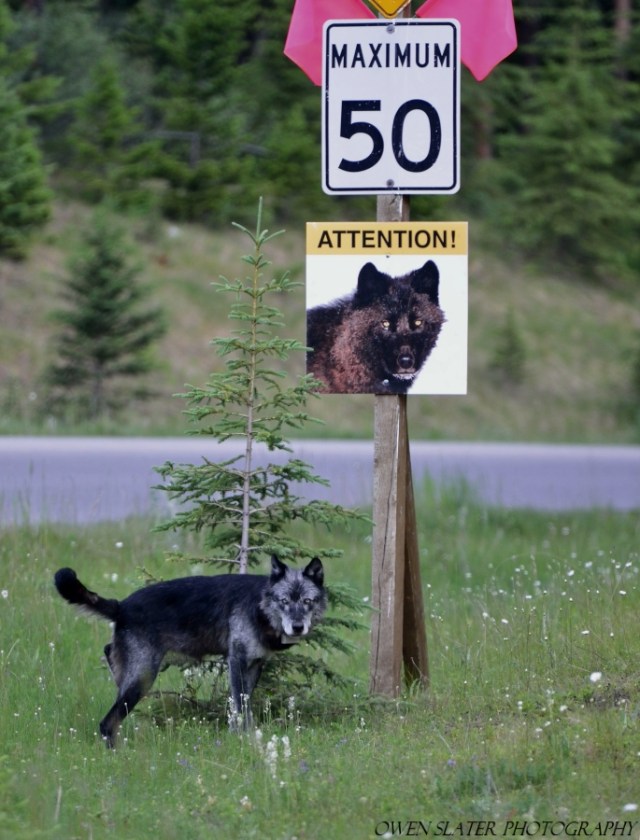 Over the past few weeks it has become clear that more education is required for people travelling to wilderness areas. Seven black bears and three wolves have been killed on the Trans Canada Highway already this summer. While some of these were likely unavoidable, speeding has played a large part in many of these deaths. Just recently someone was clocked speeding at 203km/hr just outside of Banff where the speed limit is 90km/hr! Posted speed limits on the Bow Valley Parkway (aka 1A) are much slower but are rarely followed even when wildlife warning signs are posted.
Even more concerning are the number of reports of bears and wolves being fed by people. This was sadly highlighted earlier this week when a wolf in Kananaskis country had to be killed by conservation officers because it had become a risk to public safety. This wolf had been fed by people and developed an association between humans and food. It approached parked cars, motorcycles and bicyclists looking for handouts. It frequented campgrounds and was recently observed running from a campsite with a roast in its mouth. The last straw was when it approached to within a few meters of a man and his son walking in a campground. They were able to get away by entering a bathroom at which point the wolf left. With a food conditioned large carnivore reliant on people for food, there was no other option and it was promptly shot. All because a few people thought that it would be a good idea to give it a few handouts.
I have spent more time in Banff National Park this year than any other year and it is abundantly clear that many people think it is Disney Land. I have seen parents placing their children within a few feet of bull elk to photograph them with these animals. One even tried to place their child on the antlers! Others park in the middle of the road and jump out to photograph bears feeding on plants right next to them. Remarkably, the animals have tolerated this stupidity and simply retreated, often times with people racing after them.
Wildlife photographers are also a problem. Several routinely get out of their vehicles and approach grizzly bears with cubs to within 10-15 feet, prompting a bluff charge from the bears. These same photographers have high powered telephoto lenses that enable them to stay back at a safe distance, but this seems to be lost on them. I have seen a professional photographer that proclaims to only obtain ethical wildlife photographs endangering wildlife and motorists by directly blocking the path that the animals are travelling along with his car, completely blocking traffic by parking diagonally across a road and even driving the wrong way on a one way road all in order to get the shot. Its hard to expect tourist that may not be used to seeing wildlife to act responsibly when those that know better set a poor example.
Please do your part to help our wildlife survive and reduce the risk that you will get injured while viewing wildlife. Follow the traffic laws and posted speed limits, don’t feed wildlife and view them from a safe distance while allowing them to carry out their natural behaviours. If you see others behaving inappropriately in the National Parks please report it immediately to Parks Canada staff or call 1 888 WARDENS (1-888-927-3367 ). Thanks!

I took this photo last weekend in Banff National Park. I have been fortunate enough to see this impressive female on multiple occasions over the past several months as she leaves and returns to the den site with food for her younger siblings born earlier this year. When the parents are off hunting she is an excellent babysitter, often playing with the young pups in the forest. On this particular day I spotted her a fair distance away as she made her way back from a hunting trip. This allowed me enough time to park my car in a pullout and hope that she would pass nearby. Once in place I set up my camera and waited. Sure enough, within a few minutes she trotted right up to where I was, took a few seconds to stop and look at me, before continuing on to rejoin the others back at the den. It was just enough time to get this photo.
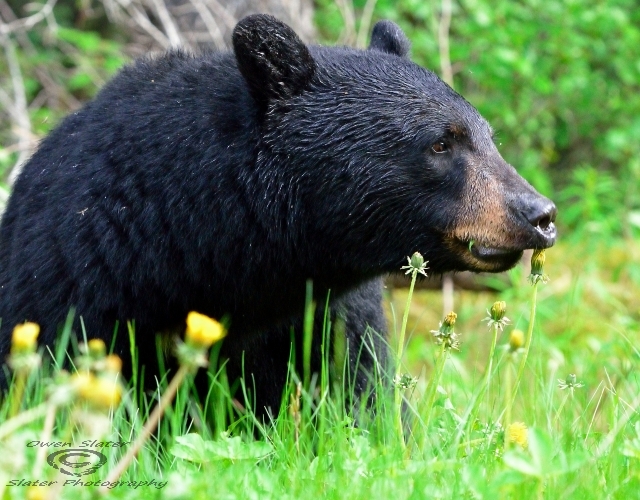
This spring has been mainly overcast with lots of rain and cool days which has extended the dandelion season in many areas of Banff National Park. Here a black bear pauses between dandelions before sticking out its upper lip to pluck off the head of the next flower. With such a short growing season in the Rockies the bears are in a constant state of looking for and eating as much food as possible. Even then, they typically are much smaller than bears found elsewhere in Alberta and across Canada.
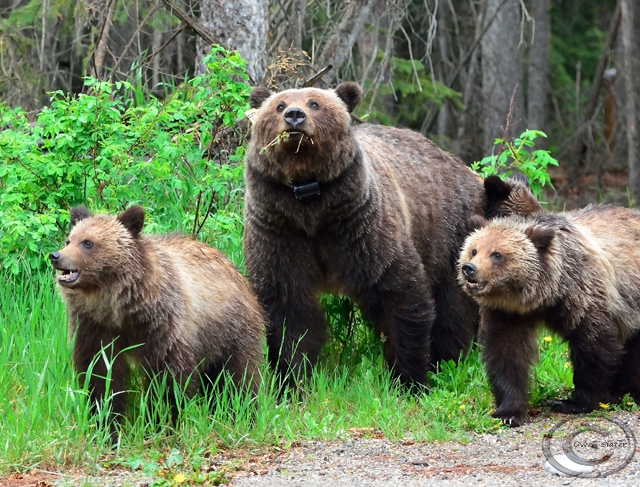
Over a 24 hour period in Banff National Park I came across 6 different grizzly bears within a very small area. This accounts for about 10% of the population of grizzly bears estimated to be in the park. This time of year with snow still present at the higher elevations, the bears are concentrated in the valleys where elk calves and fresh dandelions are numerous. This family of bears is well known in the area. The mom, known as bear 64, is a 23 year old bear that is extremely smart and has adapted to life in the busy Bow Valley. She has three yearling cubs, and has been fitted with a radio collar, ear tag and ear tag transmitter to allow Parks Canada staff to monitor her movements. She makes a living in close proximity to people and so knowledge of her movements will help managers understand how to mitigate any potential problems and will also help them determine ways to keep the bears away from the railway. A more in depth article from the local newspaper can be found here. On this day she had to contend with two large male bears (known as boars) who were in the area. If possible, the boars will try to kill her cubs so she starts cycling again and therefore, the family is always on the lookout for these males. In this photo they are sniffing the air as a big male wandered into the area (though I wasn’t aware of this until about 5 minutes later when he showed up). The family quickly dispersed into the woods and the male was more interested in eating dandelion flowers than the female.


 Owen Slater Photography