Latest Entries »

Pier favourite watermark

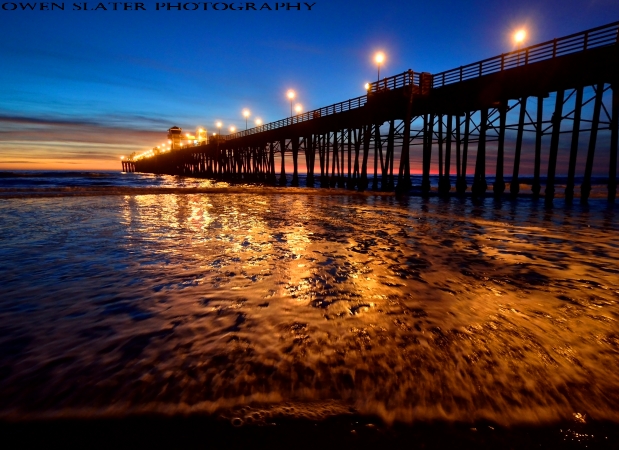
Just like people who need a break from living in the snow and cold, I figure my blog needs a break from the same!  Here is a photo from a recent trip down to sunny, warm southern California! The sunset was spectacular that night. From surfers to people combing the beach for hidden treasures, everyone seemed to stop and take in the amazing colours.

Fluffed Up

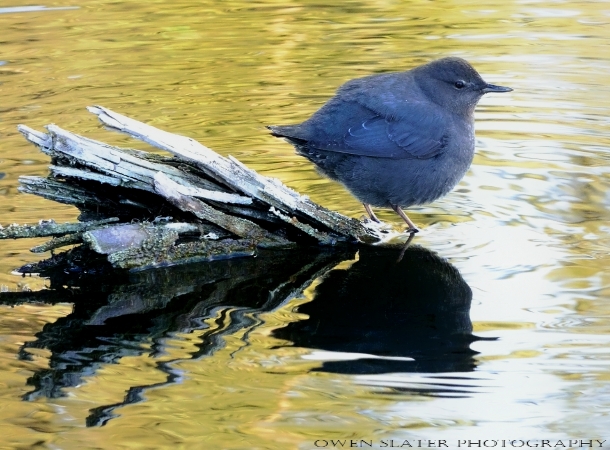
Dipper yellow water tail matching wood watermark

An American Dipper takes a break from hunting to fluff its feathers. Birds will do this for a variety of reasons. In this case the dipper purposely fluffed the feathers to trap air between the different layers. This serves two main functions. One is to keep the warm air close to the body to maintain its body temperature and the other is to get enough air between the feathers to improve buoyancy when diving for food. By doing so,  it easily floats back to the surface with minimal effort despite being weighed down by whatever food it manages to catch. A sick bird will also appear fluffed but this is accompanied by other signs such as lethargy, decreased alertness such as closing of the eyelids and usually thin body condition. As for the photo, it is one of my favourites because of the soft yellow tinge to the water created by the setting sun and the way the bird’s tail feathers match the angle and pattern of the splintered bark.

Serpentine red mountains, snow watermark

One of my favourite winter mountain shots. I love the light, the shape of the mountains and the iron rock jutting out from under the snow. This would be an extreme skiers paradise, but I’m fine with enjoying the view from a distance.

Bull elk snow fall meadow watermark

A group of  bull elk, having just gone through the rut, gather together in a meadow during a snow storm in Banff National Park. With the long, harsh winter just starting these bulls will have to use their hooves to dig down through the deep snow to find what little food remains for them. Any that become weakened will be tested by wolves and undoubtedly a few won’t make it to spring. Natural selection will favour the strong and the adaptable.

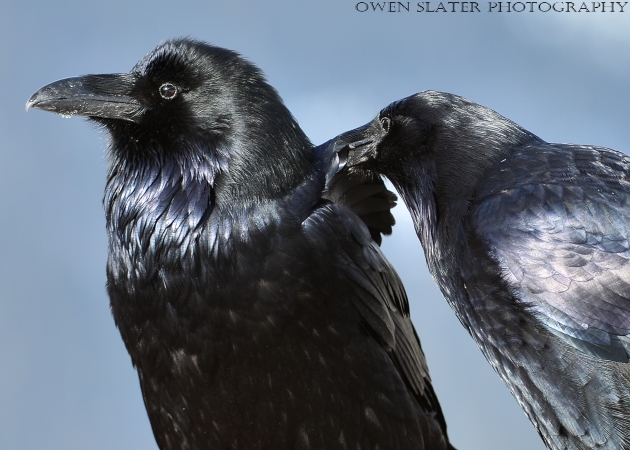
Grooming ravens watermark

I’m not sure why the other photos didn’t appear in the original post but no matter…they are here now! Keeping with the Corvid theme this week, two ravens share a moment together as one gently grooms the feathers of its perspective mate.

Feather grooming ravens watermark

After a few minutes of the back grooming the favour was quickly reciprocated with some delicate grooming around the face, beak and neck of the other raven.

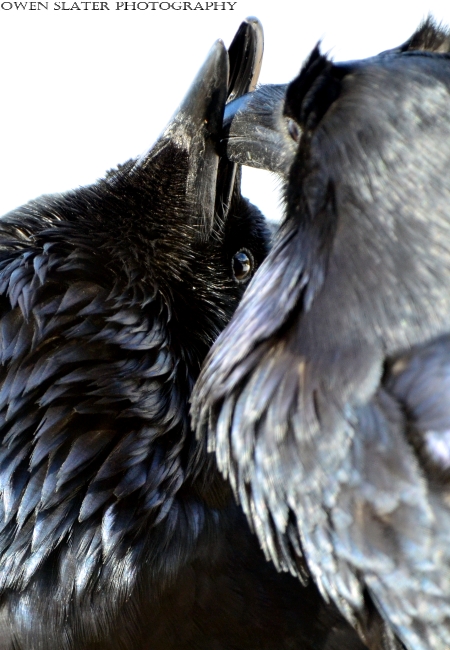
Ravens billing watermark

The grooming behaviours must have been well done since it was quickly followed up by more intimate behaviours. This is known as billing, and apparently it’s not something ravens do with just any raven!  The beaks of birds are very sensitive due to the many nerve endings similar to our own lips, so it isn’t much of a stretch to think that his feels good to them. Things continued to get heated, and not wanting to intrude on their developing relationship anymore than I already had, I quietly packed up and left them to their own devices.

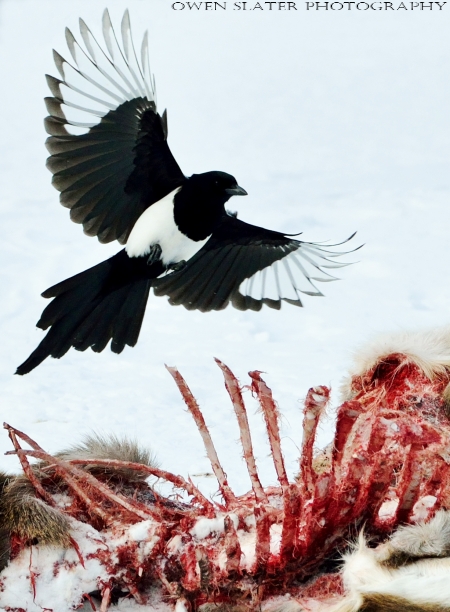
Magpie in flight deer carcass watermark

First let me say that this post was already in the works before today, which is why I got quite the laugh this morning when fellow blogger and wildlife photographer, Lyle Krahn awarded me the dubious distinction of the ‘Forgot to Leave’ award! Check out Lyle’s site for the full story as well as his great wildlife photos and stories!

Whenever I come across a carcass I have visions of wolves or cougars, or the even more elusive wolverine catching the scent and coming in to feed. The thought of witnessing these rarely observed animals in the wild doing things that I or few others have ever seen before keeps me out in the wilderness for hours on end. So with that optimism in mind, I hunkered down and waited. As you can probably imagine, sitting around in -15 degree Celsius temperatures is no fun. You can’t move around to keep warm since that will scare off any wildlife and the cold has a way of quickly removing any resolve that might have initially been there. But that day I was determined to give it a few hours so I waited some more. Within about an hour some magpies showed up and distracted me from the cold. In between feeding on the kill, they flew off to cash their food. Before flying back down to get more pieces of meat they perched in nearby trees and called out. This was great for me since it gave me enough time to turn the camera back on, compose the image and get my finger out of my glove to fire off the shutter. In their typical dramatic aerial flare, they swooped down to the carcass and fanned out their beautiful wings and tail feathers. I was treated to these displays for hours but eventually my resolve was broken. The tipping point was the hot packs I had placed in my boots and gloves could no longer keep my toes and fingers warm. Getting a few images like this made the surrender a little easier but as I hiked back to my car I wondered what I would have seen if I had waited a bit longer.

Tuned In

Prairie hare 2 watermark

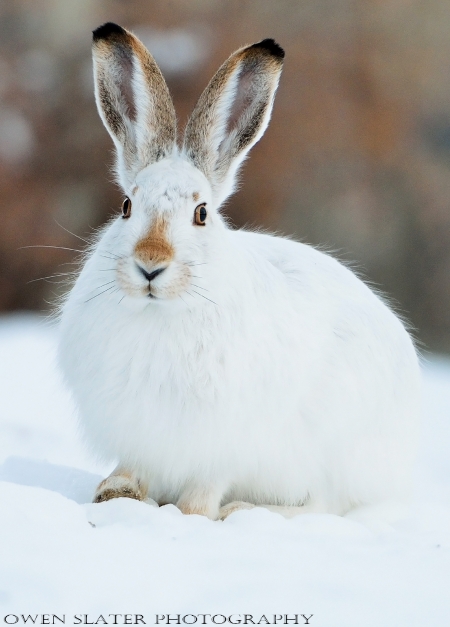
Prairie hares, also known as white-tailed jackrabbits are frequent backyard visitors in Calgary neighbourhoods but since they are primarily nocturnal, getting decent photographs of them is not easy. Sometimes a bit of luck is all that is required! This photo is probably the easiest wildlife photograph I have ever taken. I didn’t even have to leave the house! I just grabbed my camera, opened the sliding door and snapped off a few photos before the last of the sunlight disappeared.

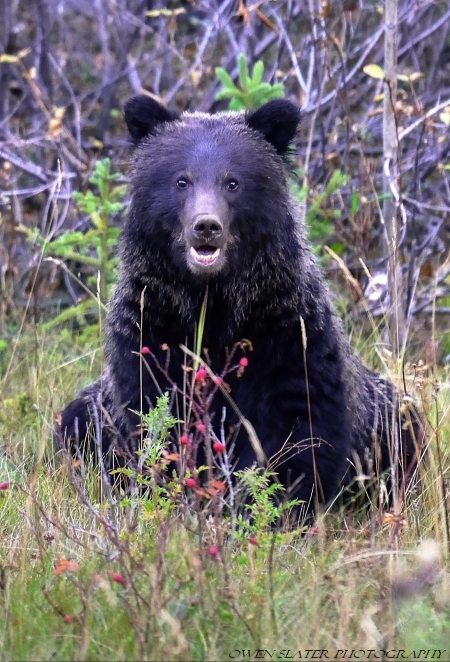
A grizzly cub appears to smile at the site of berries still available for eating in late October. This very spot is now covered in over a meter of snow and her and her family have long since found a den to comfortably sleep away the winter.

muskrat and ducks water 2 watermark

One afternoon I crouched by a small piece of shallow open water on an otherwise frozen lake trying to get some decent photos of green winged teal. Just as the ducks went bottoms up to forage for food a muskrat appeared from the bank. It immediately spotted the teals and to my surprise, swam directly towards them. The unsuspecting birds continued to dabble away at the bottom of the lake as the muskrat quickly closed the gap. Just as it was about to reach one of them, the ducks spotted him and in a burst of energy they frantically splashed and paddled away. Not to be discouraged, the muskrat picked up his pace and gained ground (or water) on them. Like a wolf separating off the weakest animal, the muskrat honed in on the slowest one. With less than a foot between them, the muskrat went into stealth mode. It dove under the water and in a burst of speed went for the underside of the duck. I’m not sure if it was successful at biting the duck or not, but the duck flew up into the air and the muskrat surfaced in its wake. Before the teal could land, the muskrat turned its attention to the others and another chase ensued.  After several close calls with the other teals the muskrat took a break. It dove down, grabbed a plant and headed back to its lodge.

Muskrat chasing ducks watermark

Seeing that the muskrat was gone the ducks resumed feeding. After no more than a few minutes the muskrat returned. This time the ducks were prepared. Seeking refuge from the marauding muskrat, some of the teals jumped out of the water and rested along the frozen shoreline.  As they preened themselves the muskrat chased after the remaining teals still in the water. They quickly decided to join the others along the shoreline, which seemed to placate the muskrat. It found some more food and returned to its lodge. Some of the teals sat down on the ice while the others kept a lookout. They were soon on high alert again as the muskrat made its way back to the feeding area. With its head above water the muskrat must have spotted the ducks. It swam back and forth directly in front of them but the ducks stood their ground.  That is until the muskrat launched itself out of the water and literally started running after the teals on the frozen lake! After a bit of frantic waddling the teals took flight and landed back in the open water. This only resulted in a brief reprieve. The muskrat dove back into the lake and resumed the cat and mouse chase. This cycle continued off and on for over an hour. By then the teals must have had enough and flew off, no doubt in search of a muskrat free patch of open water!  I made my way back to my car, chuckling to myself along the way. Just before I was out of sight, I turned for one last look and there was the muskrat eating a plant in the middle of the water with no teals to be seen!

Foxy Lady

Stretching fox watermark

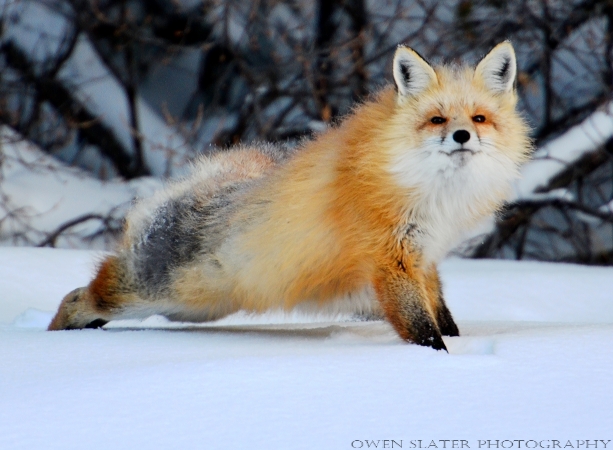
After waking up from a nap, this female red fox stretched out and struck a pose as if she were competing for best in show.  She gets my vote!

Aspen snow sun

On one of the recent cold snaps in Calgary, a light dusting of snow covered the branches of the aspen trees in my backyard, creating a beautiful winter wonderland. I’m sure in a few months I will be longing for a tropical retreat, but for now I’m enjoying winter!

Moose two bulls castle mountain crop watermarkHappy New Year! Thanks for stopping by and for those returning, thanks for your support in 2012! It was my best year to date with visits from over 110 different countries! I had several amazing wildlife experiences resulting in a few of the photos you see here. It will be hard to top 2012, but I’m looking forward to seeing what develops in 2013 and sharing my photos and stories with you here.

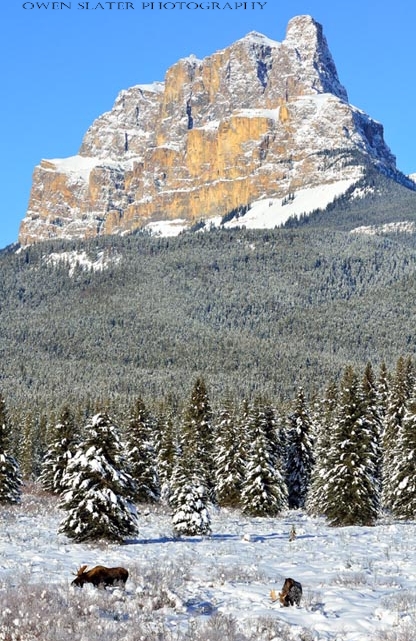
On one of my recent trips to the mountains I watched a pack of wolves slowly wander along a frozen river and took in a beautiful sunrise as the moon set over the mountains. I also came across these two bull moose in a large meadow surrounded by mountains.  Moose in the Bow Valley ecosystem are the hardest of the ungulates to find and it’s even more rare to see more than one adult together at a time. However, this past year I have seen more moose than ever before and there is evidence to suggest that their numbers will steadily increase in the park over the next decade (as long as rail and vehicles strikes can be minimized).

These two large males just came through the rutting season. Just before the start of the rut, their testosterone levels surge and they essentially become the human equivalent of an Olympic caliber athlete on performance enhancing drugs. For over a month they battled other males, wander large distances to find reproductively active females and hardly eat a thing, all  for the opportunity to breed. The end of the season is marked by a gradual decrease in their testosterone levels. They no longer view each other as competition but instead, periodically seek out the company of other males and forage together.  These two spent the day trying to replenish their energy reserves by eating and resting together in a large meadow. The mountain in the background is known as Castle Mountain, which on its own is one of my favourite mountains to photograph in Banff National Park. Add in a sunny day with clear skies, a great vantage point and a couple of moose and it was the perfect recipe for getting a good photograph.

Wolf Faith Snow watermark

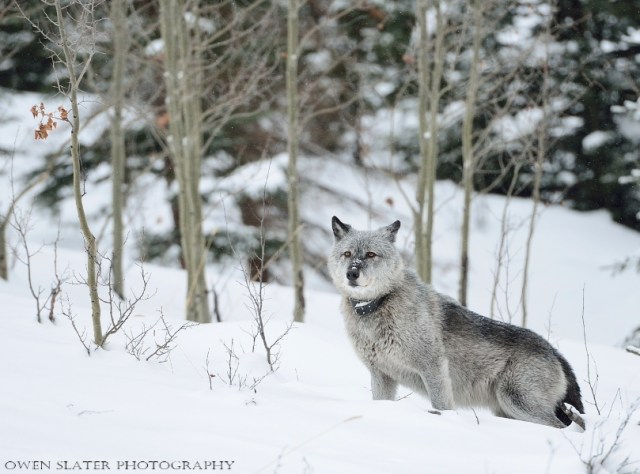
A radio-collared wolf pauses to survey her surroundings before plowing through the deep snow. While looking ahead she used one ear to listen for members of the pack following behind as they co-ordinated their movements up a hill in search of prey.

Elk antler scratch watermark

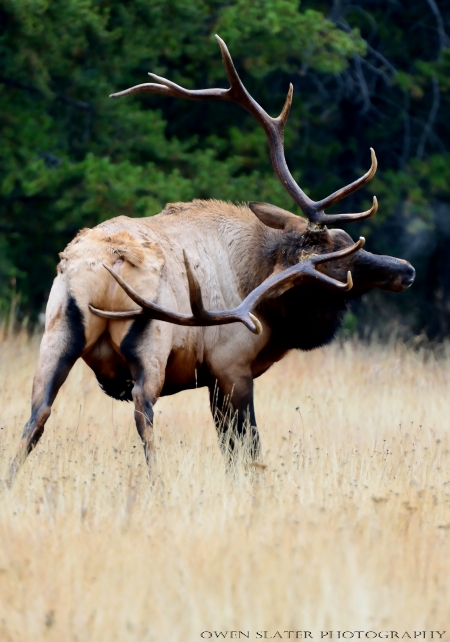
When not using his antlers to fight  over breeding rights, this elk delicately used his antlers to scratch a hard to reach spot!

American dipper in ice cave watermark

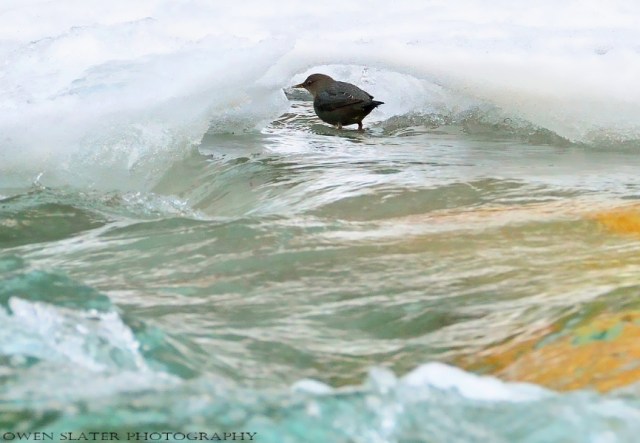
The dipper gets the distinction of being the only aquatic passerine (songbird) in North America. Remarkably, it makes its living diving and swimming in frigid glacier fed waters and then flies around in temperatures as low as -40 degrees. Adaptations that allow this bird to survive include an extra layer of feathering, an enlarged preen (oil secreting) gland for waterproofing, a nictitating membrane (third eyelid), enlarged muscles of the eye to accommodate for underwater vision, nasal flaps and increased hemoglobin levels to boost their blood oxygen carrying capacity that is essential for underwater swimming for up to 30 seconds at a time! I spotted this one along a partially frozen river as it entered a small ice cave in search of food.