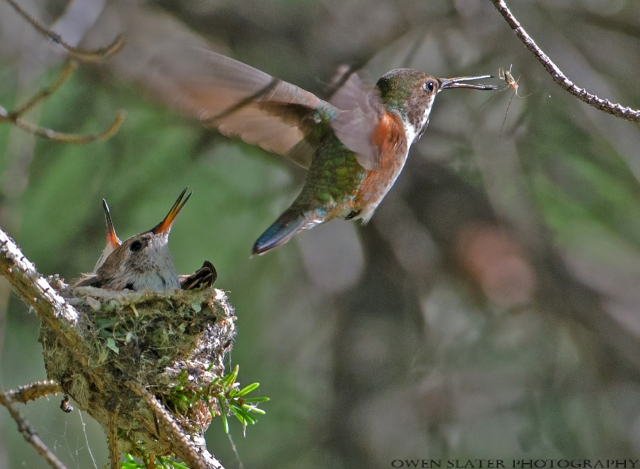
A round trip migration of over 12000 km, a heart rate of 1200 beats/minute, a wing beat rate of 3000-3700 beats/minute, having to go into torpor every evening to survive the long cold nights. Hummingbirds are about as close to mythical that exists in the bird world. I have held them in my hands, felt the vibrations of their little hearts beating and marveled at how something so small and fragile can survive, but it’s still hard to believe they can eek out a living in the harsh environment of the Canadian Rockies. Until this year I had never seen an active nest in the wild. So to say I was ecstatic when, with a bit of help, I came across this one would be a bit of an understatement!
Hummingbird nests, which in themselves are works of art, are constructed with the soft silk of spider webs! Imagine how many spider webs are needed to make a nest like this? It was placed on a thin drooping branch that wouldn’t support the weight of any potential predators (crows, squirrels, martens, etc.). It was woven around the branches and then lichen and moss were attached to the outside to provide camouflage. As is typical, 2 eggs the size of small jellybeans were laid and incubated for just over 2 weeks. The chicks grow at an exponential rate and within 19 days they fledge, fly off with mom and never return to the nest again.
When I came across this one, the chicks were already about 1.5 weeks old and had tiny pin feathers. Contrary to what many believe, hummingbirds don’t rely on nectar to feed their young. The rapidly growing chicks need a high protein diet so they are almost exclusively fed insects. This is why in early summer if you have a hummingbird feeder you won’t see females at it. They return to the feeders later in the summer with their fully grown offspring to teach the young about the best feeding spots. This lasts all but a few days at which point the offspring are self-sufficient.
Watching a hummingbird can be dizzying, not to mention painful from all of the mosquito bites, and while I wish I could say I planned to get this photo, simply put, I didn’t nor could I have imagined it possible given the conditions! The light was low, the nest was well hidden, multiple small branches were getting in the way and as you know these birds do everything at warp speed. I knew the only way I was ever going to have a chance at being successful was if the sun’s rays found a break in the trees to penetrate into the forest and if I set my camera up on a tripod and manually focused on the nest. With the settings locked in I stepped back from the camera with my remote in hand to take in the action from a distance so I didn’t disturb them. After a few minutes the sun was low enough to get through the dense canopy and light up the area around the nest. Now all I needed was for the mom to come back and feed her babies.
Luck was on my side. She flew in and started plunging food down the throats of her chicks. After feeding them she would usually zoom off into the surrounding meadows to catch more food, but this time she did something different. She flew up from the nest but remained hovering right next to it in the beautiful soft light of the sun! I was too far away to see what she was looking at so instead I clicked the remote as fast as possible hoping I would get one good photo of her in flight. The whole sequence lasted less than two seconds but I managed to snap off a few frames that were in focus. It wasn’t until afterwards when I zoomed in on the images that I saw what she was so intent on. Under the watchful eyes of her chicks she had spotted and caught a spider! If you look at this photo closely you can see one of the legs of the unsuspecting spider in her beak just before she clamped down on it! The spider tried to get away by hiding behind the branch but it was no match for the hummingbird and was quickly snapped up and eaten!
While I have other images of the mom and her chicks, none tells the story of the life of this hummingbird family as well as this one! The background and shadows are a bit distracting but this photo is still to date my favourite photo of the year. I hope you like it as much as I do!

 A bald eagle cries out as it effortlessly soars through the air near Prince Rupert, B.C. Once back home, with the help of Photoshop I created this image by keeping the eagle in colour while making the rest of the image black and white. I love the eye-catching effect is has and it turns the image into something more like art than traditional wildlife photography. Sometimes it’s nice to do things a bit differently! Please click on the image for the full size and let me know what you think!
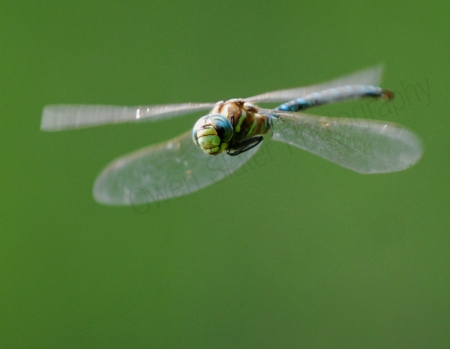 It took a bit of luck and a lot of patience but eventually I got a few pictures of this dragonfly (I believe it’s a paddle tailed darner) that I was happy with.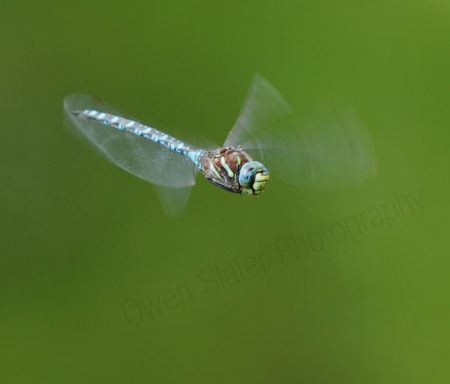






 Owen Slater Photography