
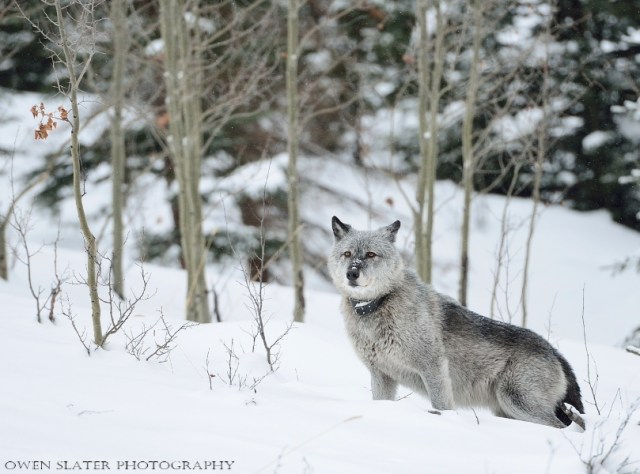
A radio-collared wolf pauses to survey her surroundings before plowing through the deep snow. While looking ahead she used one ear to listen for members of the pack following behind as they co-ordinated their movements up a hill in search of prey.
A radio-collared wolf pauses to survey her surroundings before plowing through the deep snow. While looking ahead she used one ear to listen for members of the pack following behind as they co-ordinated their movements up a hill in search of prey.
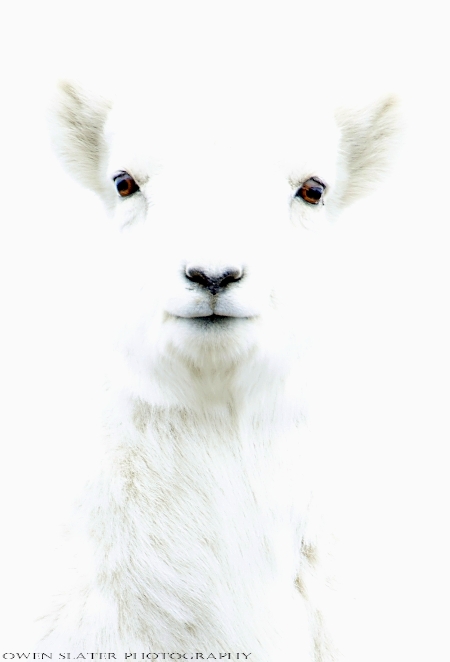
One more for today. This lamb of the year watched me from a comfortable distance on a snow covered mountain near Destruction Bay, Yukon. The herd blended in so well with the snow it was hard to spot them initially. I wanted to mimic this in my photo so I overexposed more than typical to create this effect.
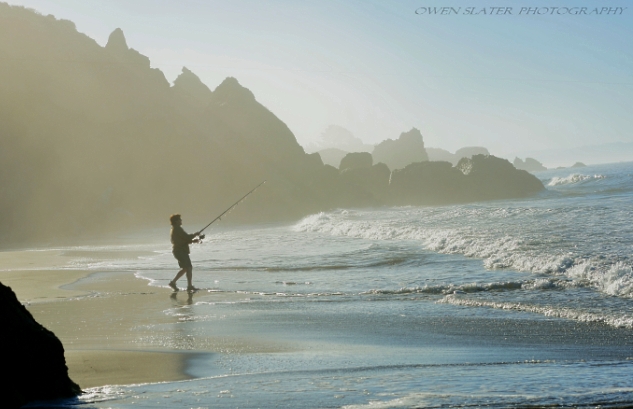 As the fog lifts over the Pacific ocean, a fisherman casts into the waters off the coast of Northern California. Shortly afterwards he reeled in what he initially thought was a big fish, only to find a tangled mess of dead seaweed on the end of his hook.
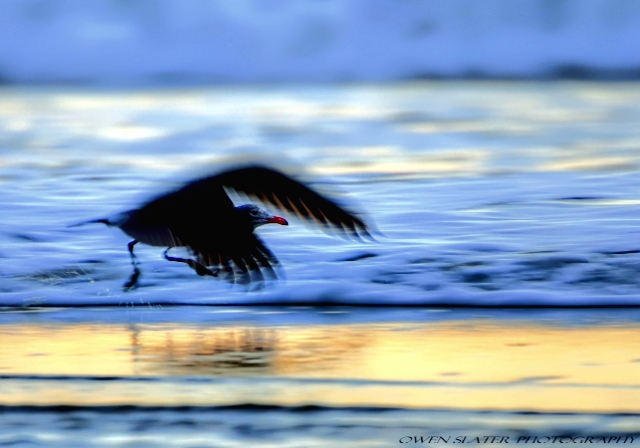 On a recent trip to California I went on a short road trip up to Point Reyes. Along the way I stopped at Stinson beach. Just as the sun was setting I found some Heermann’s gulls to photograph. I have been trying for quitesome time to get a good photo of a bird in flight with the wings in motion and the head in focus. Add in the droplets of water being kicked off the bird’s feet as it springs into the air, the sunset reflecting off of the water and the motion of the incoming wave and I’m thrilled with the result!
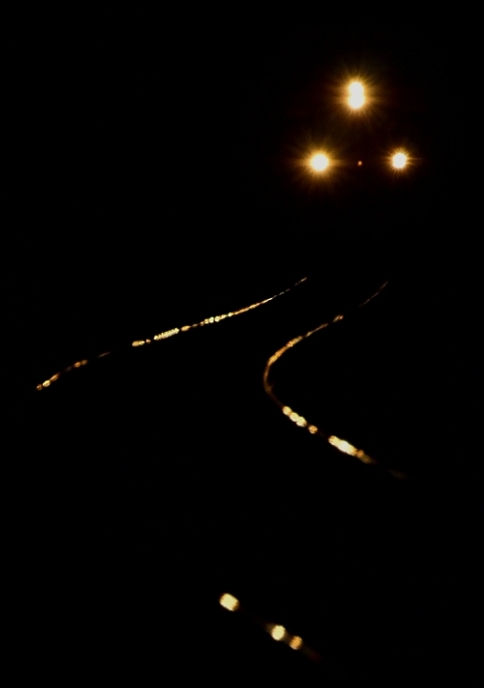
The high powered lights of a train reflect off the tracks as it travels through Banff National Park. This image is likely what the two grizzly cubs observed just before being hit. I took this photo in an effort to replicate what an animal might see when a train is approaching at night. While you would think the sound would be enough to displace the animals off the tracks, the blinding lights conceal the hundreds of tonnes of steel hurtling down the tracks towards them and the animals would not be able to recognize the size of what was approaching. Apex predators such as bears and wolves have very little to fear in their natural ecosystems and as such they often stand their ground to defend themselves. In fact, bears and particularly mothers with cubs, have been known to charge at the trains to try to scare them off. If they did try to run, they usually stick to the path of least resistance. With the headlights only highlighting the tracks directly in front of the train and not much of the surrounding terrain, the animal’s eyes would not be able to adjust and pick up escape routes along the tracts. Instead they tend to run along them in an attempt to escape. The trains move about 60km/hr through the park. At that speed, no animal will be able to outrun them, the conductor doesn’t have enough time to slow the train down, and so invariably they are run down. In rare instances, some animals have survived train strikes. Just this past winter, a juvenile wolf attempted to outrun the train, was clipped and flung into the air. It landed in some hard snow just a few inches away from the rail cars. Remarkably, the following day I watched it walking along a river bed with no obvious injuries.

The Bow Valley is dominated by human presence and infrastructure that the wolf pack must navigate on a daily basis. Of the 7 pups born into the pack last year, 6 died due to either train or motor vehicle accidents. As the summer has progressed, this years litter of wolf pups are now spending all their time on the go with their parents and the yearling sibling, learning the ropes of the Bow Valley ecosystem. It won’t be easy for them to survive in this environment but so far four have managed to make it past the first few months and are quickly learning the lessons required to survive.

Just as I was packing up from photographing osprey one evening I looked up and it was almost like the clouds had formed their own river coursing through the sky that mirrored the bow river below. Add in the beautiful sunset and it was a spectacular sight.
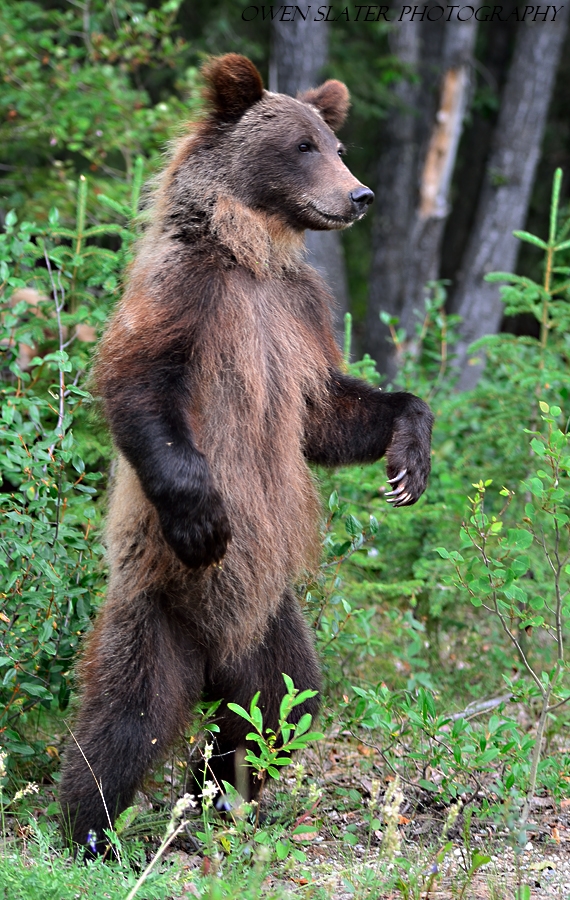
A one and half year old grizzly cub stands up to get a better vantage point of his surroundings. This year has produced a bumper crop of buffalo berries which when coupled with the high snow fall at higher elevations has resulted in the bears staying in the valleys for longer than normal. Having such long and powerful claws is of no use when feeding on the small berries. Instead, they use their very dexterous lips to grasp the berries off the stems. In an average day, an adult grizzly can consume about 200,000 berries!

It is relatively common to see black wolves in North America, but that was not always the case. In fact, the black colouration is actually, in evolutionary time, a recent coat colour inherited from none other then the domestic dog some 10,000 to 14,000 years ago. Genomic studies have shown that prior to this time there were no black wolves. However, this trait was common in dogs and through breeding between the two, this gene has since been incorporated into the North American wolf genome and has provided these wolves with an adaptive advantage. What that advantage is no one really knows. Theories include improved camouflage, which doesn’t hold a lot of weight when you consider that wolves are not ambush predators. Another is that black colouration is linked to other genes that enhance immune function, which would provide these individuals with an obvious advantage. However, this theory has holes as well because there aren’t any black Arctic wolves, which you would expect if black colouration provided such a clear immune advantage but. Whatever the reason, Banff National Park has one of, if not the highest proportion of black wolves anywhere. This black wolf pup is one of six pups born this spring in Banff National Park. Of those six pups, five are black.

A three month old wolf pup peers out from behind a small hill in Banff National Park. This pup is one of six born this spring in Banff National Park. He is one of the bold ones, and as such tends to wander off from the den area without parental supervision to explore his new surroundings. Already, the parents are taking the pups on long hunting excursions, swimming across fast flowing rivers, avoiding grizzly and black bears, navigating the roads and railways all the while searching for their next meal. If the family is lucky, half of the pups will survive through their first year.

The mountain parks have received a tremendous amount of rain this year, resulting in very high rivers and even mudslides that have caused numerous road closures. Here, a huge uprooted tree comes to rest along the banks of the swollen Bow river, as Castle mountain emerges from the clouds in the distance.

I took this photo last weekend in Banff National Park. I have been fortunate enough to see this impressive female on multiple occasions over the past several months as she leaves and returns to the den site with food for her younger siblings born earlier this year. When the parents are off hunting she is an excellent babysitter, often playing with the young pups in the forest. On this particular day I spotted her a fair distance away as she made her way back from a hunting trip. This allowed me enough time to park my car in a pullout and hope that she would pass nearby. Once in place I set up my camera and waited. Sure enough, within a few minutes she trotted right up to where I was, took a few seconds to stop and look at me, before continuing on to rejoin the others back at the den. It was just enough time to get this photo.
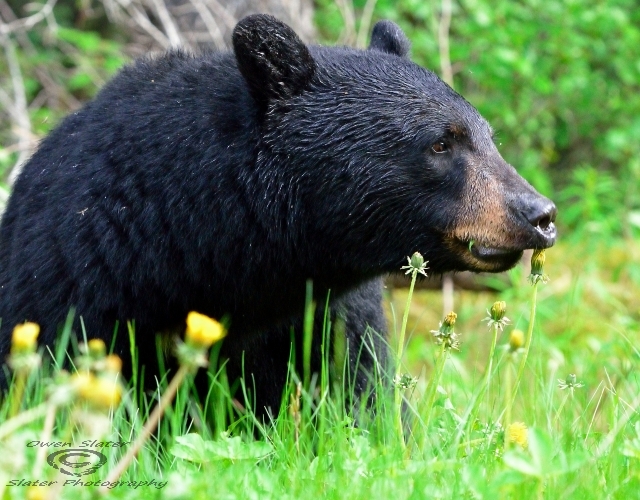
This spring has been mainly overcast with lots of rain and cool days which has extended the dandelion season in many areas of Banff National Park. Here a black bear pauses between dandelions before sticking out its upper lip to pluck off the head of the next flower. With such a short growing season in the Rockies the bears are in a constant state of looking for and eating as much food as possible. Even then, they typically are much smaller than bears found elsewhere in Alberta and across Canada.
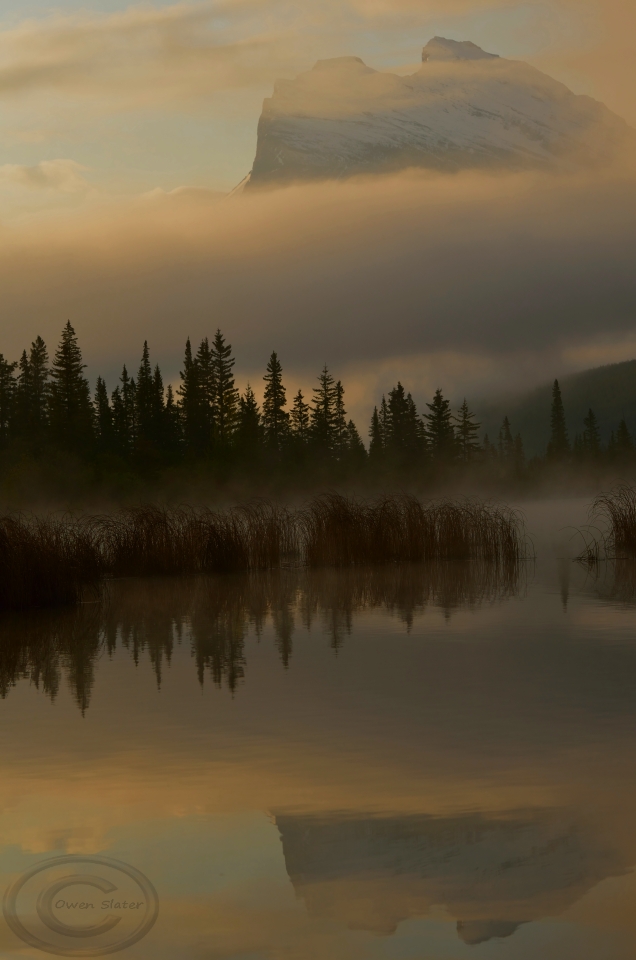
An early morning start paid off when the dense fog lifted just in time for a beautiful sunrise with Mount Rundle reflecting in the calm waters of Vermilion Lake in Banff National Park.
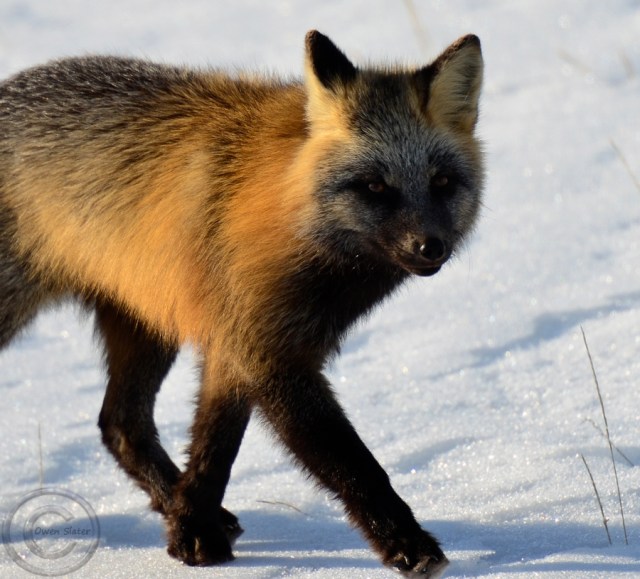
I came across this uniquely coloured fox just outside of Whitehorse. Red fox colouration can vary from their typical appearance to almost completely black. This one was a cross between the two and hence the name “cross fox” that is assigned to this naturally occurring variant.


 Owen Slater Photography