
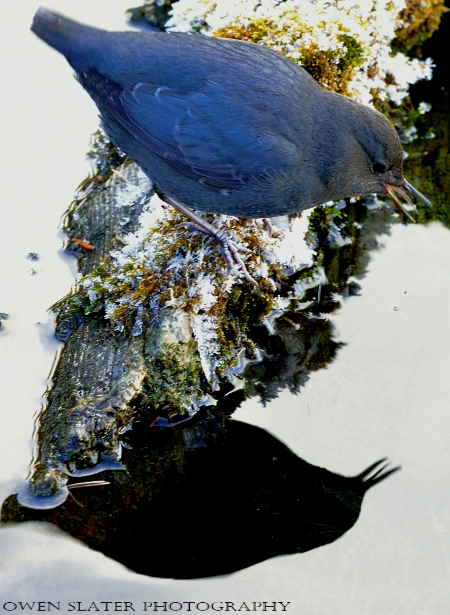
 A funny photo for the day. I will let you decide if the dipper was sticking its tongue out at me, for the photo, or just because it can!
A funny photo for the day. I will let you decide if the dipper was sticking its tongue out at me, for the photo, or just because it can!
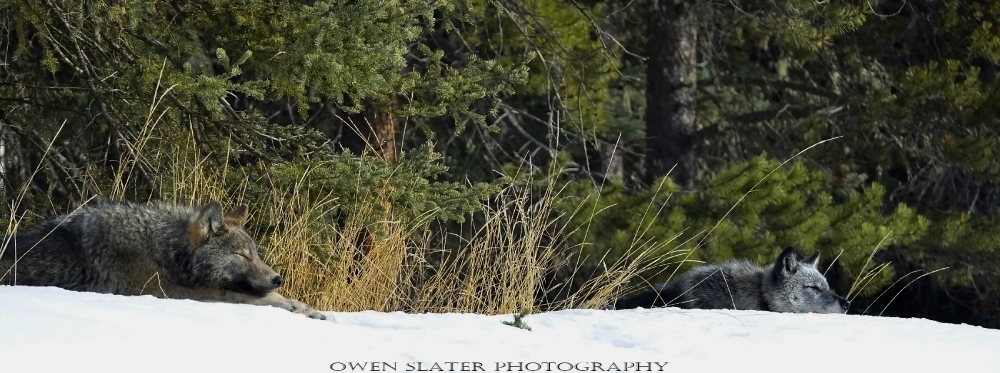
Fast forward to last week for this image (please click on the photo for the larger version).
For anyone that has had the privilege of seeing wild wolves in their natural environment, you can appreciate how fleeting the glimpses usually are. Often times they are visible for only a few seconds, usually in poor light with something obstructing the view. In these situations I often won’t even bother trying to take pictures. I will just watch them from a distance and enjoy the moment before they vanish into the forest.
Last week I was having a very unproductive morning with no good wildlife sightings to speak of so I decided to start heading back to town. I rounded a corner and my luck drastically changed. There, basking in the mid-day sun were three wolves! It is very rare to see them during the day and for them to be lying out in the open is exceptionally rare! I quickly pulled my car over to the side of the road, rolled down the window and turned the engine off in the hopes that I wouldn’t disturb them. Thankfully, within seconds they relaxed and went back to lounging in the sun!
To me nothing is more rewarding when watching wildlife then to have them be seemingly unaffected by my presence. I think this should be the gold standard for anyone that wants to watch or photograph wildlife. Sometimes it doesn’t happen, but if an effort is made to make this the first priority then it will occur a lot more often than not. In this case by keeping my distance, staying in the car and making as little movement or noise as possible I was able to watch them undisturbed for several minutes. One walked down the hill right in front of me while these two stayed on the ridge above. The two on the hill would periodically lift their heads to check on the other wolf below. The most amazing moment that illustrated that they weren’t concerned with me in the least was when they laid their heads down and closed their eyes for a few moments. To me this was the ultimate compliment.
You might be wondering how it all ended? I wish I could tell you that I left the wolves were I found them but unfortunately as is all too common these days a vehicle came around the corner, stopped behind me and the person got out of their car. In a split second the wolves on the hill leaped up, swirled around and vanished into the trees while the one of the road bolted up the hill and out of sight. Frustrating to say the least but hopefully the wolves were able to find a more secluded sunny spot to rest in for the remainder of the afternoon.
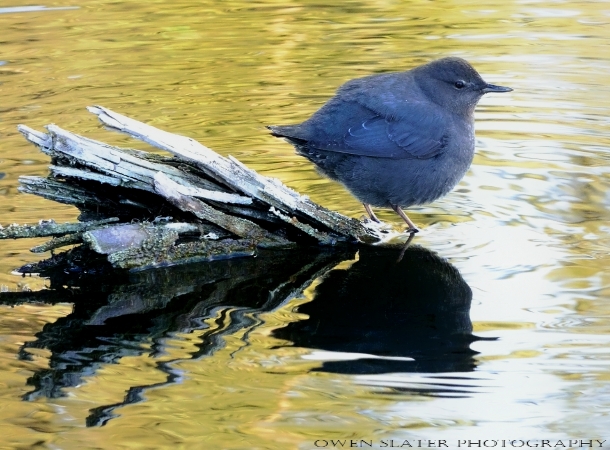
An American Dipper takes a break from hunting to fluff its feathers. Birds will do this for a variety of reasons. In this case the dipper purposely fluffed the feathers to trap air between the different layers. This serves two main functions. One is to keep the warm air close to the body to maintain its body temperature and the other is to get enough air between the feathers to improve buoyancy when diving for food. By doing so, it easily floats back to the surface with minimal effort despite being weighed down by whatever food it manages to catch. A sick bird will also appear fluffed but this is accompanied by other signs such as lethargy, decreased alertness such as closing of the eyelids and usually thin body condition. As for the photo, it is one of my favourites because of the soft yellow tinge to the water created by the setting sun and the way the bird’s tail feathers match the angle and pattern of the splintered bark.

A group of bull elk, having just gone through the rut, gather together in a meadow during a snow storm in Banff National Park. With the long, harsh winter just starting these bulls will have to use their hooves to dig down through the deep snow to find what little food remains for them. Any that become weakened will be tested by wolves and undoubtedly a few won’t make it to spring. Natural selection will favour the strong and the adaptable.
First let me say that this post was already in the works before today, which is why I got quite the laugh this morning when fellow blogger and wildlife photographer, Lyle Krahn awarded me the dubious distinction of the ‘Forgot to Leave’ award! Check out Lyle’s site for the full story as well as his great wildlife photos and stories!
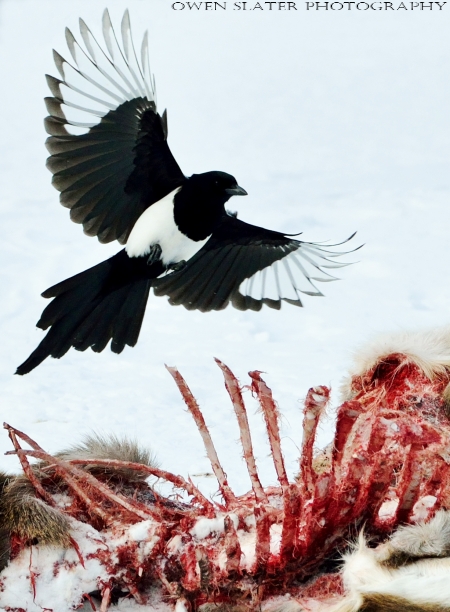
Whenever I come across a carcass I have visions of wolves or cougars, or the even more elusive wolverine catching the scent and coming in to feed. The thought of witnessing these rarely observed animals in the wild doing things that I or few others have ever seen before keeps me out in the wilderness for hours on end. So with that optimism in mind, I hunkered down and waited. As you can probably imagine, sitting around in -15 degree Celsius temperatures is no fun. You can’t move around to keep warm since that will scare off any wildlife and the cold has a way of quickly removing any resolve that might have initially been there. But that day I was determined to give it a few hours so I waited some more. Within about an hour some magpies showed up and distracted me from the cold. In between feeding on the kill, they flew off to cash their food. Before flying back down to get more pieces of meat they perched in nearby trees and called out. This was great for me since it gave me enough time to turn the camera back on, compose the image and get my finger out of my glove to fire off the shutter. In their typical dramatic aerial flare, they swooped down to the carcass and fanned out their beautiful wings and tail feathers. I was treated to these displays for hours but eventually my resolve was broken. The tipping point was the hot packs I had placed in my boots and gloves could no longer keep my toes and fingers warm. Getting a few images like this made the surrender a little easier but as I hiked back to my car I wondered what I would have seen if I had waited a bit longer.
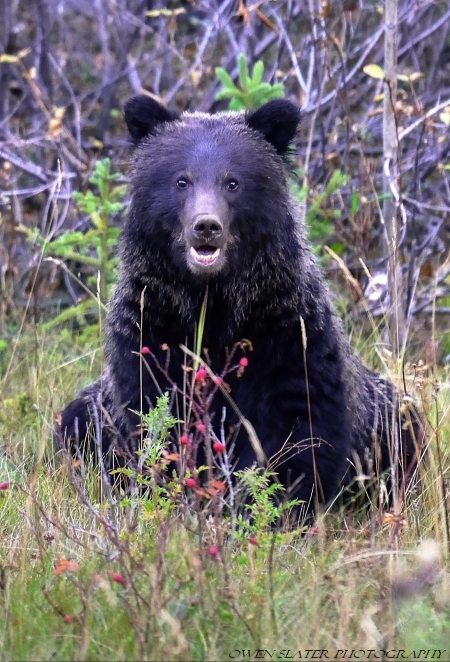
A grizzly cub appears to smile at the site of berries still available for eating in late October. This very spot is now covered in over a meter of snow and her and her family have long since found a den to comfortably sleep away the winter.
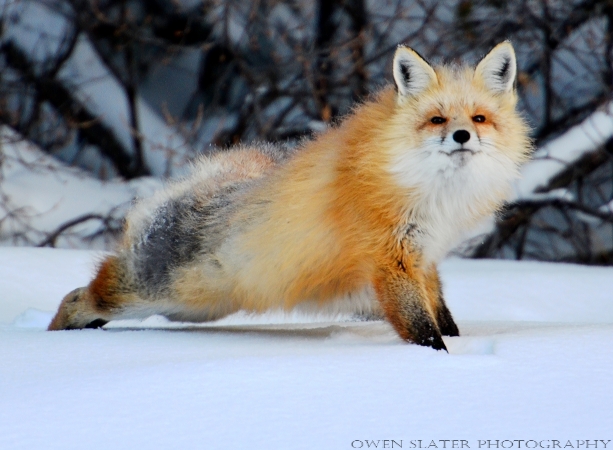
After waking up from a nap, this female red fox stretched out and struck a pose as if she were competing for best in show. She gets my vote!
 Happy New Year! Thanks for stopping by and for those returning, thanks for your support in 2012! It was my best year to date with visits from over 110 different countries! I had several amazing wildlife experiences resulting in a few of the photos you see here. It will be hard to top 2012, but I’m looking forward to seeing what develops in 2013 and sharing my photos and stories with you here.
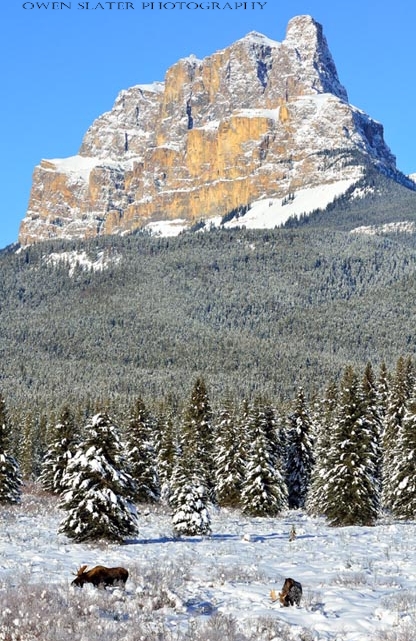
On one of my recent trips to the mountains I watched a pack of wolves slowly wander along a frozen river and took in a beautiful sunrise as the moon set over the mountains. I also came across these two bull moose in a large meadow surrounded by mountains. Moose in the Bow Valley ecosystem are the hardest of the ungulates to find and it’s even more rare to see more than one adult together at a time. However, this past year I have seen more moose than ever before and there is evidence to suggest that their numbers will steadily increase in the park over the next decade (as long as rail and vehicles strikes can be minimized).
These two large males just came through the rutting season. Just before the start of the rut, their testosterone levels surge and they essentially become the human equivalent of an Olympic caliber athlete on performance enhancing drugs. For over a month they battled other males, wander large distances to find reproductively active females and hardly eat a thing, all for the opportunity to breed. The end of the season is marked by a gradual decrease in their testosterone levels. They no longer view each other as competition but instead, periodically seek out the company of other males and forage together. These two spent the day trying to replenish their energy reserves by eating and resting together in a large meadow. The mountain in the background is known as Castle Mountain, which on its own is one of my favourite mountains to photograph in Banff National Park. Add in a sunny day with clear skies, a great vantage point and a couple of moose and it was the perfect recipe for getting a good photograph.
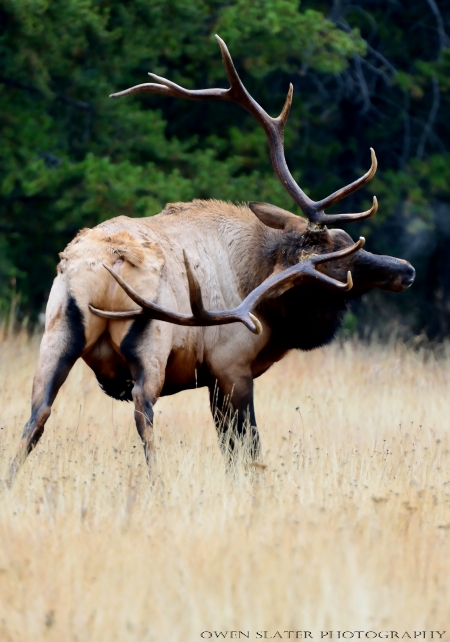
When not using his antlers to fight over breeding rights, this elk delicately used his antlers to scratch a hard to reach spot!
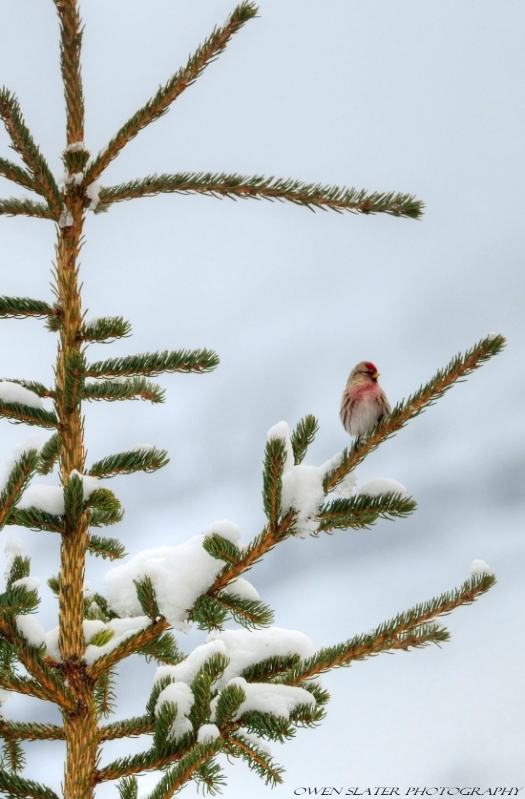
A male red poll (males have crimson breast feathers in addition to the red cap) sits on snow covered fir tree in Banff National Park

Shortly after the 4 month old pup howled I heard rustling in the bushes just ahead of me. Peering up the avalanche chute, through all the bent aspen saplings I spotted the movements of another wolf. As it entered a clearing it was clear that it was the mother. She was making her way through the trees carrying the back end of a lamb in her mouth! She made her way to the pup hiding in the forest and shortly afterwards I heard the excited cries of the reunion and then growls over the meat. If you look closely you can see the hooves of the lamb near the base of the radio-collar. Survival of the fittest in its purest form.
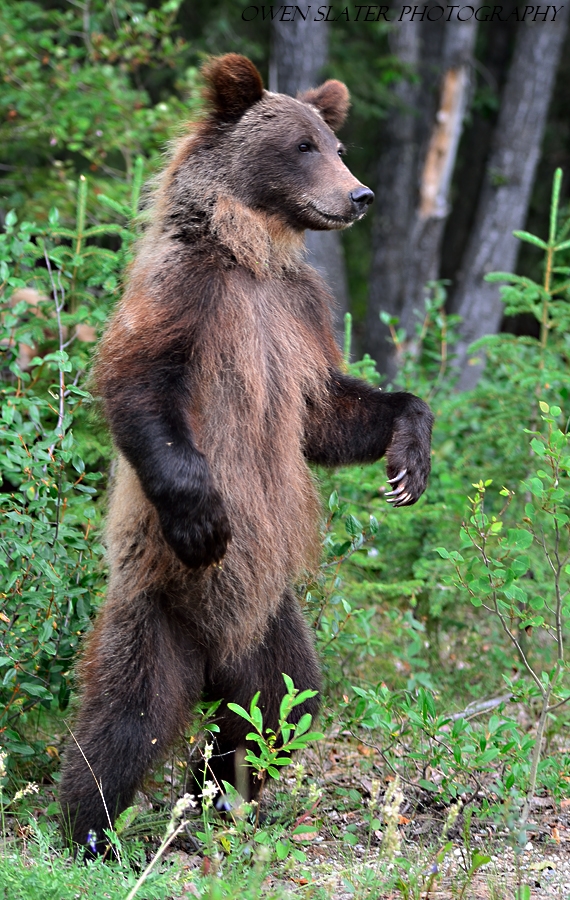
A one and half year old grizzly cub stands up to get a better vantage point of his surroundings. This year has produced a bumper crop of buffalo berries which when coupled with the high snow fall at higher elevations has resulted in the bears staying in the valleys for longer than normal. Having such long and powerful claws is of no use when feeding on the small berries. Instead, they use their very dexterous lips to grasp the berries off the stems. In an average day, an adult grizzly can consume about 200,000 berries!

I have watched this nest periodically over the summer, hoping to catch the fledglings as they take to the air. I lucked out, as I saw each one of them practice their newly discovered flying abilities. This particular bird did a low fly by over the heads of the two others, who ducked to get out of the way as they watched it soar past.

It is relatively common to see black wolves in North America, but that was not always the case. In fact, the black colouration is actually, in evolutionary time, a recent coat colour inherited from none other then the domestic dog some 10,000 to 14,000 years ago. Genomic studies have shown that prior to this time there were no black wolves. However, this trait was common in dogs and through breeding between the two, this gene has since been incorporated into the North American wolf genome and has provided these wolves with an adaptive advantage. What that advantage is no one really knows. Theories include improved camouflage, which doesn’t hold a lot of weight when you consider that wolves are not ambush predators. Another is that black colouration is linked to other genes that enhance immune function, which would provide these individuals with an obvious advantage. However, this theory has holes as well because there aren’t any black Arctic wolves, which you would expect if black colouration provided such a clear immune advantage but. Whatever the reason, Banff National Park has one of, if not the highest proportion of black wolves anywhere. This black wolf pup is one of six pups born this spring in Banff National Park. Of those six pups, five are black.

A three month old wolf pup peers out from behind a small hill in Banff National Park. This pup is one of six born this spring in Banff National Park. He is one of the bold ones, and as such tends to wander off from the den area without parental supervision to explore his new surroundings. Already, the parents are taking the pups on long hunting excursions, swimming across fast flowing rivers, avoiding grizzly and black bears, navigating the roads and railways all the while searching for their next meal. If the family is lucky, half of the pups will survive through their first year.


 Owen Slater Photography