Tag Archive: Alberta


Caribou curious WM

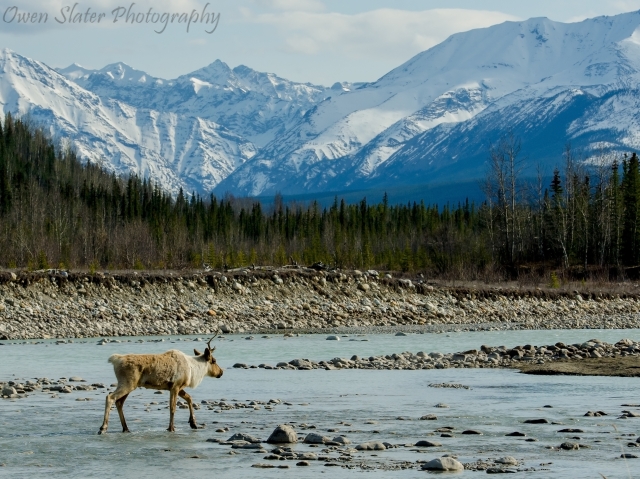
If I told you that for the past few years mountain caribou have been captured by nets, sedated and loaded into helicopters and then flown to either awaiting transport trailers or large enclosures on the sides of mountains you would likely think I’m pulling your leg. I wish I was, but for the past several years dedicated teams composed of First Nations personnel, wildlife biologists, fellow veterinarians, and countless others have being doing just that in order to try to conserve some of the most critically endangered caribou herds in British Columbia.

Past and current caribou conservation measures in the province include everything from limiting human access to caribou habitat, predator management and caribou translocations. Talks continue to occur to establish a captive breeding program so that there is a source population for dwindling herds, but while those plans are still in the preliminary stages other intensive caribou conservation initiatives are being implemented. The most recent includes what is termed ‘maternal penning’ of caribou.

Maternal penning involves taking wild, pregnant caribou and placing them in large enclosures in their native habitat for about 3 months. During this time they are protected from predators, given lots of lichen and other high quality caribou food and provided with a safe place to give birth to their calves. Disturbances from people are kept to an absolute minimum so caribou are not conditioned to human presence. The calves are born in May-June and kept in the enclosure for the next 1-2 months until they are strong enough to easily keep up with the herd and to be able to outrun predators like wolves and bears. At this point the mothers and calves are released back into their natural habitat and monitored to track calf survival. Previous application of this technique in the Yukon showed promising results and so the technique was adapted for use in the mountainous areas of British Columbia.

A few months ago maternal penning projects were undertaken for two declining herds in BC. One was in Revelstoke and another near Chetwynd. The later is a unique initiative spearheaded by the West Moberly First Nations in partnership with biologists and the provincial government.  The West Moberly first nations have suspended their treaty right to hunt caribou for the past several decades and have recently used this treaty right to drive the process of caribou recovery in their native lands. They created their own caribou recovery plan that met the requirements of the Species at Risk Act, which in turn has led to the maternal penning project that was implemented earlier this spring.

It is too early to say whether all of these efforts will pay off, and some may argue that the resources put into mountain caribou conservation would be better spent elsewhere. In my opinion caribou are just a symptom of much bigger problems that will need to be addressed sooner rather than later. While governments decide on what to do to combat climate change as a result of habitat destruction and pollution, those of us on the front lines will continue to try to treat the symptoms until the bigger issues are finally addressed.

If you’re interested in learning more about mountain caribou click on the below links for additional details.
 

Caribou water mountains WM


Mountain caribou herds facing extinction

Alberta government sells off caribou habitat to industry

US government downgrades mountain caribou federal status despite continued declines
Revelstoke caribou rearing in the wild

Captive breeding of mountain caribou

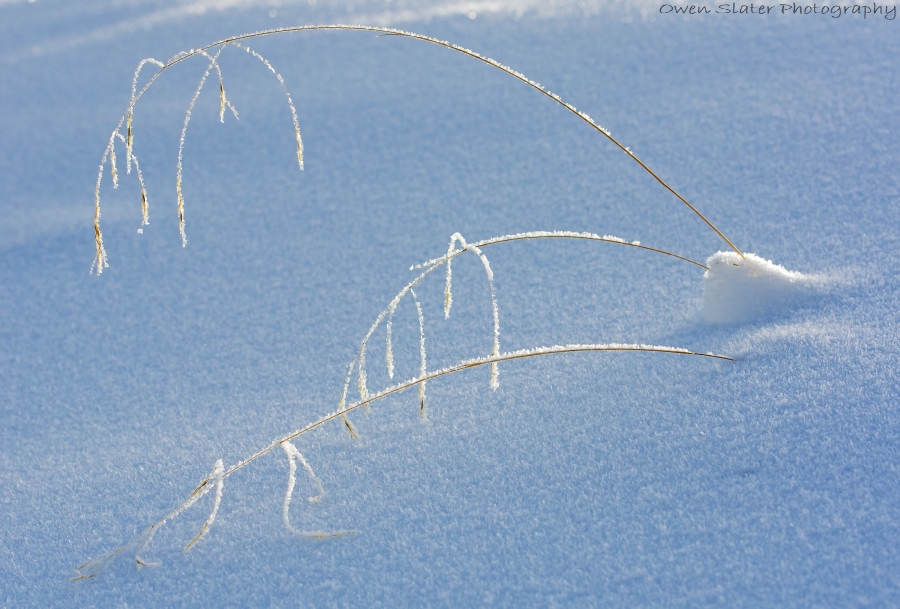
Hoar frost three grasses horizontal WMWith temperatures hovering around -25 degrees Celsius last week, getting out into the mountains was a bit more challenging, but the extra effort always pays off in one form or another.

Pine marten hunting grass WMI knew after I took this photo that it was going to be my favourite of him, but initially I wasn’t sure if I was going to get it. The marten was moving behind a small hill out of site and I thought he might just disappear into the bushes. But I got lucky and he came up from behind a snow bank, cocked his head back and forth and intently listened for rodents scurrying under the snow.  I quickly fired off a few frames and smiled to myself knowing that I had the photo I wanted.

Which of the two marten photos do you like best?

(Please click on the image for the full size)

Pine marten looking back WMWhile pine martens are relatively common in coniferous forests in western Canada, they aren’t often seen since they’re primarily arboreal and when they do come down to the ground, they rarely stay in one spot for long.  These weasels are out all year-long, but are generally not as active in winter. They hunt pretty much anything they can sink their teeth into including ground squirrels, snowshoe hare, fish and birds.

This little guy was out bounding through the deep snow looking for breakfast. He stopped a few times to watch and listen for any prey, which gave me just enough time to get a few photographs of him before he disappeared back into the forest.

Heavy Breathing

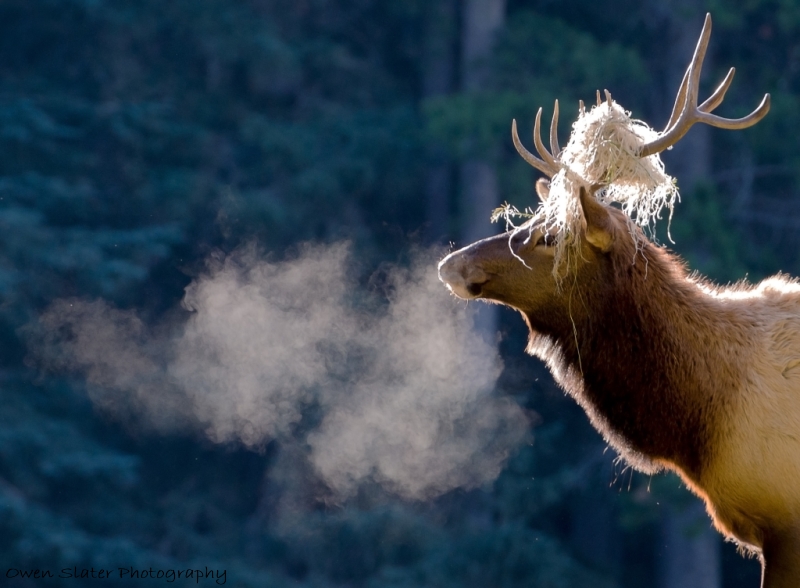
Elk exhale antler grass WMWith the  annual elk rut in Banff National Park taking place around the town site, many of the elk end up with ropes, plastic bags and other items tangled up in their antlers. Some require sedation to remove the items, while less severe entanglements like this one can be left alone.

The new antler-wear didn’t seem to bother this elk, but he had bigger concerns. Due to his young age and relatively small rack he was relegated to the sidelines and needed to stay out of the way of the larger, much more powerful and battle harden males.  After narrowly skirting around one, he took a few minutes to catch his breath before wisely deciding to move off into the forest.

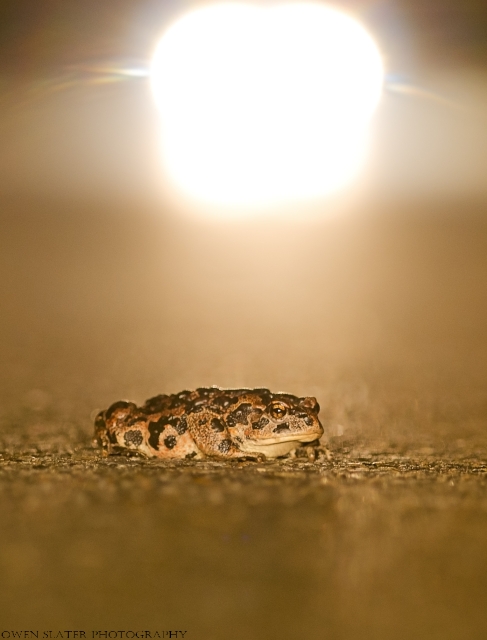
Western toad and headlights WMIt was the worst of times. With the wet spring and summer it was a very good year for amphibians in Western Canada but it wasn’t all great news for them. Each morning I would find many of them squashed on the roads, particularly in Banff National Park. They were too mutilated to be able to ID, but on one of the late nights returning from photographing the night sky I eventually came across one that was alive and well. It was a western toad; a species of “special concern” under the Species At Risk Act (SARA).

I pulled over to the side of the road and got out to take a few photographs. While laying on the road to get the perspective I wanted, a couple with a truck and camper came around the corner in the opposite direction. I used the opportunity to take a photograph that tells the fate of many of these toads on the roads this year. However, I didn’t anticipate the reaction from the people in the vehicle!

As they passed by they must have looked down and saw me laying on the road directly in front of my parked car. I assumed they saw me photographing something and wondering what it was I assumed they started backing up in my direction to find out what it was. I continued taking photos until they were right beside me, at which point I got up.  Almost immediately the driver yelled at me that I had just given him the scare of his life! He explained that he thought there had been an accident, that I had been hit or thrown from my vehicle and that he thought I was dead on the road! I apologized several times, but I think he was still in shock because he kept repeating the same refrain. I apologized once more before he slowly drove off towards the campground shaking his head. Not wanting to cause any more concern, I quickly coaxed the toad off the road, got back in my car and drove away.

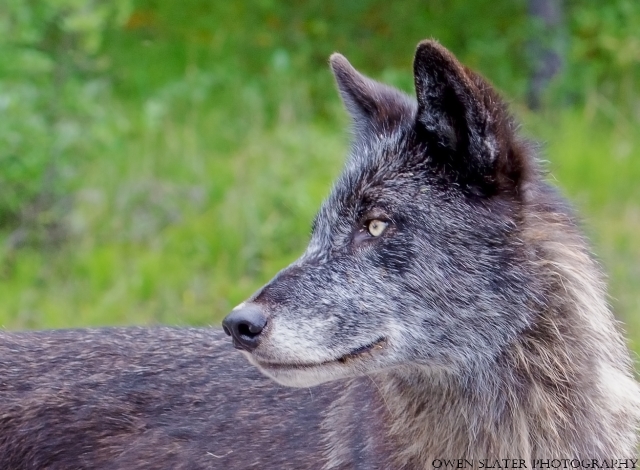
Seeing and photographing wild wolves is always a thrill,  even more so this year since finding any has been a lot more challenging. On the few occasions when I have been lucky the glimpses were always fleeting or with lots of trees and bushes obstructing my view.

On one day late in August I got my best glimpse this year. Some of the pack was resting deep in the forest near a kill site and the only way I knew they were there was from the periodic howling. After awhile I noticed some movement between the trees and it soon became clear they were on the move. I had a pretty good idea of the path they would take and where they would come out of the forest for a few seconds so I drove ahead a few minutes, parked my car and set up my camera. With the settings dialed in, I didn’t have long to wait. The two year old female emerged from the trees and came trotting along the clearing. She stopped not too far from where I was parked, turned and looked behind her as if waiting for something.

Wolf 2y old WM

It didn’t take long to see who it was. One grey and one black pup soon appeared and followed in her footsteps through the clearing.

Wolf pups 2013 WMWith the pups close behind I only had a few seconds to get some photos before the adult lead the pups back into the forest and out of sight.

Morant's curve 2WMThe famous Morant’s Curve on a beautiful, moonlit night in Banff National Park.

I have been trying to get this photo for some time but finally all the elements came together.  Under the light of the moon the colours in the Bow river and on trees were highlighted, while the brightest of the stars and the soft glow of light from Lake Louise became visible in the distance.

It wasn’t hard to just sit and wait for a train that night, but I didn’t have to wait long. As it lumbered along the tracks on its approach to the curve I could see the lights of a car approaching. Was I finally going to get the lights of both in the same frame? As it rounded the curve I started the exposure and for almost a minute I held my breath hoping that I had got the settings correct.  Soon I had my answer…a perfect ending to another great day in the Rockies.

Bug-eyed bighorn WMI have grown accustom to big horn sheep hanging out roadside licking up minerals and eating grass to the point that I have developed the bad habit of not paying them much attention. However, with company in town the sheep were low hanging fruit and they became an instant hit. We stopped for several minutes so they could watch and photograph them. Initially I didn’t lift my camera up but soon some of them were making pretty entertaining faces that I could not longer ignore! They put on a great show for us and left me with the parting shot below. I guess I need to pay them a bit more attention the next time!

BHS tongue out WM

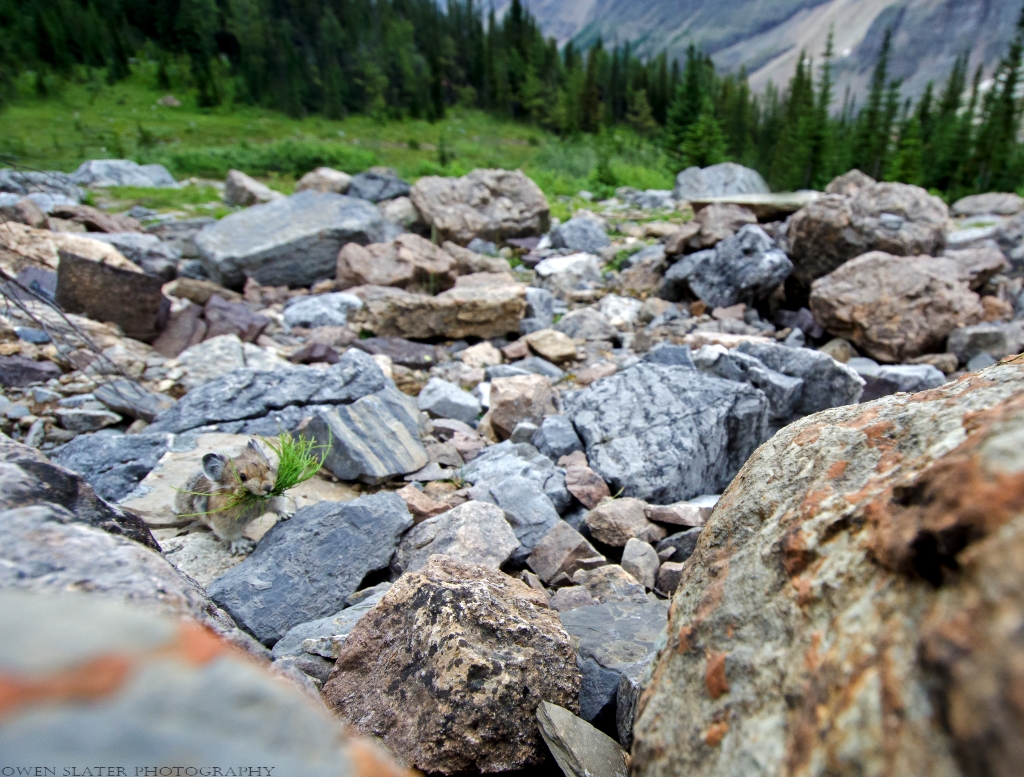
Pika mouthfull landscape WMOn a 3-4 hour round trip hike into a backcountry area of the Rockies my girlfriend was struggling to stay motivated and it was clear she wasn’t enjoying the steady uphill climb. While she can carry a heavy pack and hike like a machine in the prairies on scorching hot days while I whither under the sun, she detests any uphill hikes in the mountains. Finding a hike that would be enjoyable was out of the question, it was just a matter of finding one that had a big enough reward at the end to make it worth it!  I tried picking one that was not very steep and that had a tea house at the end where we could treat ourselves to drinks and treats in a beautiful wilderness setting. While that helped get her to the trail head, it didn’t guarantee that she would want to do anything like it again. Thankfully, her love of small mammals seems to trump almost anything else and as luck would have it there were lots where we were heading, including pika, a species she had never laid eyes on before!

After visiting the tea house and trying some of homemade treats and teas we went over to a huge rock avalanche area with a nearby meadow full of lush vegetation; about as ideal a spot for pika as you can find. We sat quietly on the rocks and within a few minutes we were rewarded with our first pika, then another and another! We watched as they sun bathed on the rocks, learned their favourite feeding spots and travel routes and saw them unsuccessfully trying to defend their stashes from the raiding chipmunks. It was a rodent biologists dream come true and needless to say the torture of the uphill hike quickly melted away and was replaced by her excitement at seeing and watching these little farmers go about their daily lives.

With the pika and chipmunks providing the entertainment, I focused on photography. I set up my wide angle lens on a rock next to an area that it routinely passed by on the way back to its hay stash. I pre-focused on the spot I guess it would pass through, moved back and waited with my remote in hand. It didn’t take long before it jumped along the rocks with a mouth full of green grass completely unconcerned by the addition a clicking camera.

That little pika really did save the day and plans are in the works for the next mountain wildlife hike!

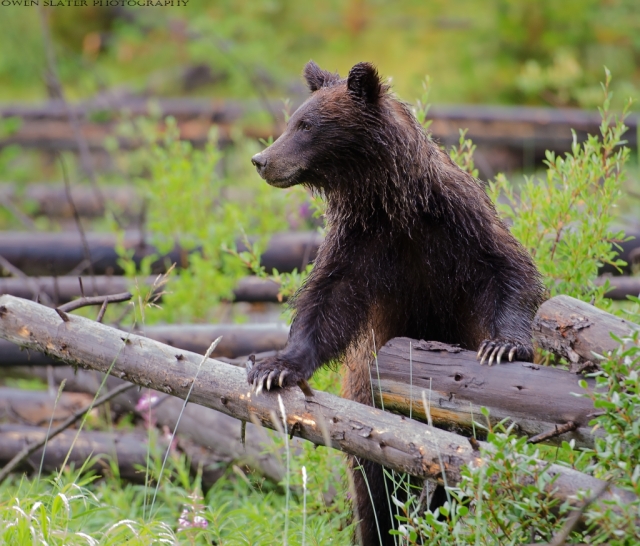
Grizz dark cub 64 3yold WMWhile her two brothers flight with each other over buffalo berries and appear oblivious to their surroundings, this dark phase grizzly bear stands up to search for her mom.

Many people in Banff National Park know these bears, as their mother is bear 64 who is one of the most commonly seen grizzly bears in Banff. She prefers to make her living in the wilderness areas surrounding the Banff townsite and has successfully navigated this busy landscape for over two decades.

Even now, with her cubs at 3.5 years of age, they are still very reliant on her to keep them safe and to show them all the seasonal food sources in the Rockies. Grizzly bears here have the longest interval between births of any grizzly bears in the world at upwards of 5-6 years. This is thought to be do to the harsh landscape and reduced food supplies compared to other regions where grizzly bears can be found.

This almost adult sized youngster has always stayed very close to her mother and is never far from her side. In a sign of her growing independence she has started to go off and forage on her own but she always tries to keep tabs on where her mom is. On this day, 64 was off doing her own thing and out of her cubs sight, so this youngest stood up on her hind legs and search the area for her. When that didn’t work she started calling out. Within seconds 64 appeared from the bush and came running over to see what she was being called about. Content that her Mom was back in close proximity, this ‘cub’ relaxed and went back to ravenously feeding on berries.  In the next few months their independence from 64 will grow and they will likely head off on their own or be sent packing by Mom soon.


Melting away Victoria Glacier WMA large chunk of ice cracked off of Victoria glacier causing a mini avalanche.  The noise of the ice cracking travelled down the mountain giving me just enough time to fire off some photos as the slab crumbled against the rocks.

Coat Change

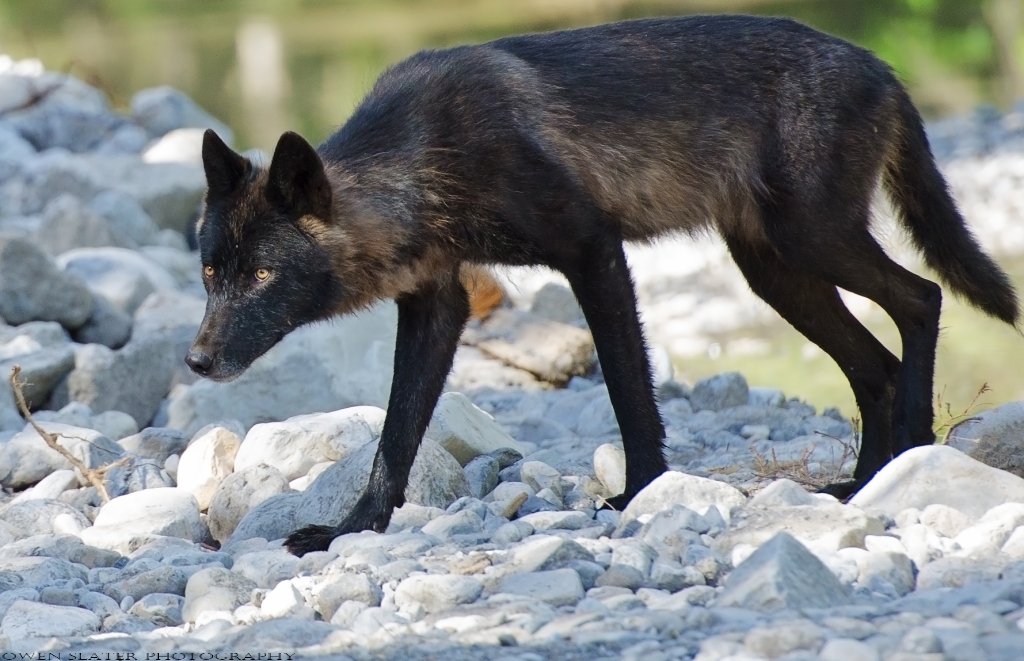
Wolf yearling creek crossing WMThe last remnants of a winter coat cling to the neck and sides of this wolf as he makes his way along the rocky banks of a river.

With only small amounts of snow remaining on the mountain peaks, wolves become even more like ghosts of the forest during the summer. Coming across them is always, to some extent based on luck and usually the glimpses are very fleeting.

With the sunlight trickling through the trees I only had a few seconds to steady my camera and get this photograph before it disappeared back into the dense understory of the bush. Such remarkable and elusive creatures!

Sunshine meadow 2 WM

GGO spruce top horizontal best WM

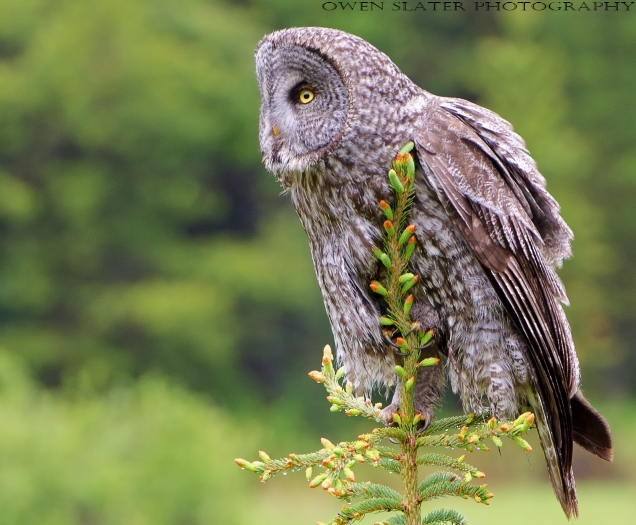
With its razor sharp talons firmly grasped around the flimsy top of a sapling, a great grey owl intensely scans and listens for any unsuspecting prey.