Category: Mammals


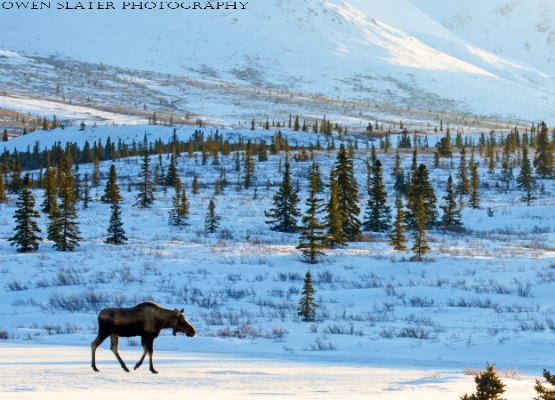
Moose Denali Landscape WM

On a recent trip up to Alaska for some work with caribou, I took a quick detour down to Denali National Park to get in a few days of photography before the real work started. It was mid April and the road into the park was still barely even open. Night time temperatures were around -20 Celsius and a balmy -5 during the day! Early on the first morning I came across this cow moose as she made her way across a still frozen pond. Golden eagles had returned. but other than that there were few signs of spring. However, the wonderful sound of silence, the few hardy animals I came across and the amazing surrounding scenery was still well worth the detour.

Wolf Junction Butte pack PS SS WM

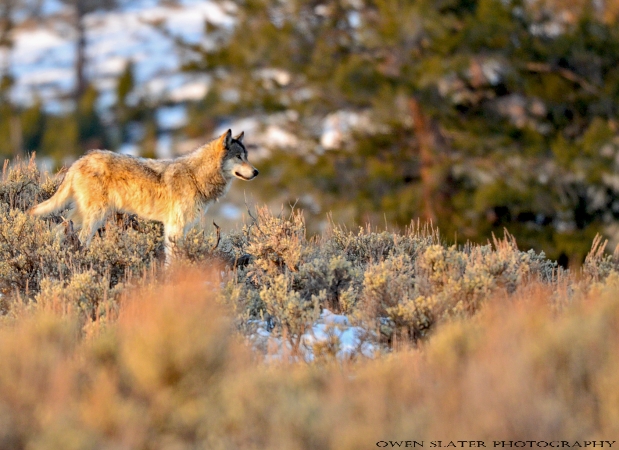
The trip to Yellowstone wouldn’t have been complete if I didn’t get a chance to photograph wolves. On the second morning we lucked out and came across the Junction Butte pack. We had seen them the day before but through a spotting scope since they were a few kilometers from the road. Overnight the pack must have traveled a fair distance, but as luck would have it they were right next to the road. This one was slowly making its way through the sage brush right past a herd of adult bison. The bison clearly knew how to behave around the wolves as they stood their ground and just stared at the wolves who quickly determined that they should keep going.  As the sun crested the hill, this wolf paused for a few seconds to see where the rest of the pack had gone giving me the perfect opportunity to get a few photos.

Bison soft light willows WM

The early morning light created beautiful soft colours on the bison’s coat and off of the small bushes in the background.


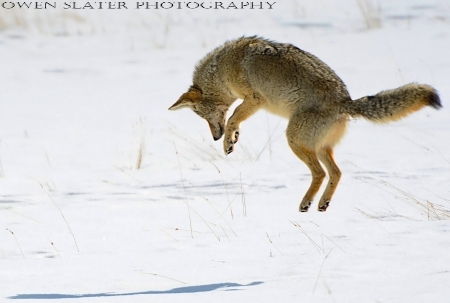
Coyote mousing WMA coyote launches into the air in what appears to be an attempt to catch its shadow. While it wasn’t successful at that, a few split seconds later it was feasting on a vole!

Pronghorn female stare WM

I have been casually trying for a while now to get a decent photo of a wild pronghorn with no luck. Apparently all it takes is a quick trip to Yellowstone, where there are pronghorn everywhere you look when first entering the north gate. Even better was that many of them were curious when I was laying on the ground and they started to walk towards me to investigate.

Rude Awakening

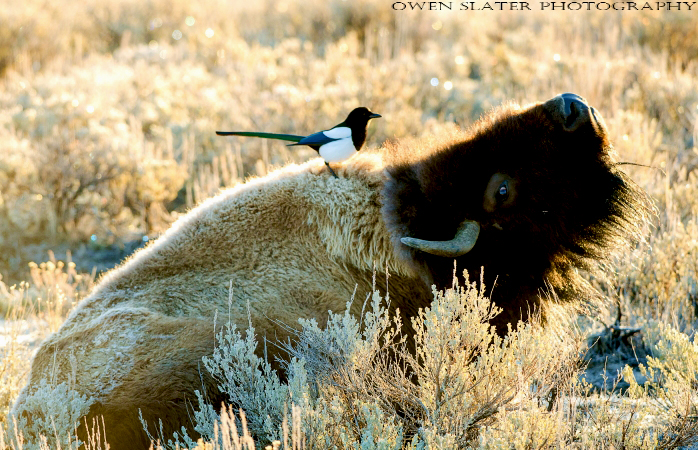
Bison and Magpie PS SS WMWhere has April gone? I will try to catch up on my posts over the next few weeks.

I took this one in Yellowstone about a month ago. The bison herd was bedded down and just waking up from a frosty night in the park. The magpies were going from one bison to the next, singing their typical magpie songs and picking off bugs as the sun rose over the hills. Most of the bison didn’t seem to mind the wake up call, but this one didn’t take too kindly to it. It tossed its head back several times to try to dislodge the bird, but the magpie just ignored him. Eventually the bison gave up his protest and went back to trying to get some more rest.

Grey pup BW PS SF WM

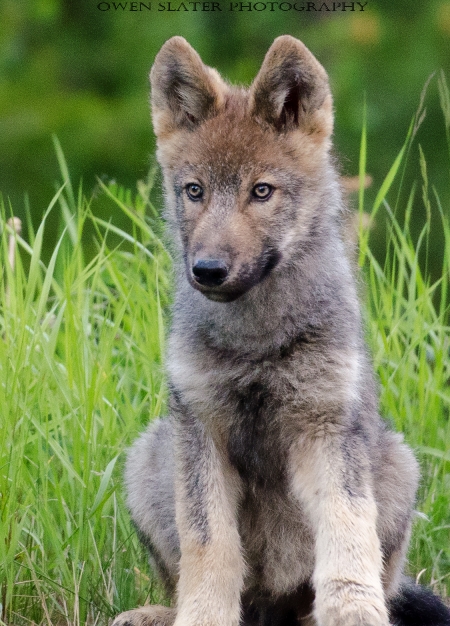
I guess I spoke too soon in my recent post about this wolf helping the pack with puppy chores in the spring. Just a few days ago, on the morning of Friday, April 5th this wolf’s life was cut short by a CP train in Banff National Park.  The young male was just shy of its one year birthday.

It really shouldn’t come as a surprise to anyone that it was killed by a train, after all this has been a routine event in Banff for years now. Trains remain the number one killer of Banff grizzly bears and in the past year numerous black bears and several wolves have also met their demise on the tracks. This is not even mentioning the elk, deer, moose and coyotes. Everything from the smallest birds to the largest mammals are commonly hit by the trains as they travel through the park.

The pack that this wolf belonged to has 2 of 6 pups remaining from last years litter.  Only 1 of 7 pups from the previous year has survived. Of the two surviving 1-year-old pups, one was hit by a train in late fall while she and the rest of her family were feeding on a rail killed deer carcass next to the tracks.   Somehow this wolf managed to survive the strike and miraculously has made it through the winter and appears to have almost completely healed from what I suspect was a fractured left hind limb. Of the seven pups born the previous year all but the surviving wolf were either hit by trains or cars.

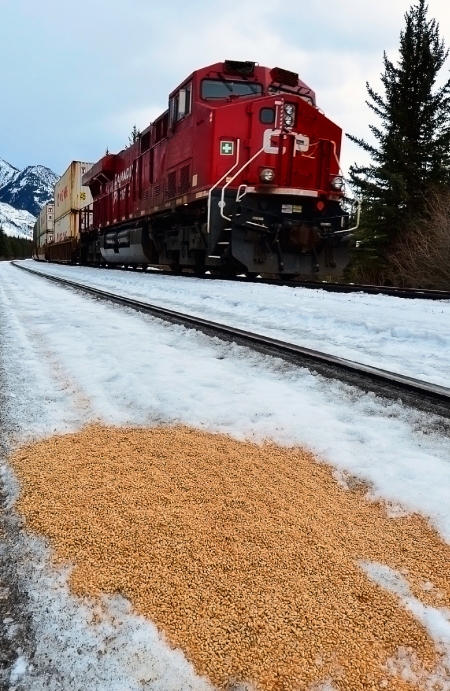
Efforts continue between Parks Canada and CP Rail to research the factors that influence these train mortalities.  While it’s great that they have committed time, money and staff to this problem, the fact remains that train caused wildlife deaths in the park have occurred on a frequent basis for years and despite some attempts to address the problem, it continues to happen on a very regular basis.The vacuum truck that is supposed to remove the grain spills doesn’t seem to come along the high risk areas of the tracks during the winter and it would seem that grain spills, which as you will see are pretty obvious, go unreported. Wildlife-train collisions are also not always reported and the strikes that are reported are not always appropriately removed from the tracks.  Add in that parks staff have been cut thin to the point that they can’t always adequately respond to all the human wildlife conflict events in a timely manner and several other variables that are a product of chronic underfunding and we have a recipe for more wildlife carnage.

CP train and spilled grain PS SSOne has to see the hypocrisy that signs in Banff state it’s illegal to feed wildlife and yet these trains are doing just that, like a giant cafeteria conveyor belt. Expecting others to act responsible while allowing this to occur is a perfect example of do as I say and not as I do.

While it is simplistic to say that all the train mortalities are caused either directly or indirectly from the grain, one has to accept the fact that even if grain or other food attractants aren’t present at the time of the event, animals will still travel the tracks looking for the free handouts whether they are there or not. After all, this has become a learned behaviour passed down from generation to generation. They have been condition from the time they are old enough to walk or fly that the tracks offer a steady supply of food so one cannot truthfully state that a particular train mortality wasn’t associated with grain or a carcass simply because these attractants weren’t present at the time of death. This is misconstruing the root of the problem. It will take years of continuous negative feedbacks for animals to stop coming to the tracks to look for handouts. The reduction in spillage to current levels is a start but breaking this pattern will require no less than complete prevention of these spills and quick removal of any carcasses from the area.  Only then will researchers be able to tease apart the other minor factors that might be at play.

In the grand scheme of things this is only one more human induced wildlife death in the long record of deaths that have happened in Banff and all along the tracks from Saskatchewan to Vancouver. However, it should serve as a prime example to every stakeholder that sooner than later added actions are required to address this problem and there is no better place to start than in Banff.  Parks and CP rail should not simply state ongoing research will be used to investigate possible solutions. Short term solutions are required now while the longer term options are investigated. However, the buck doesn’t just stop with them. Instead of visitors just complaining about all the most recent deaths and demanding something be done, they too should take actions of their own. If you are a visitor to the park and are walking near the tracks, report any carcasses, grain spills or any other concerns to Parks by calling Banff Dispatch at 403-762-1470 (24hrs/day). Even better if you can follow-up to make sure that the problem has been addressed and if it hasn’t, report it again. Every time a call is made a paper record is created that must be reviewed by Parks Canada management to make sure that the problem is taken care of. Other options include photographing what you see and forwarding it along or contacting Parks and CP staff directly with your concerns.

My hope is that this most recent death helps initiate more concerted efforts by everyone to actually solve this decades old problem. One can still hope can’t they?

Grey pup 3 months PS SS WMA 3 month old grey wolf pup takes in its surroundings after recently leaving the den.

Grey wolf pup 10 months PS LFSeven months later he has grown into an impressive animal with thousands of miles under his feet and has learned how to hunt deer and other small prey on its own. Over the coming months he will be relied upon to help provide food, puppy sitting duties and protection for a new litter of pups.

Metropolitan Moose

Moose on the loose watermark

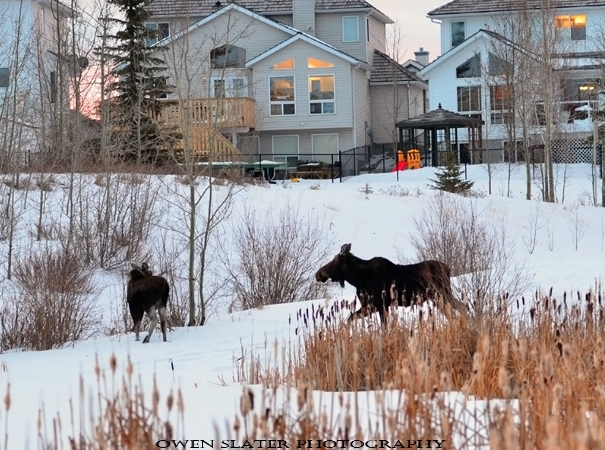
The New Year has not resulted in a slow down in my opportunistic backyard wildlife photography and in fact it seems to have picked up a bit!  This time it was the largest cervid in North America to make an appearance and while the photo isn’t great, it is was more to document the sighting than anything!

I was enjoying the beautiful morning sunrise in Calgary while cooking breakfast when I looked out the kitchen window and noticed this cow and calf moose making their way down the path to the backyard pond! I immediately sprang into action, racing around the house throwing on warm clothes and my boots while grabbing my camera and coat hoping they would still be there when I got out the back door. Sure enough, they had stopped where I last saw them to nibble on some shoots. I walked down the small hill to the pond and managed to snap off a few photos before the mother got spooked by something and trotted across the frozen pond with her calf in tow. By this point, several cars and pedestrians had stopped along the road to take in the rare event. As everyone looked on, the moose made their way up the bank and down the sidewalk ignoring the backlog of traffic before disappearing out of sight.

Every year a few moose end up in Calgary. They make their way into the city by travelling along rivers and park systems. Thankfully, these two appeared to know their way around the neighbourhood and successfully navigated all the city traffic, houses and pedestrians on their way to more suitable habitat on the outskirts of town. Those that wander too far into the city require ‘assistance’ from the local Fish and Wildlife officers, who sometimes need to sedate and move the moose if they get stuck in someone’s backyard or wander into the downtown core.

It will be hard to top this latest backyard wildlife sighting but it left me wondering what wildlife will be next to show up at my doorstep?

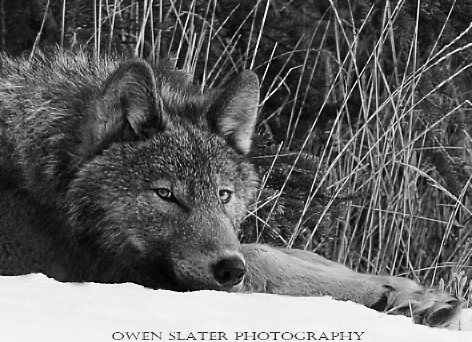
Wolves sleeping watermark

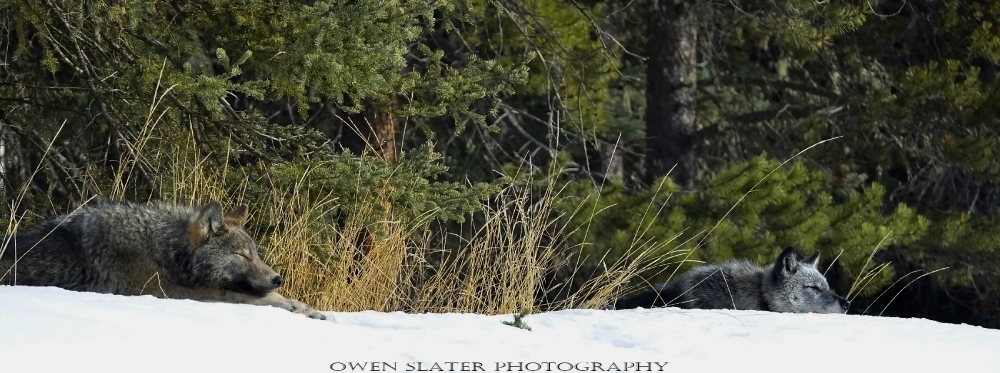
Fast forward to last week for this image (please click on the photo for the larger version).

For anyone that has had the privilege of seeing wild wolves in their natural environment, you can appreciate how fleeting the glimpses usually are. Often times they are visible for only a few seconds, usually in poor light with something obstructing the view. In these situations I often won’t even bother trying to take pictures. I will just watch them from a distance and enjoy the moment before they vanish into the forest.

Last week I was having a very unproductive morning with no good wildlife sightings to speak of so I decided to start heading back to town.  I rounded a corner and my luck drastically changed. There, basking in the mid-day sun were three wolves! It is very rare to see them during the day and for them to be lying out in the open is exceptionally rare!  I quickly pulled my car over to the side of the road, rolled down the window and turned the engine off in the hopes that I wouldn’t disturb them. Thankfully, within seconds they relaxed and went back to lounging in the sun!

To me nothing is more rewarding when watching wildlife then to have them be seemingly unaffected by my presence. I think this should be the gold standard for anyone that wants to watch or photograph wildlife.  Sometimes it doesn’t happen, but if an effort is made to make this the first priority then it will occur a lot more often than not. In this case by keeping my distance, staying in the car and making as little movement or noise as possible I was able to watch them undisturbed for several minutes. One walked down the hill right in front of me while these two stayed on the ridge above. The two on the hill would periodically lift their heads to check on the other wolf below. The most amazing moment that illustrated that they weren’t concerned with me in the least was when they laid their heads down and closed their eyes for a few moments.  To me this was the ultimate compliment.

You might be wondering how it all ended? I wish I could tell you that I left the wolves were I found them but unfortunately as is all too common these days a vehicle came around the corner, stopped behind me and the person got out of their car. In a split second the wolves on the hill leaped up, swirled around and vanished into the trees while the one of the road bolted up the hill and out of sight.  Frustrating to say the least but hopefully the wolves were able to find a more secluded sunny spot to rest in for the remainder of the afternoon.

Buzz off!

Predator or Prey wolf mosquito watermark

Let’s continue to ease back into the winter photography. Here is one from my bank of images taken in the summer.

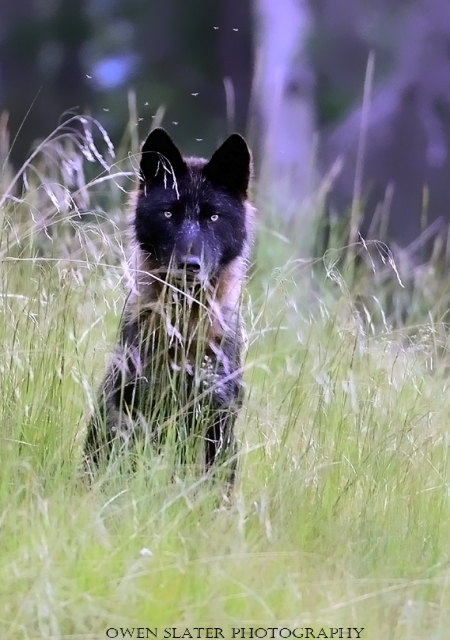
The predator and prey roles are reversed when a ‘pack’ of hungry mosquitoes descends down on a wolf. They are mostly kept at bay by the thick coat, but just like when a wolf goes in for a kill, the mosquitoes hone in on the most vulnerable spots where their prey is less likely to be able to defend itself.

The wolf didn’t seem to be too bothered. I on the other hand was cursing at them under my breath.  The welts that I soon developed and the itching that happened for days afterwards was a small price to pay.

It almost makes me appreciate the long mosquito free winters. Almost!

Bull elk snow fall meadow watermark

A group of  bull elk, having just gone through the rut, gather together in a meadow during a snow storm in Banff National Park. With the long, harsh winter just starting these bulls will have to use their hooves to dig down through the deep snow to find what little food remains for them. Any that become weakened will be tested by wolves and undoubtedly a few won’t make it to spring. Natural selection will favour the strong and the adaptable.

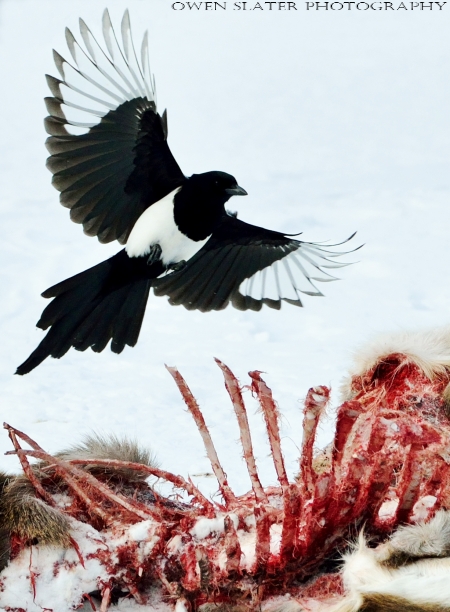
Magpie in flight deer carcass watermark

First let me say that this post was already in the works before today, which is why I got quite the laugh this morning when fellow blogger and wildlife photographer, Lyle Krahn awarded me the dubious distinction of the ‘Forgot to Leave’ award! Check out Lyle’s site for the full story as well as his great wildlife photos and stories!

Whenever I come across a carcass I have visions of wolves or cougars, or the even more elusive wolverine catching the scent and coming in to feed. The thought of witnessing these rarely observed animals in the wild doing things that I or few others have ever seen before keeps me out in the wilderness for hours on end. So with that optimism in mind, I hunkered down and waited. As you can probably imagine, sitting around in -15 degree Celsius temperatures is no fun. You can’t move around to keep warm since that will scare off any wildlife and the cold has a way of quickly removing any resolve that might have initially been there. But that day I was determined to give it a few hours so I waited some more. Within about an hour some magpies showed up and distracted me from the cold. In between feeding on the kill, they flew off to cash their food. Before flying back down to get more pieces of meat they perched in nearby trees and called out. This was great for me since it gave me enough time to turn the camera back on, compose the image and get my finger out of my glove to fire off the shutter. In their typical dramatic aerial flare, they swooped down to the carcass and fanned out their beautiful wings and tail feathers. I was treated to these displays for hours but eventually my resolve was broken. The tipping point was the hot packs I had placed in my boots and gloves could no longer keep my toes and fingers warm. Getting a few images like this made the surrender a little easier but as I hiked back to my car I wondered what I would have seen if I had waited a bit longer.

Tuned In

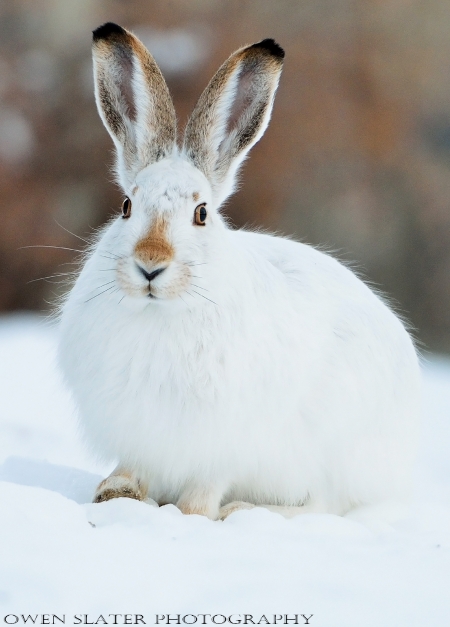
Prairie hare 2 watermark

Prairie hares, also known as white-tailed jackrabbits are frequent backyard visitors in Calgary neighbourhoods but since they are primarily nocturnal, getting decent photographs of them is not easy. Sometimes a bit of luck is all that is required! This photo is probably the easiest wildlife photograph I have ever taken. I didn’t even have to leave the house! I just grabbed my camera, opened the sliding door and snapped off a few photos before the last of the sunlight disappeared.

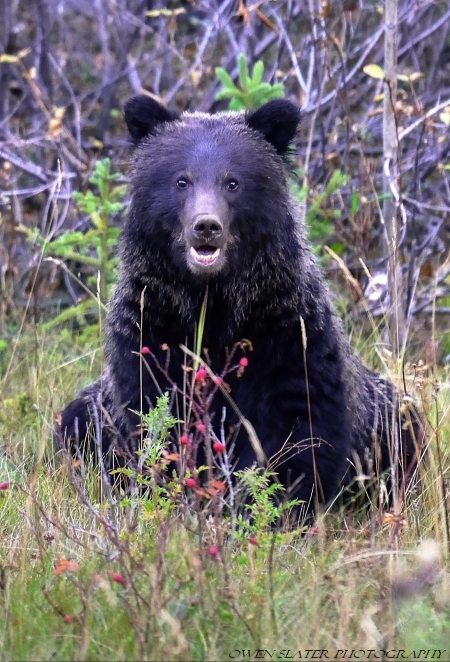
A grizzly cub appears to smile at the site of berries still available for eating in late October. This very spot is now covered in over a meter of snow and her and her family have long since found a den to comfortably sleep away the winter.