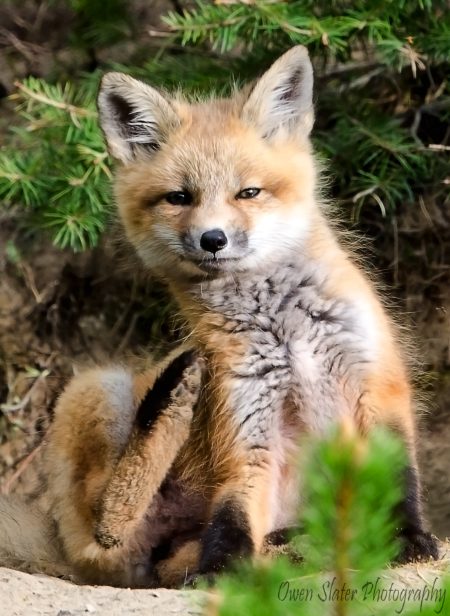
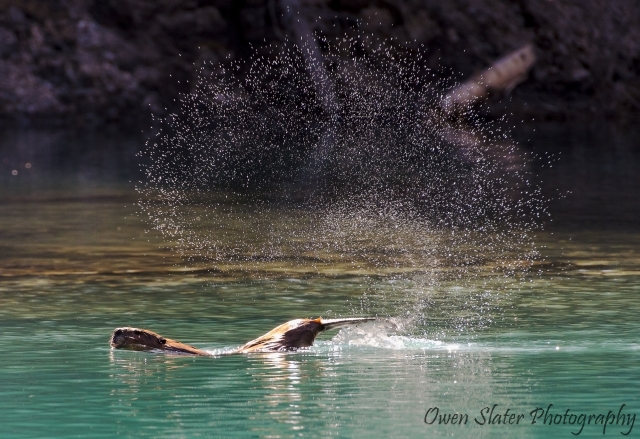
The morning after photographing Fire Fox the same fox, now several miles from where I first found it, was feasting on a snowshoe hare. After burying a few mouthfuls to lighten the load, it neatly folded the rest into a bundle and made the long journey back to the den to serve breakfast to its family.
Category: Canada
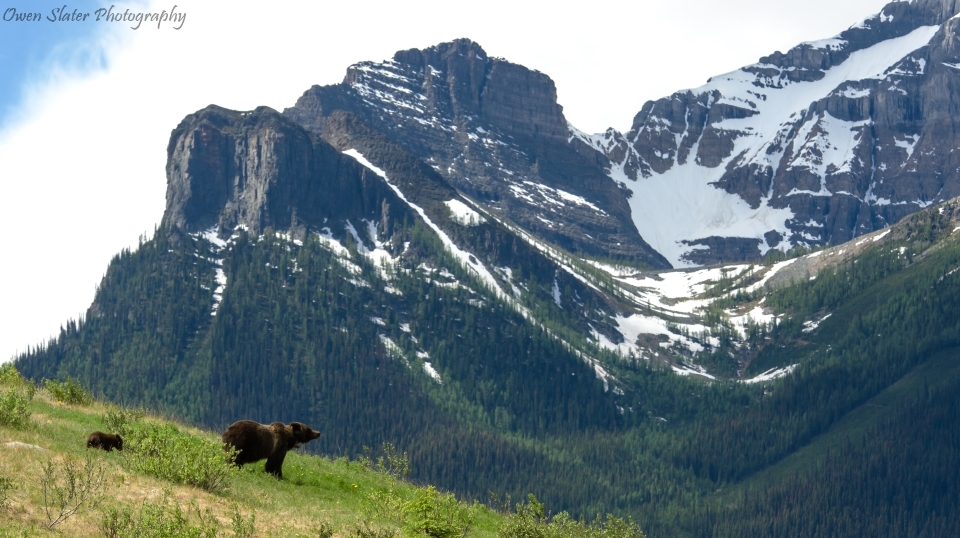
One could be forgiven for thinking that even the grizzly bears in Banff take a break from their daily routines to appreciate the mountain scenery. While I will never discount the fact that other animals can appreciate their surroundings, what’s more likely is that this bear is smelling the air for any potential threats or food options.
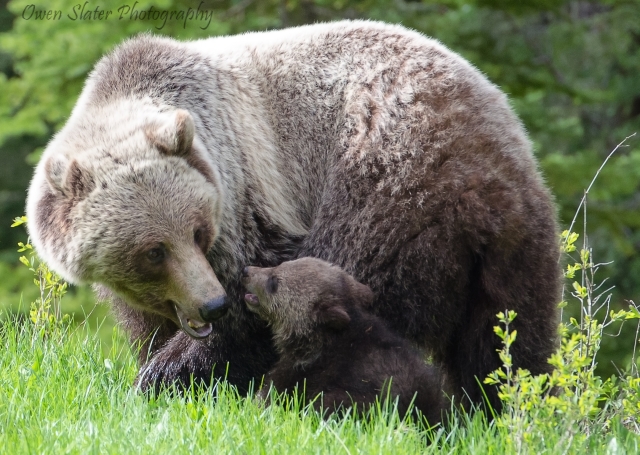
I took this photo last month near one of the most popular places in Canada; Lake Louise. Bear 138 as she is known to park biologists, was feasting on one of the only spring food sources available to the bears; dandelions. Imagine how many dandelions a 150-200kg lactating grizzly bear would need to eat to produce enough milk to feed her two cubs? Needless to say, it’s a staggering amount. When they enter their hyperphagic state later this month, they eat about 35,000 calories a day. To put that in perspective, the average person eats about 2000 calories daily! Almost all of these calories are from berries, with a single bear eating between 200-300,000 berries per day to put on enough fat to survive the winter. That’s the equivalent of you or I eating 63 hamburgers daily! Yet these bears suffer no heart disease or complications association with high cholesterol.
This only touches the tip of the iceberg of all the interesting adaptations of bears, but I hope you agree that these are amazing animals and deserving of our respect and protection.
I came across this gray wolf in Muncho Lake Provincial Park in Northern British Columbia.
If you spend any time photographing wild wolves, they make it clear from their body language if they are relaxed with you around. This 2-3 year old wolf (based on body size and teeth condition) could have cared less that I was just a short distance away. It kept its ears forward, jaw relaxed and pace at a slow trot, paying no attention to me while scanning the clearings for any caribou or stone sheep.
The entire sighting was over within a few minutes as it disappeared into the trees, but like with any wolf encounter, it left me with an adrenalin rush that kept me going for the rest of the day.
Tonight is the first super moon of the summer. The moon’s orbit is closet to the Earth, making it appear larger than other full moons. As a result, tides will be larger and people will on average get about 50 minutes less sleep.
I took this photo last night on my drive back from the mountains. There were enough smoke particles in the atmosphere from a nearby wildfire to give the sunset a purplish hue. Along the Trans-Canada Highway, many people pulled over to take pictures and appreciate the celestial event.
If you want to see the real full moon tonight, head outside just as the sun is setting, when the moon will be closest to the horizon and warmly lit by the sun’s rays. This is when it will appear the largest and when the light levels are balanced enough that you will get a great picture. If you happen to miss it, two other super moons in August and September will give you lots of chances to see it. Enjoy!
A horde of mosquitoes descends on a stoic stone sheep in Northern British Columbia. With every spring comes the masses of biting insects in the north. As someone who is a mosquito magnet, I couldn’t imagine having to put up with this after surviving a long, harsh winter. Just taking this photo made me feel itchy!
If I told you that for the past few years mountain caribou have been captured by nets, sedated and loaded into helicopters and then flown to either awaiting transport trailers or large enclosures on the sides of mountains you would likely think I’m pulling your leg. I wish I was, but for the past several years dedicated teams composed of First Nations personnel, wildlife biologists, fellow veterinarians, and countless others have being doing just that in order to try to conserve some of the most critically endangered caribou herds in British Columbia.
Past and current caribou conservation measures in the province include everything from limiting human access to caribou habitat, predator management and caribou translocations. Talks continue to occur to establish a captive breeding program so that there is a source population for dwindling herds, but while those plans are still in the preliminary stages other intensive caribou conservation initiatives are being implemented. The most recent includes what is termed ‘maternal penning’ of caribou.
Maternal penning involves taking wild, pregnant caribou and placing them in large enclosures in their native habitat for about 3 months. During this time they are protected from predators, given lots of lichen and other high quality caribou food and provided with a safe place to give birth to their calves. Disturbances from people are kept to an absolute minimum so caribou are not conditioned to human presence. The calves are born in May-June and kept in the enclosure for the next 1-2 months until they are strong enough to easily keep up with the herd and to be able to outrun predators like wolves and bears. At this point the mothers and calves are released back into their natural habitat and monitored to track calf survival. Previous application of this technique in the Yukon showed promising results and so the technique was adapted for use in the mountainous areas of British Columbia.
A few months ago maternal penning projects were undertaken for two declining herds in BC. One was in Revelstoke and another near Chetwynd. The later is a unique initiative spearheaded by the West Moberly First Nations in partnership with biologists and the provincial government. The West Moberly first nations have suspended their treaty right to hunt caribou for the past several decades and have recently used this treaty right to drive the process of caribou recovery in their native lands. They created their own caribou recovery plan that met the requirements of the Species at Risk Act, which in turn has led to the maternal penning project that was implemented earlier this spring.
It is too early to say whether all of these efforts will pay off, and some may argue that the resources put into mountain caribou conservation would be better spent elsewhere. In my opinion caribou are just a symptom of much bigger problems that will need to be addressed sooner rather than later. While governments decide on what to do to combat climate change as a result of habitat destruction and pollution, those of us on the front lines will continue to try to treat the symptoms until the bigger issues are finally addressed.
If you’re interested in learning more about mountain caribou click on the below links for additional details.
Mountain caribou herds facing extinction
Alberta government sells off caribou habitat to industry
US government downgrades mountain caribou federal status despite continued declines

Putting it mildly, mountain caribou as a whole are not doing well. Several of the southern and central mountain herds are down to less than 50 animals! In fact, these two populations were just listed as endangered by COSEWIC (Committee on the Status of Endangered Wildlife in Canada). The northern mountain population was listed as ‘special concern,’ which is one step away from threatened status.
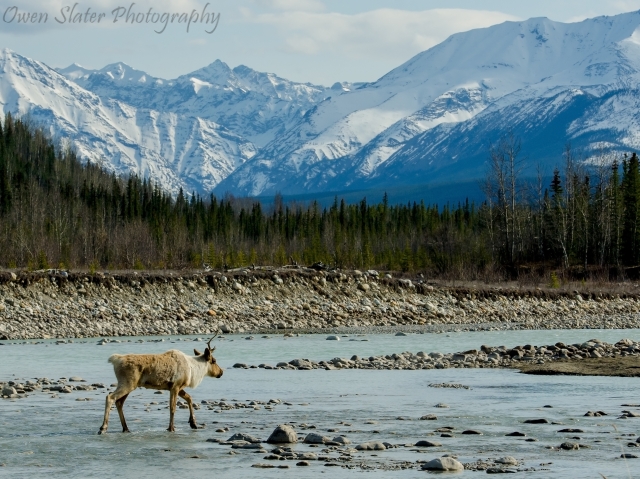
On my drive up to a conference to discuss current research on caribou I was lucky enough to come across some of these iconic animals along the way. This bull was hanging out near the border between BC and the Yukon, where many bulls were feeding on plants in the valley bottoms. Unfortunately, in the near future sightings like this may become exceedingly rare.
Next week I will post on some of the intensive conservation measures being undertaken to try to save this species.

After a busy few months I’m starting to get back on track with my photography. I took this photo earlier this month in northern British Columbia near the Yukon border. It was more spring like in the Yukon than in Calgary, so that was a nice, pleasant surprise!
Ironically, it seems every time I’m on this road there is a caribou connection. The first time I drove this section it was to complete a long distance transport of a herd of caribou from Fairbanks, Alaska to Fort St. John BC, so we only stopped for fueling up and short breaks. This time it was because I was presenting at the North American Caribou Workshop in Whitehorse, Yukon and I decided to drive rather than fly. It was a great trip with lots of wildlife sightings, including numerous caribou along the way.
Over the next month or so I will post a few photos from the trip. I hope you enjoy them!