Category: Banff National Park


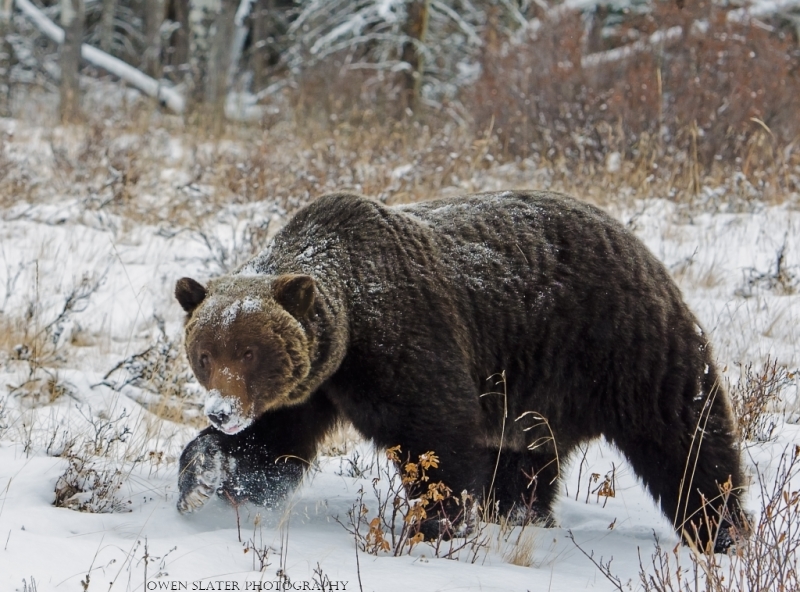
Grizzly snow WMAn adult male grizzly bear plows through 10 centimeters of snow in minus 10-15 degree Celsius temperatures. While the females and young cubs are already tucked away in their dens, these big males are still out looking for food to pack on the pounds so they can compete against the biggest males for breeding opportunities in the spring.

For the past several years I have tried in vain to get a good photo of a grizzly bear in snow. I have run into them as late as December, always either really early in the morning or late at night. All of that changed when this bear lumbered out of the forest in the middle of the day. He wander back and forth following the tracks of a pack of wolves that had been in the area earlier in the morning. Most likely he was trying to determine if the wolves had made a kill. Being the biggest predators in the Rockies, they will follow wolves and steal away their kills through brute force but on this day the bear came up empty handed. With his nose covered in snow, he plodded along weaving a route back and forth through the forest before giving up and moving on.

Angry Birds

Osprey aerial fighting WM

Well not really, more like hungry birds! These two osprey are siblings that successfully fledged this year. They took to the skies to practice their maneuvers and to compete with one another for the best waiting spot. It takes a few more weeks after fledgling before they are proficient at hunting on their own so the parents would return with fresh fish to give to them. It was always first come, first serve and once one had a fish there was no way they were going to share it!

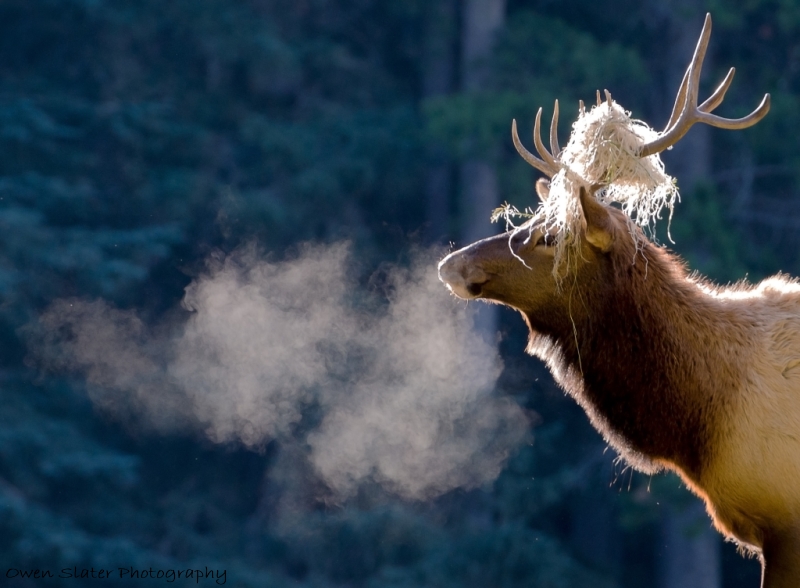
Heavy Breathing

Elk exhale antler grass WMWith the  annual elk rut in Banff National Park taking place around the town site, many of the elk end up with ropes, plastic bags and other items tangled up in their antlers. Some require sedation to remove the items, while less severe entanglements like this one can be left alone.

The new antler-wear didn’t seem to bother this elk, but he had bigger concerns. Due to his young age and relatively small rack he was relegated to the sidelines and needed to stay out of the way of the larger, much more powerful and battle harden males.  After narrowly skirting around one, he took a few minutes to catch his breath before wisely deciding to move off into the forest.

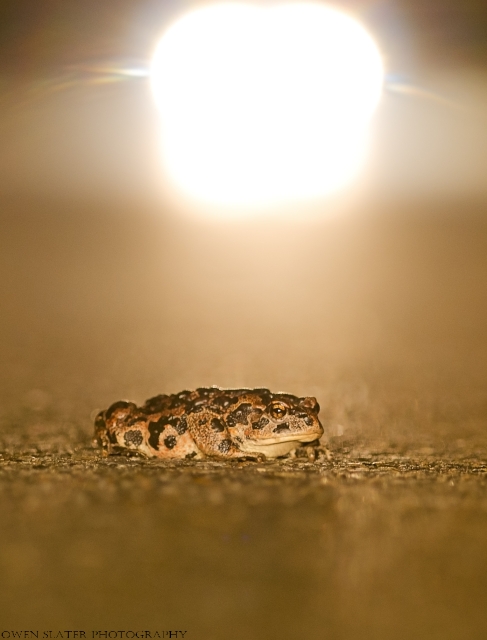
Western toad and headlights WMIt was the worst of times. With the wet spring and summer it was a very good year for amphibians in Western Canada but it wasn’t all great news for them. Each morning I would find many of them squashed on the roads, particularly in Banff National Park. They were too mutilated to be able to ID, but on one of the late nights returning from photographing the night sky I eventually came across one that was alive and well. It was a western toad; a species of “special concern” under the Species At Risk Act (SARA).

I pulled over to the side of the road and got out to take a few photographs. While laying on the road to get the perspective I wanted, a couple with a truck and camper came around the corner in the opposite direction. I used the opportunity to take a photograph that tells the fate of many of these toads on the roads this year. However, I didn’t anticipate the reaction from the people in the vehicle!

As they passed by they must have looked down and saw me laying on the road directly in front of my parked car. I assumed they saw me photographing something and wondering what it was I assumed they started backing up in my direction to find out what it was. I continued taking photos until they were right beside me, at which point I got up.  Almost immediately the driver yelled at me that I had just given him the scare of his life! He explained that he thought there had been an accident, that I had been hit or thrown from my vehicle and that he thought I was dead on the road! I apologized several times, but I think he was still in shock because he kept repeating the same refrain. I apologized once more before he slowly drove off towards the campground shaking his head. Not wanting to cause any more concern, I quickly coaxed the toad off the road, got back in my car and drove away.

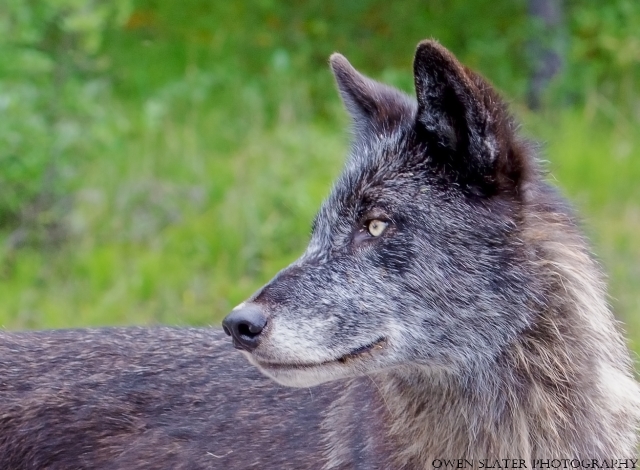
Seeing and photographing wild wolves is always a thrill,  even more so this year since finding any has been a lot more challenging. On the few occasions when I have been lucky the glimpses were always fleeting or with lots of trees and bushes obstructing my view.

On one day late in August I got my best glimpse this year. Some of the pack was resting deep in the forest near a kill site and the only way I knew they were there was from the periodic howling. After awhile I noticed some movement between the trees and it soon became clear they were on the move. I had a pretty good idea of the path they would take and where they would come out of the forest for a few seconds so I drove ahead a few minutes, parked my car and set up my camera. With the settings dialed in, I didn’t have long to wait. The two year old female emerged from the trees and came trotting along the clearing. She stopped not too far from where I was parked, turned and looked behind her as if waiting for something.

Wolf 2y old WM

It didn’t take long to see who it was. One grey and one black pup soon appeared and followed in her footsteps through the clearing.

Wolf pups 2013 WMWith the pups close behind I only had a few seconds to get some photos before the adult lead the pups back into the forest and out of sight.

Morant's curve 2WMThe famous Morant’s Curve on a beautiful, moonlit night in Banff National Park.

I have been trying to get this photo for some time but finally all the elements came together.  Under the light of the moon the colours in the Bow river and on trees were highlighted, while the brightest of the stars and the soft glow of light from Lake Louise became visible in the distance.

It wasn’t hard to just sit and wait for a train that night, but I didn’t have to wait long. As it lumbered along the tracks on its approach to the curve I could see the lights of a car approaching. Was I finally going to get the lights of both in the same frame? As it rounded the curve I started the exposure and for almost a minute I held my breath hoping that I had got the settings correct.  Soon I had my answer…a perfect ending to another great day in the Rockies.

Bug-eyed bighorn WMI have grown accustom to big horn sheep hanging out roadside licking up minerals and eating grass to the point that I have developed the bad habit of not paying them much attention. However, with company in town the sheep were low hanging fruit and they became an instant hit. We stopped for several minutes so they could watch and photograph them. Initially I didn’t lift my camera up but soon some of them were making pretty entertaining faces that I could not longer ignore! They put on a great show for us and left me with the parting shot below. I guess I need to pay them a bit more attention the next time!

BHS tongue out WM

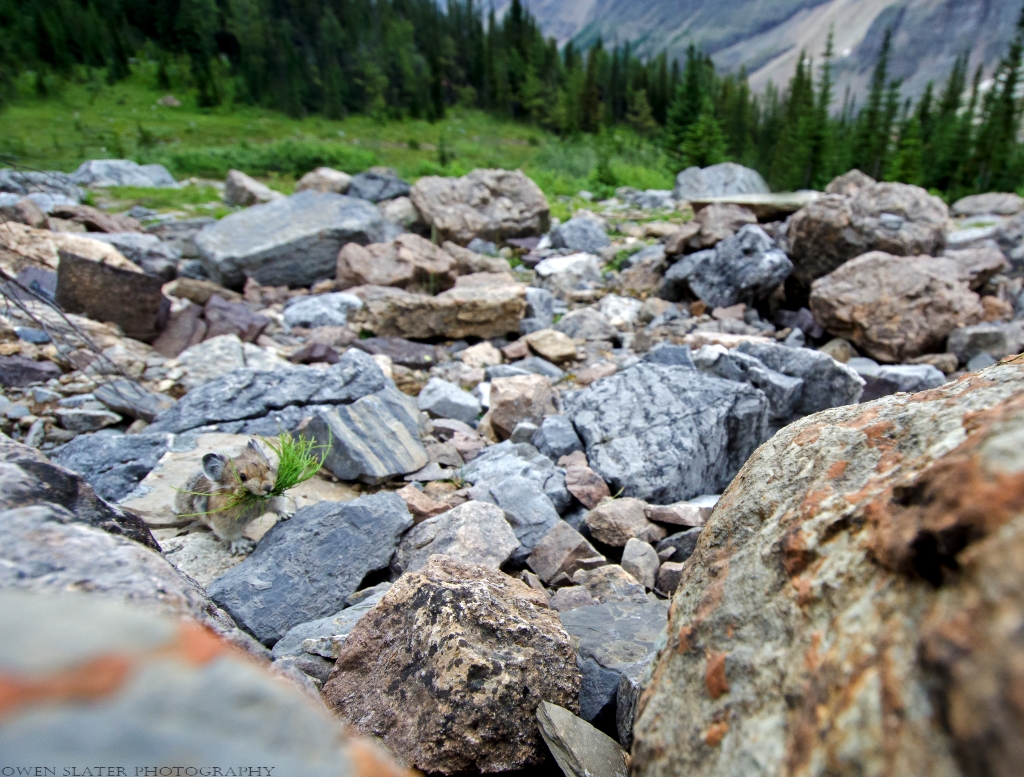
Pika mouthfull landscape WMOn a 3-4 hour round trip hike into a backcountry area of the Rockies my girlfriend was struggling to stay motivated and it was clear she wasn’t enjoying the steady uphill climb. While she can carry a heavy pack and hike like a machine in the prairies on scorching hot days while I whither under the sun, she detests any uphill hikes in the mountains. Finding a hike that would be enjoyable was out of the question, it was just a matter of finding one that had a big enough reward at the end to make it worth it!  I tried picking one that was not very steep and that had a tea house at the end where we could treat ourselves to drinks and treats in a beautiful wilderness setting. While that helped get her to the trail head, it didn’t guarantee that she would want to do anything like it again. Thankfully, her love of small mammals seems to trump almost anything else and as luck would have it there were lots where we were heading, including pika, a species she had never laid eyes on before!

After visiting the tea house and trying some of homemade treats and teas we went over to a huge rock avalanche area with a nearby meadow full of lush vegetation; about as ideal a spot for pika as you can find. We sat quietly on the rocks and within a few minutes we were rewarded with our first pika, then another and another! We watched as they sun bathed on the rocks, learned their favourite feeding spots and travel routes and saw them unsuccessfully trying to defend their stashes from the raiding chipmunks. It was a rodent biologists dream come true and needless to say the torture of the uphill hike quickly melted away and was replaced by her excitement at seeing and watching these little farmers go about their daily lives.

With the pika and chipmunks providing the entertainment, I focused on photography. I set up my wide angle lens on a rock next to an area that it routinely passed by on the way back to its hay stash. I pre-focused on the spot I guess it would pass through, moved back and waited with my remote in hand. It didn’t take long before it jumped along the rocks with a mouth full of green grass completely unconcerned by the addition a clicking camera.

That little pika really did save the day and plans are in the works for the next mountain wildlife hike!

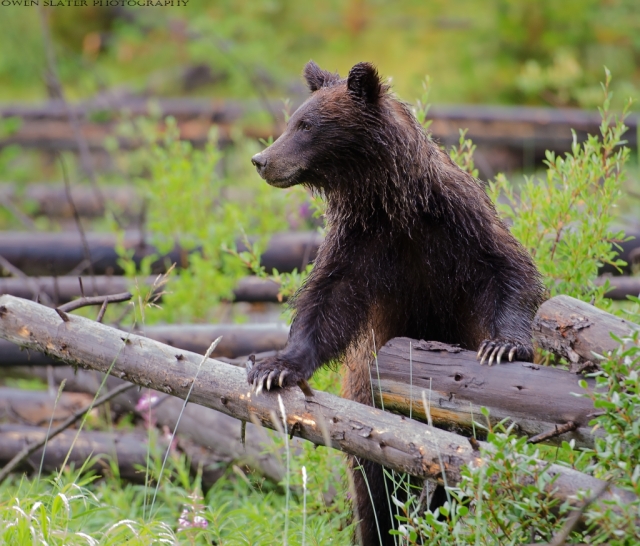
Grizz dark cub 64 3yold WMWhile her two brothers flight with each other over buffalo berries and appear oblivious to their surroundings, this dark phase grizzly bear stands up to search for her mom.

Many people in Banff National Park know these bears, as their mother is bear 64 who is one of the most commonly seen grizzly bears in Banff. She prefers to make her living in the wilderness areas surrounding the Banff townsite and has successfully navigated this busy landscape for over two decades.

Even now, with her cubs at 3.5 years of age, they are still very reliant on her to keep them safe and to show them all the seasonal food sources in the Rockies. Grizzly bears here have the longest interval between births of any grizzly bears in the world at upwards of 5-6 years. This is thought to be do to the harsh landscape and reduced food supplies compared to other regions where grizzly bears can be found.

This almost adult sized youngster has always stayed very close to her mother and is never far from her side. In a sign of her growing independence she has started to go off and forage on her own but she always tries to keep tabs on where her mom is. On this day, 64 was off doing her own thing and out of her cubs sight, so this youngest stood up on her hind legs and search the area for her. When that didn’t work she started calling out. Within seconds 64 appeared from the bush and came running over to see what she was being called about. Content that her Mom was back in close proximity, this ‘cub’ relaxed and went back to ravenously feeding on berries.  In the next few months their independence from 64 will grow and they will likely head off on their own or be sent packing by Mom soon.


Melting away Victoria Glacier WMA large chunk of ice cracked off of Victoria glacier causing a mini avalanche.  The noise of the ice cracking travelled down the mountain giving me just enough time to fire off some photos as the slab crumbled against the rocks.

Coat Change

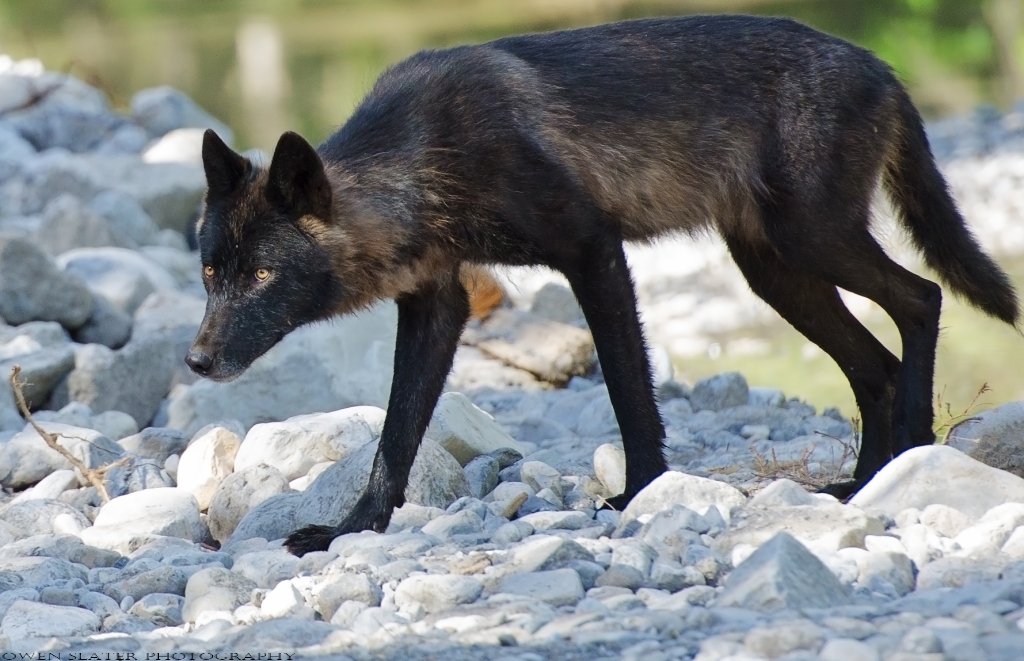
Wolf yearling creek crossing WMThe last remnants of a winter coat cling to the neck and sides of this wolf as he makes his way along the rocky banks of a river.

With only small amounts of snow remaining on the mountain peaks, wolves become even more like ghosts of the forest during the summer. Coming across them is always, to some extent based on luck and usually the glimpses are very fleeting.

With the sunlight trickling through the trees I only had a few seconds to steady my camera and get this photograph before it disappeared back into the dense understory of the bush. Such remarkable and elusive creatures!

Sunshine meadow 2 WM

GGO spruce top horizontal best WM

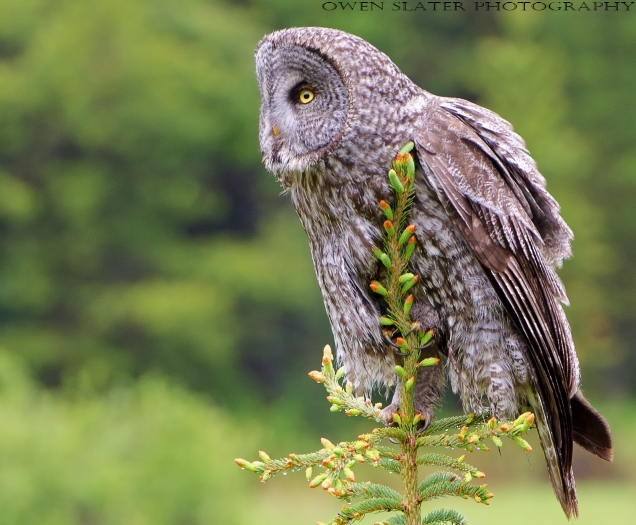
With its razor sharp talons firmly grasped around the flimsy top of a sapling, a great grey owl intensely scans and listens for any unsuspecting prey.

Rufous hummingbird flight spider fledglings final WM

A round trip migration of over 12000 km, a heart rate of 1200 beats/minute, a wing beat rate of 3000-3700 beats/minute, having to go into torpor every evening to survive the long cold nights. Hummingbirds are about as close to mythical that exists in the bird world. I have held them in my hands, felt the vibrations of their little hearts beating and marveled at how something so small  and fragile can survive, but it’s still hard to believe they can eek out a living  in the harsh environment of the Canadian Rockies. Until this year I had never seen an active nest in the wild. So to say I was ecstatic when, with a bit of help, I came across this one would be a bit of an understatement!

Hummingbird nests, which in themselves are works of art, are constructed with the soft silk of spider webs! Imagine how many spider webs are needed to make a nest like this?  It was placed on a thin drooping branch that wouldn’t support the weight of any potential predators (crows, squirrels, martens, etc.). It was woven around the branches and then lichen and moss were attached to the outside to provide camouflage.  As is typical, 2 eggs the size of small jellybeans were laid and incubated for just over 2 weeks. The chicks grow at an exponential rate and within 19 days they fledge, fly off with mom and never return to the nest again.

When I came across this one, the chicks were already about 1.5 weeks old and had tiny pin feathers. Contrary to what many believe, hummingbirds don’t rely on nectar to feed their young. The rapidly growing chicks need a high protein diet so they are almost exclusively fed insects. This is why in early summer if you have a hummingbird feeder you won’t see females at it. They return to the feeders later in the summer with their fully grown offspring to teach the young about the best feeding spots. This lasts all but a few days at which point the offspring are self-sufficient.

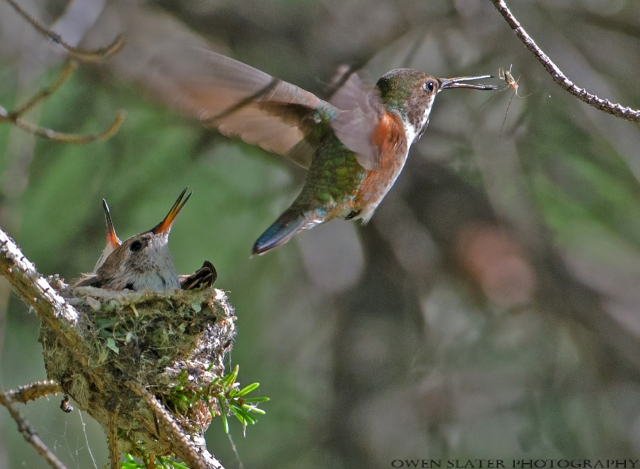
Watching a hummingbird can be dizzying, not to mention painful from all of the mosquito bites, and while I wish I could say I planned to get this photo, simply put, I didn’t nor could I have imagined it possible given the conditions! The light was low, the nest was well hidden, multiple small branches were getting in the way and as you know these birds do everything at warp speed. I knew the only way I was ever going to have a chance at being successful was if the sun’s rays found a break in the trees to penetrate into the forest and if I set my camera up on a tripod and manually focused on the nest. With the settings locked in I stepped back from the camera with my remote in hand to take in the action from a distance so I didn’t disturb them. After a few minutes the sun was low enough to get through the dense canopy and light up the area around the nest. Now all I needed was for the mom to come back and feed her babies.

Luck was on my side. She flew in and started plunging food down the throats of her chicks. After feeding them she would usually zoom off into the surrounding meadows to catch more food, but this time she did something different. She flew up from the nest but remained hovering right next to it in the beautiful soft light of the sun!  I was too far away to see what she was looking at so instead I clicked the remote as fast as possible hoping I would get one good photo of her in flight. The whole sequence lasted less than two seconds but I managed to snap off a few frames that were in focus. It wasn’t until afterwards when I zoomed in on the images that I saw what she was so intent on. Under the watchful eyes of her chicks she had spotted and caught a spider!  If you look at this photo closely you can see one of the legs of the unsuspecting spider in her beak just before she clamped down on it! The spider tried to get away by hiding behind the branch but it was no match for the hummingbird and was quickly snapped up and eaten!

While I have other images of the mom and her chicks, none tells the story of the life of this hummingbird family as well as this one! The background and shadows are a bit distracting but this photo is still to date my favourite photo of the year. I hope you like it as much as I do!

Rufous hummingbird perched WM

Imagine having to eating 2-3 times your body weight in food every day just to survive!  That if you have a bad day of not finding enough food you are going to starve to death! Hummingbirds push the limits and live their lives on the edge. No wonder people rarely see them doing anything but eating.

Their incredibly high metabolic rate means that the only way they can survive the long nights without eating is to go into a form of hibernation, called torpor. Every night they lower their body temperature to prevent wasting energy trying to keep their internal temperature at around 38 degrees Celsius. Their heart rate slows to as low as 50 beats per minute (from over 800-1200) and respiratory rates are not detectable. Simply put they appear to be dead. A few hours before dawn they have an internal alarm clock that goes off that awakens them from this suspended animation. At this point they fluff themselves up, start to shiver and beat their wings. This generates enough heat to increase their body temperature a few degrees a minute. Total time to awaken from torpor takes about 20-60 minutes.  If they have budgeted their energy reserves well, once awake they have just enough energy to fly off and find their first meal of the day. Now try to imagine how much they need to eat to raise 2-3 chicks!

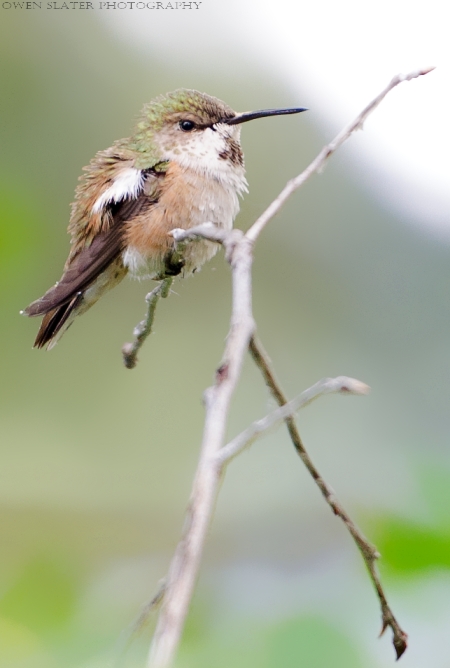
This photo is of a female rufous hummingbird after coming back from a successful feeding trip to feed her two rapidly growing chicks (photos to come down the road). She took a quick break to rest during a chilly morning in the Rockies.