Tag Archive: Wildlife


Snow Geese Migration

Snow geese massive flock WM

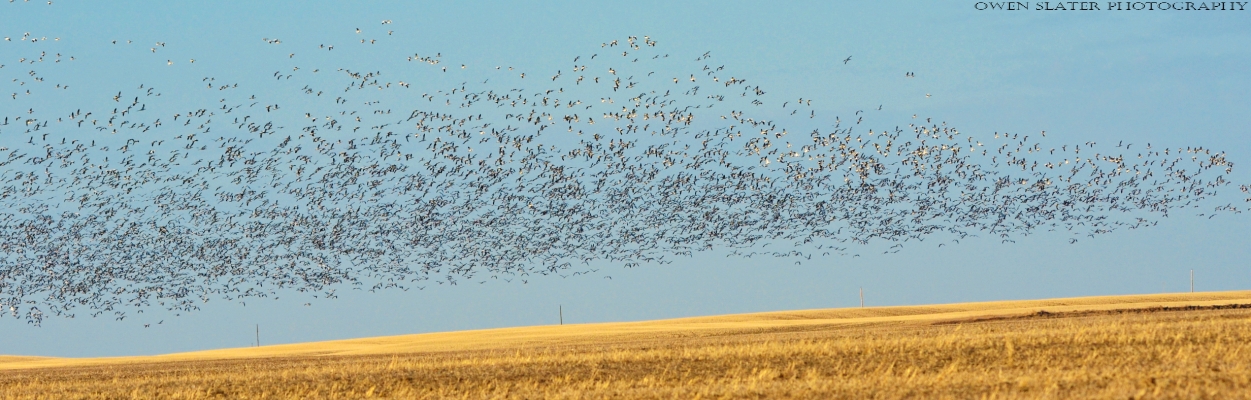
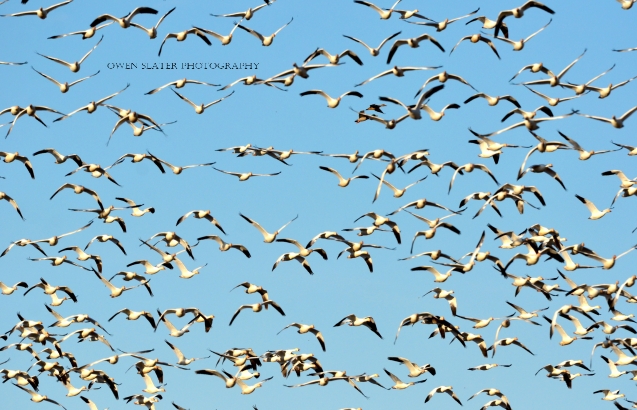
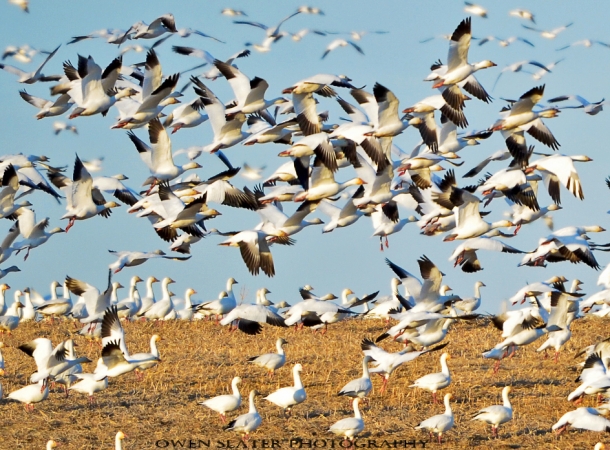
One of the most remarkable wildlife sights I have ever seen happened by chance on the drive back from Yellowstone last month. Initially it started off with a relatively small flock of about 50 snow geese passing overhead.  Soon I noticed another flock and then another, but it wasn’t until I glanced west to take in the Rockies on a clear, beautiful day that I saw almost the entire western horizon dotted with these geese! I had heard about the snow geese migration, but I had never witnessed it before. To see hundreds of thousands of birds in the sky at once was so amazing I had a hard time keeping my eyes on the road. As luck would have it, a large majority of them were headed in our direction. No more than a few kilometers up the road, thousands of these birds starting landing in a farmer’s field. This must have been a cue for the rest of the massive flock to land for the night, because within minutes there were thousands upon thousands of snow geese fluttering to the ground while making their distinctive calls along the way. I found a side road to turn off onto and started firing off photos.  In the below photo a small fraction of the goose flock flew overhead. See if you can spot another species of bird in with the geese.
Snow geese and mallards WM

A few minutes later, about a 1 kilometer stretch of the field was covered with these geese. They continued to honk as they gobbled up grain, which prompted the geese still in the sky to circle around and start landing as well. Within 10 minutes there were hundreds of thousands of birds on the ground!

There are a few examples of animals that have adapted to living with the billions of us! Snow geese are one of these. Their population has grown to over 5 million breeding birds, a 300 fold increase since the 1970’s! Much of this has been attributed to the rapid agricultural expansion that has occurred in the west, creating a smorgasbord of food for these birds as they make their way to and from the Arctic every Spring and Fall.  Other possible factors include rising Arctic temperatures. However, that only partly explains their population expansion. A lot of it also has to do with their behavioural adaptation to a changing environment.  Historically they fed in marshes but a few of the smart ones or maybe by chance some stumbled across the fact that people leave tonnes of uneaten food in the fields every year.  With the flat rolling prairies it’s also easier to see predators approaching from a distance or from the sky. This new-found migration strategy must have been passed along to the point that almost all the geese stop over in these fields to fuel up before continuing their journey.

Below is a photo of the organized goose chaos.  Multiply this photo hundreds of times and you will get an idea of what it was like to be next to this massive flock. It’s remarkable that they manage to coordinate their movements enough that they are able to land, take off and feed without colliding into each other and plummet  to the ground. It certainly is an experience I will never forget.
Snow geese standing and flight WM


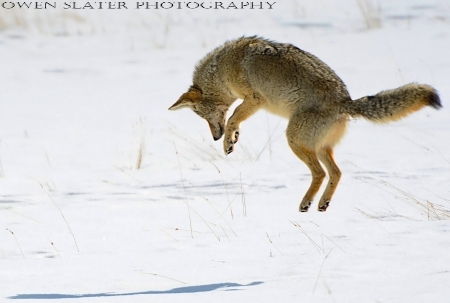
Coyote mousing WMA coyote launches into the air in what appears to be an attempt to catch its shadow. While it wasn’t successful at that, a few split seconds later it was feasting on a vole!

Pronghorn female stare WM

I have been casually trying for a while now to get a decent photo of a wild pronghorn with no luck. Apparently all it takes is a quick trip to Yellowstone, where there are pronghorn everywhere you look when first entering the north gate. Even better was that many of them were curious when I was laying on the ground and they started to walk towards me to investigate.

Feather Duster

Northern Hawk Owl Tree watermark

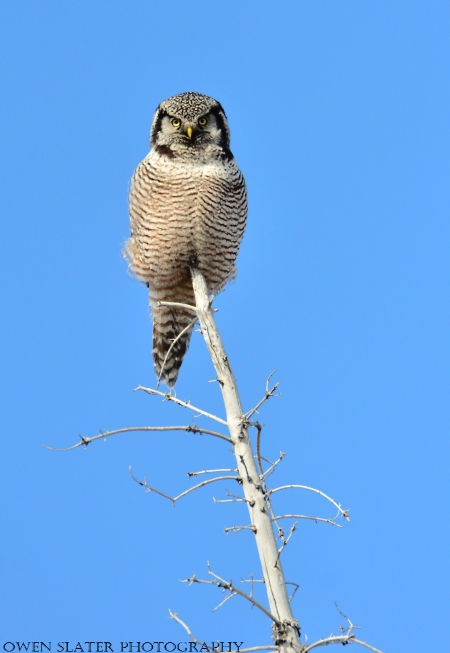
One misstep or mis-perch and this northern hawk owl might become a feather duster as it precariously sits on what looks like a very uncomfortable perch. It was about a year ago that I took this photo up in the Yukon and in the next week I will be passing by this spot on another Alaskan, Yukon and BC adventure. Hopefully I see a few more of these amazing birds along the way.

Grey pup BW PS SF WM

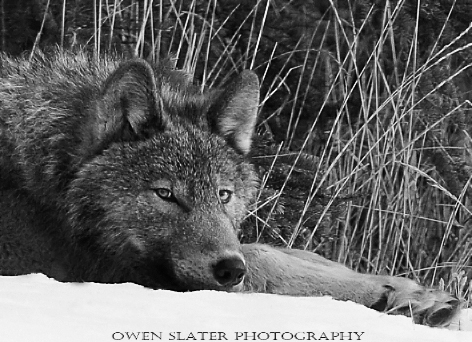
I guess I spoke too soon in my recent post about this wolf helping the pack with puppy chores in the spring. Just a few days ago, on the morning of Friday, April 5th this wolf’s life was cut short by a CP train in Banff National Park.  The young male was just shy of its one year birthday.

It really shouldn’t come as a surprise to anyone that it was killed by a train, after all this has been a routine event in Banff for years now. Trains remain the number one killer of Banff grizzly bears and in the past year numerous black bears and several wolves have also met their demise on the tracks. This is not even mentioning the elk, deer, moose and coyotes. Everything from the smallest birds to the largest mammals are commonly hit by the trains as they travel through the park.

The pack that this wolf belonged to has 2 of 6 pups remaining from last years litter.  Only 1 of 7 pups from the previous year has survived. Of the two surviving 1-year-old pups, one was hit by a train in late fall while she and the rest of her family were feeding on a rail killed deer carcass next to the tracks.   Somehow this wolf managed to survive the strike and miraculously has made it through the winter and appears to have almost completely healed from what I suspect was a fractured left hind limb. Of the seven pups born the previous year all but the surviving wolf were either hit by trains or cars.

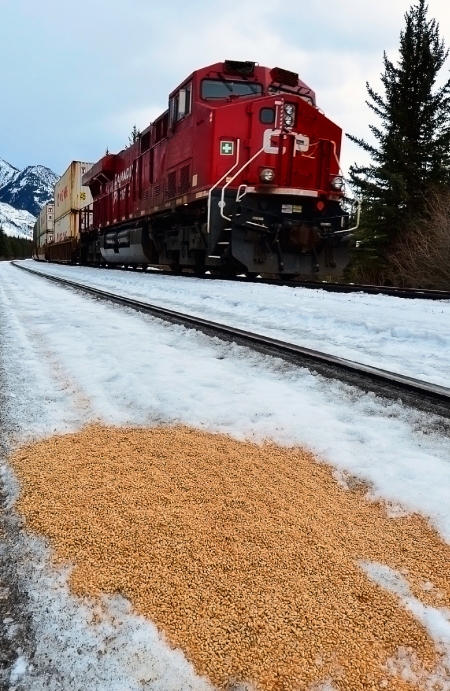
Efforts continue between Parks Canada and CP Rail to research the factors that influence these train mortalities.  While it’s great that they have committed time, money and staff to this problem, the fact remains that train caused wildlife deaths in the park have occurred on a frequent basis for years and despite some attempts to address the problem, it continues to happen on a very regular basis.The vacuum truck that is supposed to remove the grain spills doesn’t seem to come along the high risk areas of the tracks during the winter and it would seem that grain spills, which as you will see are pretty obvious, go unreported. Wildlife-train collisions are also not always reported and the strikes that are reported are not always appropriately removed from the tracks.  Add in that parks staff have been cut thin to the point that they can’t always adequately respond to all the human wildlife conflict events in a timely manner and several other variables that are a product of chronic underfunding and we have a recipe for more wildlife carnage.

CP train and spilled grain PS SSOne has to see the hypocrisy that signs in Banff state it’s illegal to feed wildlife and yet these trains are doing just that, like a giant cafeteria conveyor belt. Expecting others to act responsible while allowing this to occur is a perfect example of do as I say and not as I do.

While it is simplistic to say that all the train mortalities are caused either directly or indirectly from the grain, one has to accept the fact that even if grain or other food attractants aren’t present at the time of the event, animals will still travel the tracks looking for the free handouts whether they are there or not. After all, this has become a learned behaviour passed down from generation to generation. They have been condition from the time they are old enough to walk or fly that the tracks offer a steady supply of food so one cannot truthfully state that a particular train mortality wasn’t associated with grain or a carcass simply because these attractants weren’t present at the time of death. This is misconstruing the root of the problem. It will take years of continuous negative feedbacks for animals to stop coming to the tracks to look for handouts. The reduction in spillage to current levels is a start but breaking this pattern will require no less than complete prevention of these spills and quick removal of any carcasses from the area.  Only then will researchers be able to tease apart the other minor factors that might be at play.

In the grand scheme of things this is only one more human induced wildlife death in the long record of deaths that have happened in Banff and all along the tracks from Saskatchewan to Vancouver. However, it should serve as a prime example to every stakeholder that sooner than later added actions are required to address this problem and there is no better place to start than in Banff.  Parks and CP rail should not simply state ongoing research will be used to investigate possible solutions. Short term solutions are required now while the longer term options are investigated. However, the buck doesn’t just stop with them. Instead of visitors just complaining about all the most recent deaths and demanding something be done, they too should take actions of their own. If you are a visitor to the park and are walking near the tracks, report any carcasses, grain spills or any other concerns to Parks by calling Banff Dispatch at 403-762-1470 (24hrs/day). Even better if you can follow-up to make sure that the problem has been addressed and if it hasn’t, report it again. Every time a call is made a paper record is created that must be reviewed by Parks Canada management to make sure that the problem is taken care of. Other options include photographing what you see and forwarding it along or contacting Parks and CP staff directly with your concerns.

My hope is that this most recent death helps initiate more concerted efforts by everyone to actually solve this decades old problem. One can still hope can’t they?

Rundle reeds ice PS LF WM

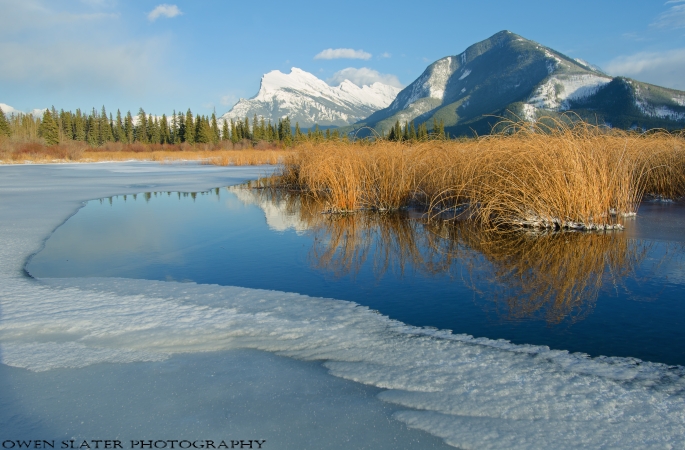
These reeds have been encased in ice and snow for much of the winter but over the past several weeks it has slowly started to melt away. The robins, starlings and male red winged blackbirds have returned, the bears are coming out of their dens and we have daylight past 8pm. A great time to be in the Rockies!

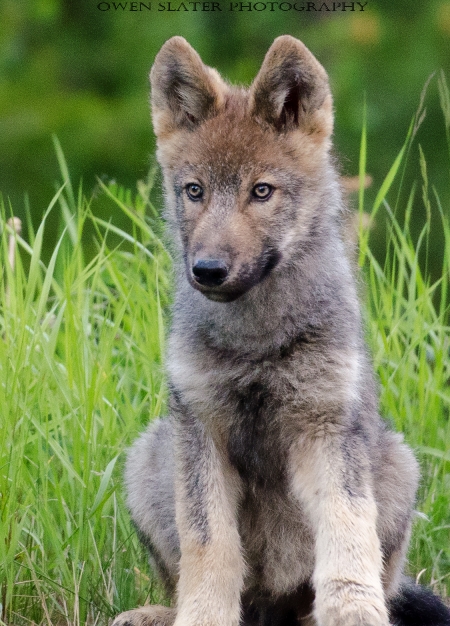
Grey pup 3 months PS SS WMA 3 month old grey wolf pup takes in its surroundings after recently leaving the den.

Grey wolf pup 10 months PS LFSeven months later he has grown into an impressive animal with thousands of miles under his feet and has learned how to hunt deer and other small prey on its own. Over the coming months he will be relied upon to help provide food, puppy sitting duties and protection for a new litter of pups.

Dipper whats over there PS SS WM

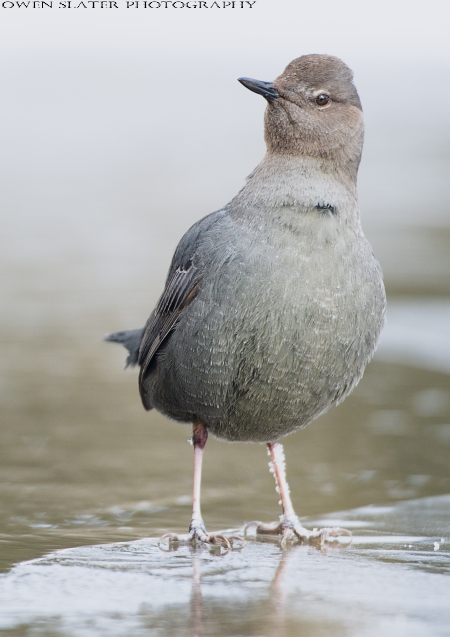
About a month ago I had a great encounter with an American Dipper. It started off with me getting a shot of it looking off into the distance at something that caught its eye. Notice the ice crystals on the legs!  No big deal for a dipper!

Dipper with stickleback swimming PS SS WM

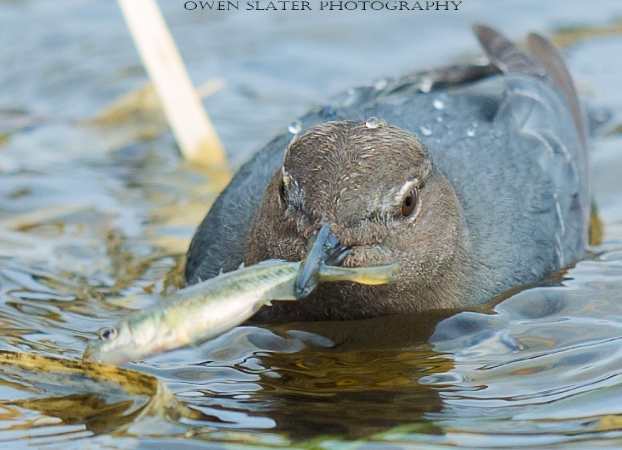
Seconds later it was diving into the frigid waters and hunting down a fish. With water droplets beading off the feathers, it surfaced and started swimming towards me to the nearest bank. The fish squirmed back and forth but couldn’t break free from the tight grip on the tail. These fish are known as sticklebacks, aptly named for the multiple sharp spines that run along their backs. This didn’t seem to deter the dipper though. It managed to avoid the spines and once to shore the fish was quickly put out of its misery.

Dipper stickleback water splashing PS SS WM

Water droplets fly as the dipper smacks the fish against the ice to kill it. Once dead, the bird took a brief break before it picked the fish up again and repeatedly smacked it against the ice. This continued for several minutes with the dipper slowly moving closer and closer to me. The only explanation I can think of for why it continued to hit the fish against the ice was that it needed to blunt the sharp large spines before it could swallow the fish whole.

Dipper stickleback beak back PS SS WM

At this point the dipper was a mere 5 feet from me.  Almost like a house cat that brings a mouse back to show off its catch! This was the final shot before it gulped the fish down and dove back into the water for another. Such an amazing sequence to see and I continue to marvel at these unique birds!

Jackson's hartebeest WM

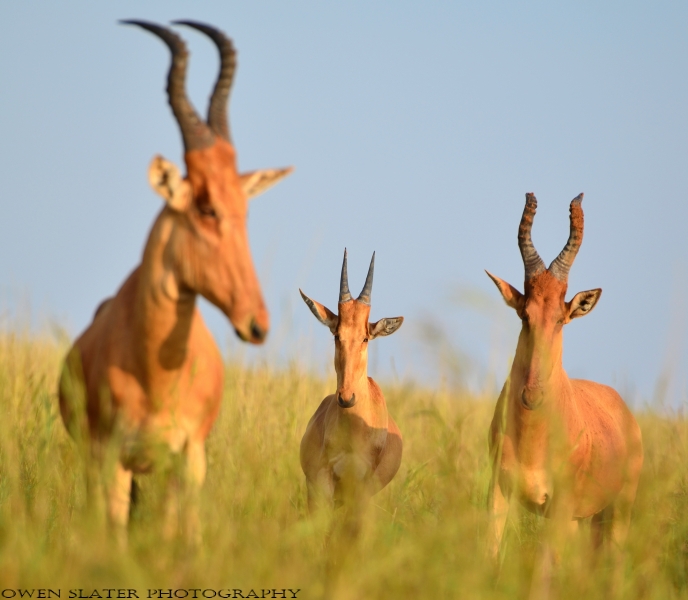
If you are a Jackson’s hartebeast there really isn’t any other option! These peculiar looking animals are a common site in Murchison Falls National Park in Uganda.

Rhino Poaching

Stop Killing Rhinos PS SS WM

I came across this sign in Kruger National Park in November 2010. At the time rhino poaching wasn’t that prevalent. Since then, poaching has skyrocketed with almost 700 rhinos poached in Africa in 2012, most coming from Kruger. Rhino horn is valued at up to $50,000/kg in Asian markets and with prices so high sophisticated poaching operations are becoming much more common. Typically these involve helicopters, and people specialized in big game hunting.  Unbelievably, even wildlife veterinarians have crossed the line and are selling ultra potent narcotics to these poachers so that the rhinos can be tranquilized in minutes. Once sedated, the horns are then cut off by chainsaws and the rhinos are left to die. The most frustrating part  is that rhino horn is no different from human fingernails!  It is simply keratin and so people could get the same ‘effect’ by chewing their own nails!

Efforts to cut poaching have ramped up. Some game reserves are safely cutting the horns off before poachers can get to them. If done correctly, this procedure is no different from cutting the tip of a fingernail off. Other efforts include increased patrols, individual guards for animals, and some have even resorted to controversial methods such as impregnating the horns with a toxic substance that will cause harm to anyone that consumes it. Others have advocated for farming rhino for their horn, since it regrows over time. This would allow for a small amount of horn to enter the market on a routine basis that might decrease the amount of poaching. Of course educating those that consume the horn is paramount and NGOs are currently working in these regions to try to curb consumption. With any long standing problem, a multi-pronged approach is required and out of the box thinking and solutions will be needed.

Black Mamba camo WM

Sometimes spotting wildlife or for that matter, not spotting wildlife can be pretty dangerous. I remember floating down the Nile in Uganda minutes before an Egyptian cobra swam past the raft I had just jumped back into. On this occasion, the most venomous land snake in Africa and one of the most feared snakes in the world peers out at me in a tree where it’s was beautifully camouflaged. Black mambas are known to be very aggressive and are not to be taken lightly.  Needless to say, I gave this one all the space it wanted.

Baboon and world WM

A globe of Earth greets visitors as they arrive on a ferry to Murchison Falls National Park in Uganda. Also waiting are cunning olive baboons that patiently wait for the right moment to grab any food they can from unsuspecting tourists. This big male took a break in the shade, ironically right below Africa on the globe!

Topi and calf ss watermark

These regal looking ungulates are called Topi. They can often be spotted in the African savannah standing on top of termite mounds or other small hills. This female jumped her way past me during a thunderstorm with her newly born calf trying hard to keep up. Please click on the image for the full size version.

Waterbuck female vertical rain ss PS watermark

Not surprisingly this female waterbuck had no issues posing in a marsh during a light rainstorm in Lake Mburu National Park. She was much less tolerant of the pesky gnats flying around her eyes and used her ears as fly swatters to keep them at bay.


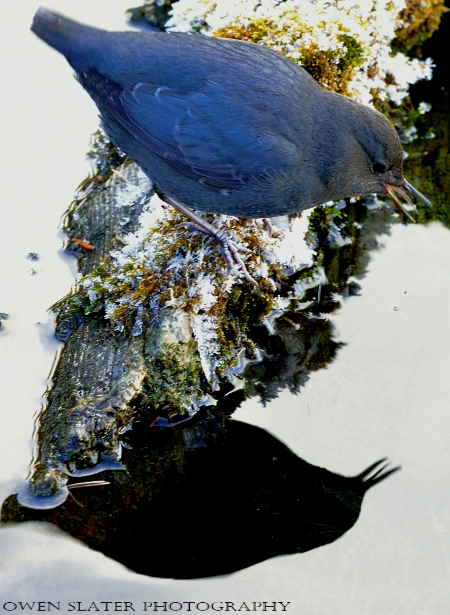
Dipper tongue out reflection log watermarkA funny photo for the day. I will let you decide if the dipper was sticking its tongue out at me, for the photo, or just because it can!