
 This photo of a juvenile ground hornbill shows a bit of their playful personality. Just prior to taking this photo the bird walked up to this torn apart tree (compliments of a hungry elephant) and grabbed at a piece of the bark. It pulled back and forth and jumped up and down until it was able to rip a piece off the tree. As if to show off it’s accomplishment it flew up onto the tree with the piece of bark still in it’s beak. However, it quickly lost interest and after pausing for a few seconds it tossed the bark up into the air, jumped down and went back to foraging for food.
Latest Entries »

In between searching for food this hornbill briefly looked up above the dried grasses to survey the open savannah. I snapped off a few photos and this by far was my favorite.
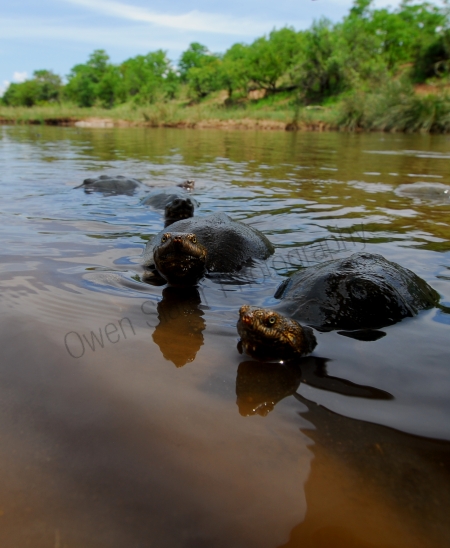 After stopping at a camp to stock up on supplies we had a look at the wildlife sighting map. Each camp has a map of the surrounding area that people can mark down the various high profile wildlife sightings (elephant, buffalo, lion, leopard, cheetah and wild dog) for that day and the day before. We were both hoping to see wild dog, but we would really have to be lucky to spot them as they are very rare in the park. Someone had posted on the board that they had seen wild dog in the area and so we headed off to try our luck. While we didn’t see any wild dog we did come across a lot of other wildlife including a large herd of elephants playing in a waterhole (photos to come), zebra and of course impala. However, with most wildlife drives I usually see something unique and unexpected, which is what these three photos illustrate.
We came down a steep section of the gravel road and had to drive across a section of road that had been flooded by a small pond adjacent to the road. As we approached the flooded road I spotted a turtle, then another and another. They appeared to have spotted us and had no fear of our car. As our tires touched the water they started walking more quickly towards the car. Soon over 10 were ‘running’ towards the car. To get these photos I put my wide angle lens on, opened the door, held my camera just above the water and tried to center a turtle in the middle of the frame so that the camera would automatically focus on it. Thankfully it worked and I managed to get several photos from their perspective. It wasn’t until I got home that I figured out that these are Serrated Hinged Terrapin (Pelusios sinuatus), a relatively common terrapin found from East Africa down to South Africa. Apparently they are naturally quiet bold as a found several photos of them perched on top of hippos! I suspect these ones associate cars with free handouts as they were way too friendly.
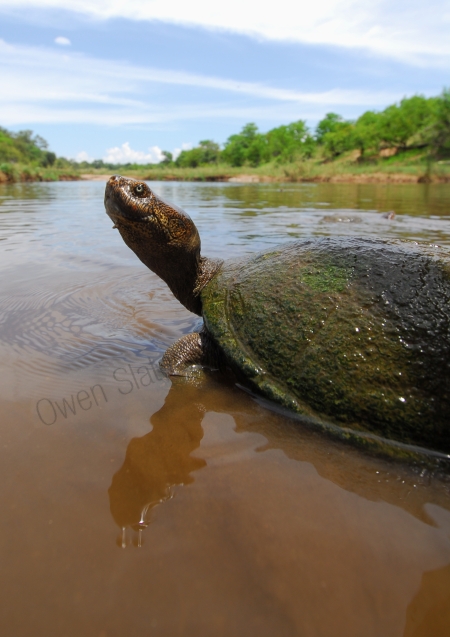 This terrapin seemed to pose for me but I suspect he was just annoyed that I was not giving him any food! Most of the other terrapin had moved back into the deeper water at this point but any time we moved the car forward they would all come racing back up.
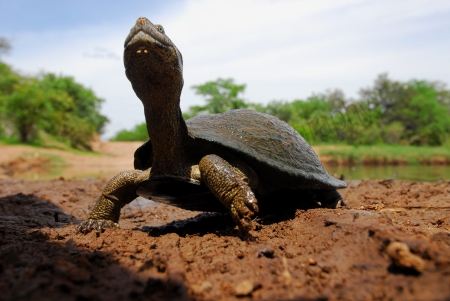 By this point we had managed to cross the water to the other side of the pond but not without being followed by one of the terrapins. The females in this species are generally larger than the males and so I think this was a curious female terrapin. She walked right up to my lens before deciding to return to the safety of the pond and we quickly left before anymore decided to come up for another visit.
 I’m back! I know it’s been quiet some time since I last posted photos on my blog so thank you for hanging around. Hopefully in the next few months I can start updating my blog on a more regular basis. I still have lots of photos from my trip last year to Kenya to add in addition to all the new photos I have of wildlife in Alberta, Canada. But I thought I would start off with a few photos from my most recent trip to South Africa. The reason for the trip was because I was teaching a course at the annual Pan African Sanctuary Alliance (PASA) Healthcare Workshop hosted by JGI Chimp Eden in Nelspruit, South Africa. The workshop is for veterinary personnel working in sanctuaries throughout Africa that care for great apes (gorillas, chimps, bonobos). I have been involved with PASA since 2003 and I am always amazed each time I come to these conferences to meet the vets working throughout Africa that do so much for the wildlife in their sanctuaries with so little in terms of supplies and basic things like reliable electricity. If you are interested in learning more about PASA please visit http://www.pasaprimates.org or find them on Facebook.
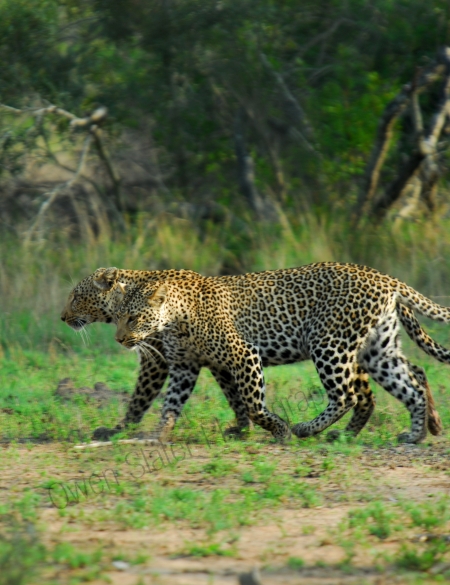
After the workshop I rented a car with a colleague from the workshop and we drove the short distance from Nelspruit to Kruger National Park. If you have the opportunity to visit this park I highly recommend renting a car and making your own safari. It is not any more expensive than going with a safari company and you can set your own itinerary. We woke up at 4am to be at the camp gate when it opened at 430am and started the morning game drive. About two hours into the drive we started passing by a bunch of large acacia trees and I thought they would be excellent places for a leopard to be resting in. Literally within a few minutes I spotted a leopard sitting up in a tree about 50 feet away. We watched if for about 10 minutes as it tried to get comfortable in the tree and get some sleep. However, it was restless and seemed to be distracted by something. It got up, stretched and slowly made it’s way down the tree to the ground. At this point all I could see was it’s tail. Initially it stayed in the spot it landed on the ground but then all of a sudden it started jumping around in the tall grass as if it was playing with something. Within a few seconds I could no longer see it anymore but I was confident that if we had patience we would see it again. We slowly circled the car around the next corner and then backtracked to the original spot but did not see the leopard. We circled around the corner again and just as we started to drive off my colleague yelled out “leopard, no two leopards!” They were sitting in the grass about 20 feet away staring at us! We couldn’t believe our luck. Not one, but two leopards and both were in a clearing with great morning light on them. Over about five minutes we watched them as they made their way through the green grass. It appeared it was a mom and her almost full grown female cub. They rubbed chins together as they walked along without a care that we were there. The next two photos are a few more I took before they disappeared.

I couldn’t believe my good luck. Not only were there two leopards, but they were in a wide open clearing with beautiful, soft morning light. I took this picture just before this leopard walked behind a bush and in between me cursing my periodically malfunctioning camera.
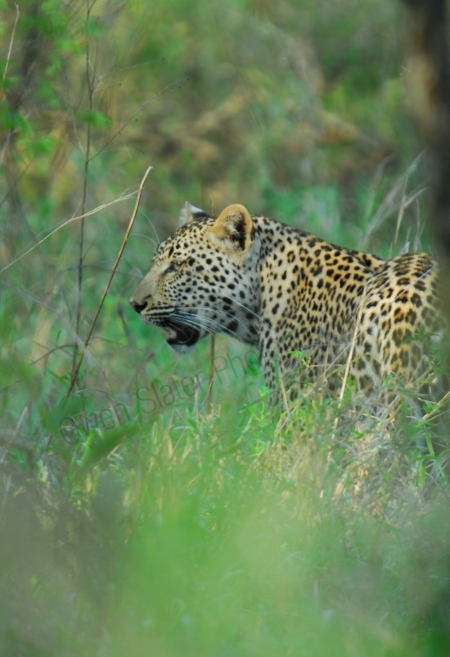 Shortly after both leopards crossed the road 20 feet in front of my car they slowly disappeared into the grass. This was one of the last photos I took before driving off to let them to find some breakfast. I think it was about this point that I finally took a breath and relaxed. Thankfully my malfunctioning camera managed to work properly for a few minutes to get a few great shots of these amazing cats but I was kicking myself for not getting the camera repaired prior to this trip. Regardless of all the shots I missed, this leopard encounter is something I will never forget.
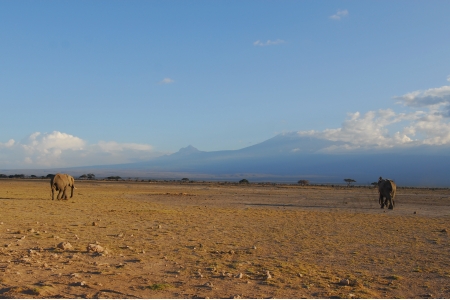 Amboseli is synonymous with elephants. And while the elephants my look the same to the casual observer, every elephant in Amboseli has a name and can be identified by the researchers studying them. The Jane Goodall of the African elephant world is Cynthia Moss. She has been studying the elephants of Amboseli since 1972 and formed the Amboseli Trust for Elephants (http://www.elephanttrust.org/) which has resulted in a much greater understanding of these amazing animals and helped protect them and their natural habitat.
These two elephants had just finished dusting themselves with dirt prior to heading back towards Mt. Kilimanjaro. With no appreciable rain for over two years, the elephants have to travel long distances to find food and water. Thankfully, a few months after I had visited the park the rains finally came and almost instantly the land was transformed from a desert into a lush green savannah.

The old matriarch of the herd brings up the rear as two huge African elephants make there way across the dusty, dry earth of Amboseli National Park. I lost count of the number of dead wildebeest and zebra that had been affected by the drought. Once elephants reach about 5 years of age they become extremely drought tolerant. However, adult females will stop cycling until they build up enough fat reserves to support a pregnancy and often the young elephants will die during a drought due to decreased fat content of the mother’s milk and lack of vegetation. The adults are much more capable of traveling long distances to find food and watering holes but instead of moving in large groups, they break off into smaller groups in search of food and very little time is spent socializing and playing because all of their time needs to be spent searching and eating food to sustain themselves. The average adult African elephant consumes about 400lbs of vegetation a day!
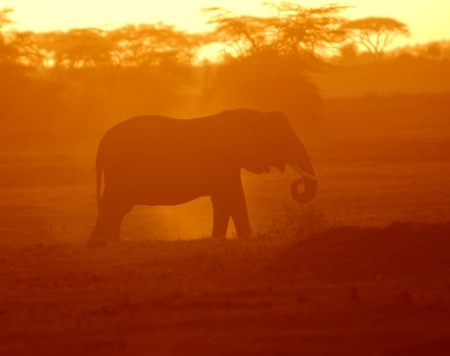 There isn’t much that is better than relaxing at the end of a long day and watching a beautiful sunset, unless of course you are in Africa, where the sunsets seem so much more intense. Add in a majestic elephant and this was the perfect ending to an awesome day of game viewing.
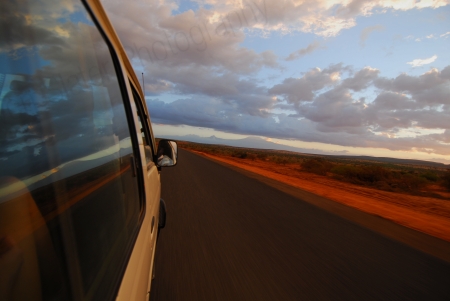
After a day of frustration in Nairobi due to a late start by the tour company we made it to Amboseli National Park just as the sun was setting and the clouds were lifting from the top of Mount Kilimanjaro. With the light fading fast I snapped this photo of the mountain as we sped down the road. Although I have traveled to many of the parks in Kenya, I had yet to make it to Amboseli and so when my trip to Samburu National Park in northern Kenya fell through I decided it would would be a perfect time to visit. Amboseli is renowned for it’s elephants and the views of the volcanic, Mount Kilimanjaro. Mt. Kilimanjaro contains virtually every ecosystem on earth – glacier, snowfields, deserts, alpine moorland, savannah, and tropical jungle and a hike up the slopes is said to be comparable to a trip from the equator to the North Pole. It is the tallest mountain in Africa at a height of 5895 meters or 19,340 feet and it also holds the title of the tallest free-standing mountain in the world rising 4900 meters or 16 000 feet above the plains at its base. While it is located entirely within Tanzania some of the best views are from Kenya.
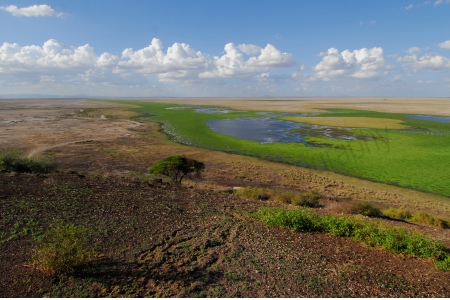 This photo was taken from on top of Observation hill in Amboseli National Park. The park has not received more than a few drops of rain in over two years! I lost count of the number of dead zebra and wildebeest and even other more drought resistant species like elephant and giraffe are severely affected. also cattle we saw on our game drives. So why is there this oasis of water and green vegetation? It is the result of the melting glaciers and snow on top of Mt. Kilimanjaro running down the sides of the mountains. The water from Mt. Kilimanjaro travels several hundred kilometers to the Indian ocean and is often the only source of water for humans and wildlife along the way. Elephants and buffalo are routinely found almost completely submerged in the marshes eating, cooling off and getting a drink while other species come to the edges to drink. By continually walking on the bottom of the marsh the elephants pack down the mud and ensure that the watering holes don’t get filled in and dry up. However, the glaciers and snow on top of Mt. Kilimanjaro are disappearing at an alarming rate which is believed to be due to global warming and the removal of large portions of the forests that grow on the sides of the mountain. It is estimated that within the next 20 years all of the frozen water on top of the mountain will have melted with devastating effects felt by the people and animals that rely on it to survive.
 One of my favorites. I took this photo from the community campsite I was staying at inside Amboseli National Park. Most of the classic photos of Mt. Kilimanjaro in the background with elephants making their way across the savannah are from Amboseli National Park. The tour guide that I had on this trip was not very accommodating so instead of going on an early morning game drive I only had the option of waking up early and walking around the campsite grounds to take photos. Thankfully, the area was quiet large and I lucked out and saw elephants browsing on acacia trees, wildebeest making their way to the watering holes and a beautiful sunrise with a clear view of Mount Kilimanjaro.

The normally majestic looking giraffe appears quiet out of ordinary when it requires a drink. Giraffe can go long periods of time without drinking, which is probably a good thing because it is so awkward for them to bend over. Physiologically, giraffe have unique anatomical differences in their blood vessels to allow them to lower their heads from a height of approximately 15 feet above ground to below ground level without fainting either when drinking or when they quickly raise their heads back up to normal position. Giraffe also have exceptionally long, dark tongues (up to 17 inches) that are incredibly tough. Both males and females have horns covered in skin. When the males fight for dominance or a mate they stand parallel with each other, swing their head and necks outward and down until they collide together around chest high. In this photo the bird in flight is an oxpecker that couldn’t hold on when the giraffe lowered it’s head. It quickly flew back onto the giraffe’s neck and a few minutes later was inside the giraffe’s ear picking out insects.


 Owen Slater Photography