
 Willow bushes zig-zag through the valley floor before reaching the mountains that seem to erupt from the ground in Denali National Park.
Willow bushes zig-zag through the valley floor before reaching the mountains that seem to erupt from the ground in Denali National Park.
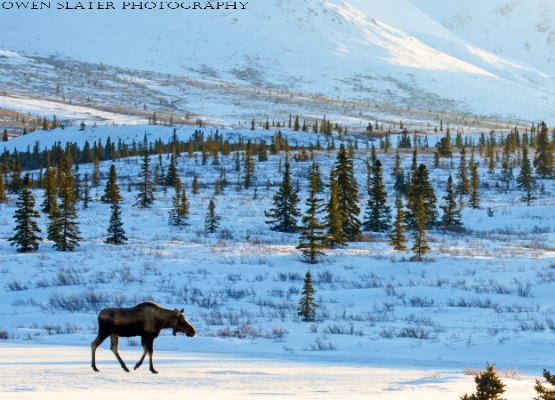
On a recent trip up to Alaska for some work with caribou, I took a quick detour down to Denali National Park to get in a few days of photography before the real work started. It was mid April and the road into the park was still barely even open. Night time temperatures were around -20 Celsius and a balmy -5 during the day! Early on the first morning I came across this cow moose as she made her way across a still frozen pond. Golden eagles had returned. but other than that there were few signs of spring. However, the wonderful sound of silence, the few hardy animals I came across and the amazing surrounding scenery was still well worth the detour.
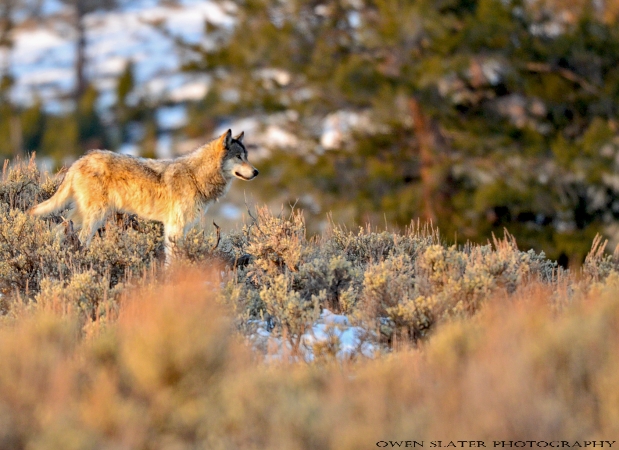
The trip to Yellowstone wouldn’t have been complete if I didn’t get a chance to photograph wolves. On the second morning we lucked out and came across the Junction Butte pack. We had seen them the day before but through a spotting scope since they were a few kilometers from the road. Overnight the pack must have traveled a fair distance, but as luck would have it they were right next to the road. This one was slowly making its way through the sage brush right past a herd of adult bison. The bison clearly knew how to behave around the wolves as they stood their ground and just stared at the wolves who quickly determined that they should keep going. As the sun crested the hill, this wolf paused for a few seconds to see where the rest of the pack had gone giving me the perfect opportunity to get a few photos.

While enjoying a picnic near the Yellowstone river, this Northern flicker flew past and landed on a nearby dead tree. Flickers never stick around for more than a few seconds, so I knew I had to be quick if I wanted to get any photos of it. Thankfully, I had left me camera right beside me so as I grabbed it I rolled onto my stomach, propped the camera against my camera bag and fired off a few frames before it was gone. I find flickers one of the hardest birds to get decent photographs of, so I was pleased that this on turned out OK.
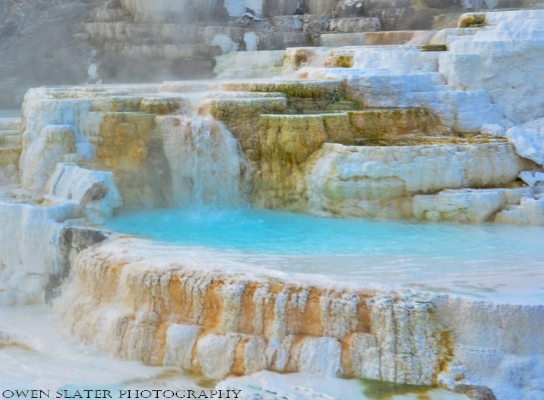
Scalding hot water cascades down a self-made rock feature. The water carries dissolved silica from underground streams. When the water evaporates, the silica is deposited on surfaces, hardens and forms sinter (aka geyserite) that creates these rock formations. Naive animals (including people) will sometimes be tempted to get too close to or actually into these hot pools to escape the extreme cold weather, often resulting in dire consequences.

The early morning light created beautiful soft colours on the bison’s coat and off of the small bushes in the background.
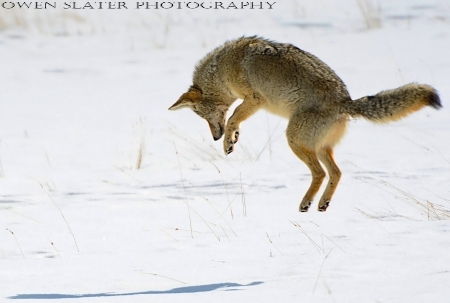 A coyote launches into the air in what appears to be an attempt to catch its shadow. While it wasn’t successful at that, a few split seconds later it was feasting on a vole!

I have been casually trying for a while now to get a decent photo of a wild pronghorn with no luck. Apparently all it takes is a quick trip to Yellowstone, where there are pronghorn everywhere you look when first entering the north gate. Even better was that many of them were curious when I was laying on the ground and they started to walk towards me to investigate.
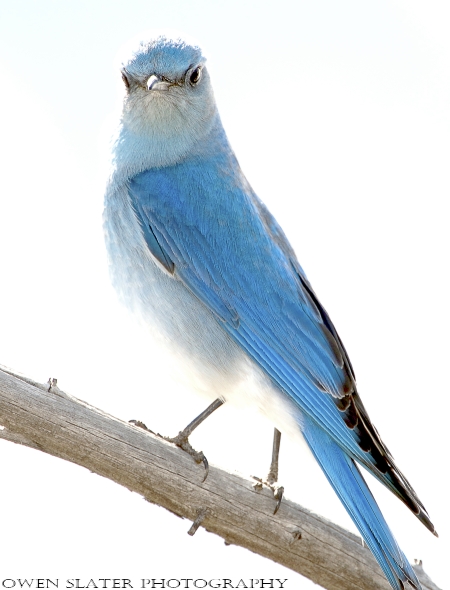
Yellowstone was full of bluebirds. I have only seen parents and offspring together before, but during this trip there were flocks of over 20 birds. This handsome male perched on a branch right next to the road which made it very easy for me. He didn’t seem to be bothered and continued to eye up the landscape for unsuspecting insects.
 Where has April gone? I will try to catch up on my posts over the next few weeks.
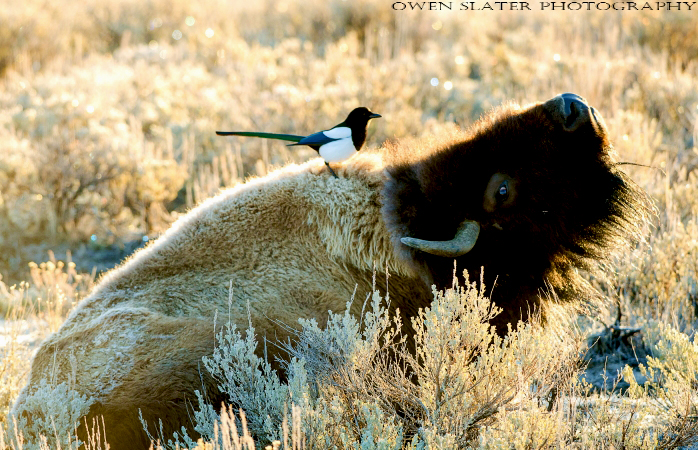
I took this one in Yellowstone about a month ago. The bison herd was bedded down and just waking up from a frosty night in the park. The magpies were going from one bison to the next, singing their typical magpie songs and picking off bugs as the sun rose over the hills. Most of the bison didn’t seem to mind the wake up call, but this one didn’t take too kindly to it. It tossed its head back several times to try to dislodge the bird, but the magpie just ignored him. Eventually the bison gave up his protest and went back to trying to get some more rest.
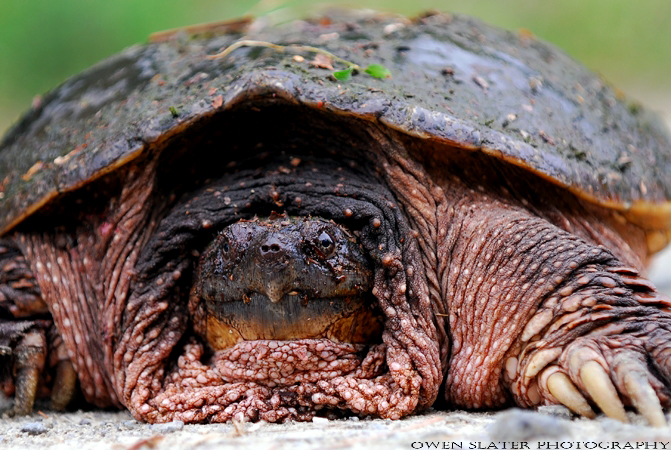
They may not be considered pretty by many but no one can argue that they are adaptable. Snapping turtle ancestors date back some 40 million years! On the other hand human ancestors have only been around as a species for about 200,000 years. Which begs the question, would snapping turtles prefer living with dinosaurs over living with humans?
As human induced climate change continues they will need to continue to adapt or face extinction. The gender of snapping turtles and several egg laying reptiles is determined by the temperature the eggs are incubated at. Female will develop at colder temperatures and males at higher temperatures. Only a few degrees of difference is needed to change the sex of the soon to be hatched eggs, but if global warming continues these reptiles will have to modify their nesting behaviours if they are going to survive.
In this photo, a female was on the move to try to find a good spot to lay her eggs. After taking this photo I carefully lifted her up to avoid being bitten and took her across the road to make sure she made it safely. Everyone needs a helping hand once in a while and now more than ever wildlife needs ours!
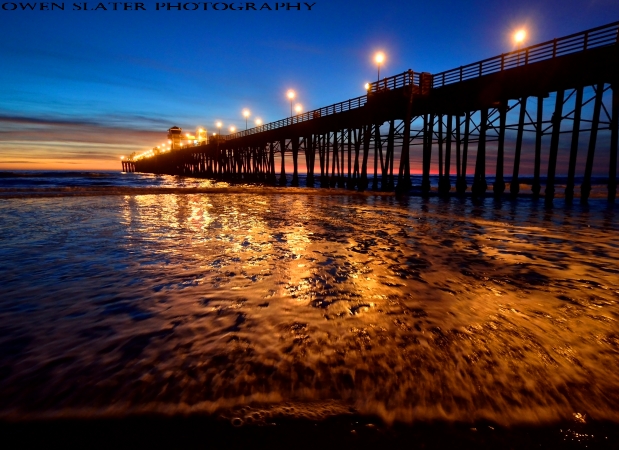
Just like people who need a break from living in the snow and cold, I figure my blog needs a break from the same! Here is a photo from a recent trip down to sunny, warm southern California! The sunset was spectacular that night. From surfers to people combing the beach for hidden treasures, everyone seemed to stop and take in the amazing colours.
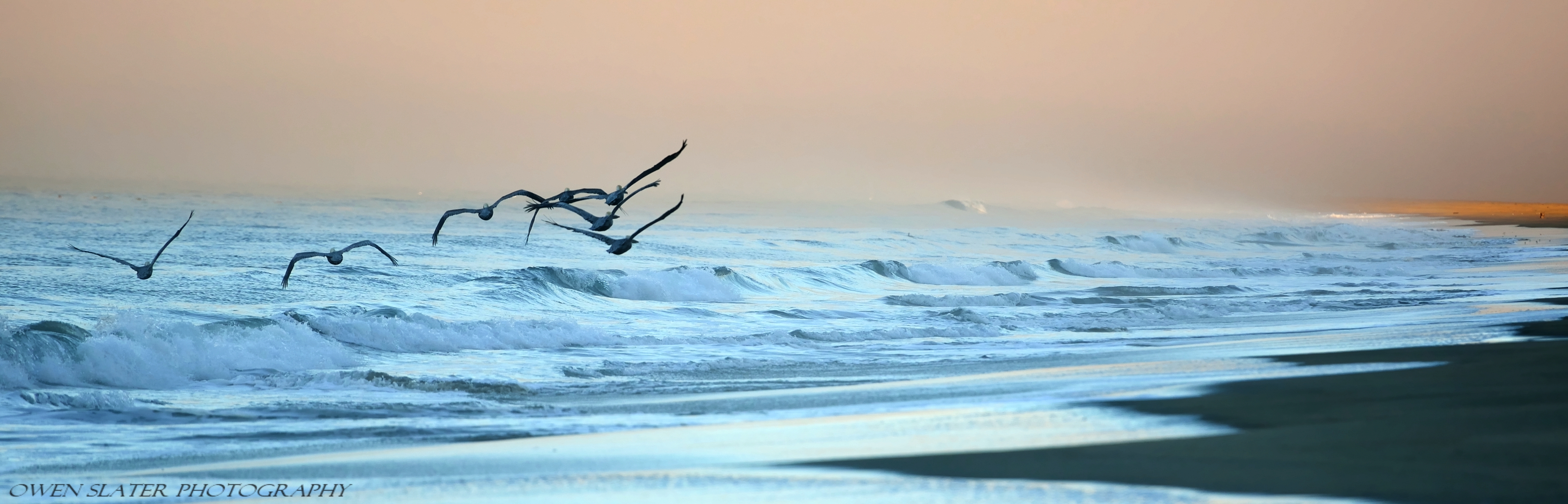
Please click on the image to view a much larger version.
Similar to surfers, pelicans have figured out how to harness energy from waves. However, it is actually more closely related to what a pilot does during take off and landing than to surfing. Interestingly, it appears pelicans are one of only a few coastal birds to have figure this out. By flying so close to the rolling wave, they are able to gain lift, speed and decreased wind resistance created by the air that gets trapped between the water surface and the underside of the wing. This air cushion essentially supports the bird’s weight just above the water’s surface. As the wave increases in height the pelican rises up parallel to the wave to maintain lift. Just prior to the wave breaking, the bird will then descend along the leading edge of the wave, gaining speed along the way much like a surfer does. By doing this they can greatly increase their flight speed without ever having to flap their wings. The key for the pelican is to build up as much speed as possible before the wave breaks. Just as the wave starts to crash over itself the pelican resumes flying to get above the resulting air turbulence. As the next incoming wave moves into shore they reposition themselves along its leading edge and repeat the maneuver. In this way they can travel much longer distances much more quickly and with less effort than other birds. While pelicans and albatross were showing us how to use this effect well before we recognized its existence, it wasn’t until the Wright brothers came along that anyone used it. Even then, no one knew what it really was. Now the phenomenon is well described and in the aviation world it’s known as ground effect. Anyone that has flown in an airplane has felt this either at take off or landing. In large planes it is most noticeable just before landing, when the plane seems to hover just above the ground and actually gain speed just prior to touchdown. In small planes it is more noticeable at take-off, when the pilot maintains the airplane just off the ground to help increase the ground speed before ascent. Next time you fly watch for this effect and you will surely notice it if you haven’t already.
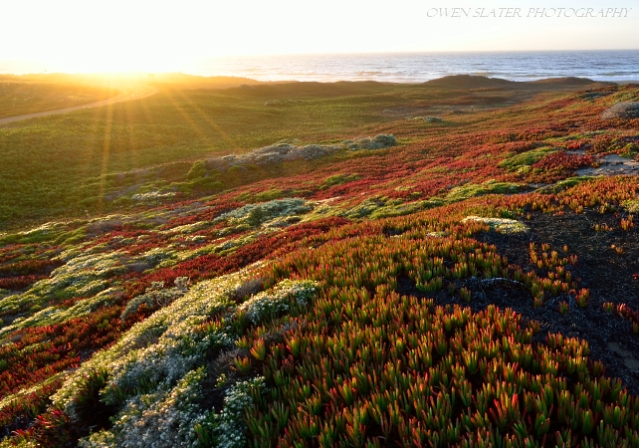
Enough of the winter photographs from Alberta for this week. Back in California I took this photo near the lighthouse at Point Reyes. The dominant plant in the landscape is known as ice plant (Carpobrotus edulis), which was originally introduced from South Africa to prevent soil and sand erosion. However, the plant has become invasive, strangling out other native species. Making matters worse, since the plant has a shallow root system when it rains the leaves engorge with water, get too heavy and actually cause entire slopes to collapse when the roots can no longer support the weight of the plant. Efforts are ongoing to remove it from much of the coastline to restore the landscape to its original form. Complicating efforts is its appeal with local gardeners for the bright red colour that the leaves turn in the fall.
PS. Too all the Boardwalk Empire fans out there…sorry that your favourite character was killed off in the TV series. However, thanks for checking out my site!


 Owen Slater Photography