
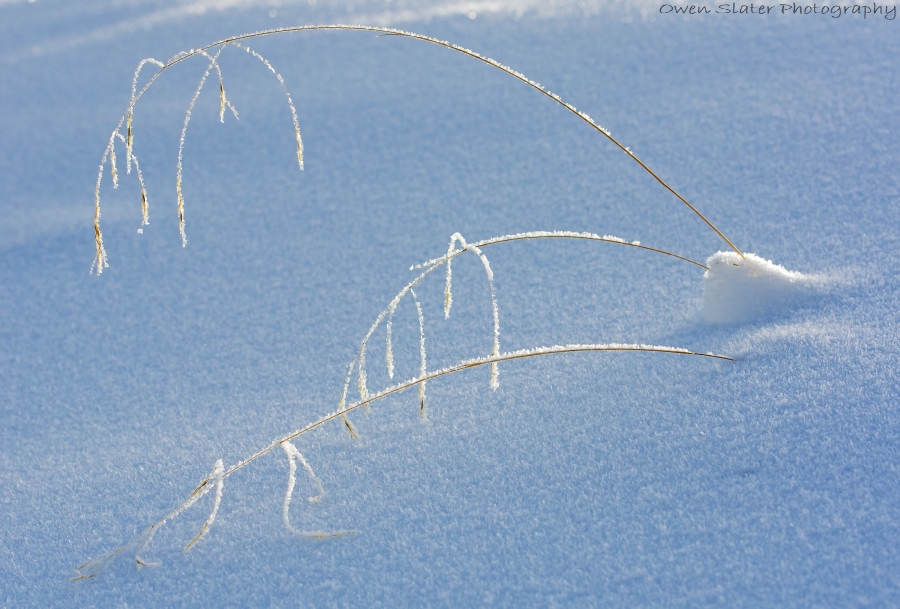
 With temperatures hovering around -25 degrees Celsius last week, getting out into the mountains was a bit more challenging, but the extra effort always pays off in one form or another.
Category: Canada
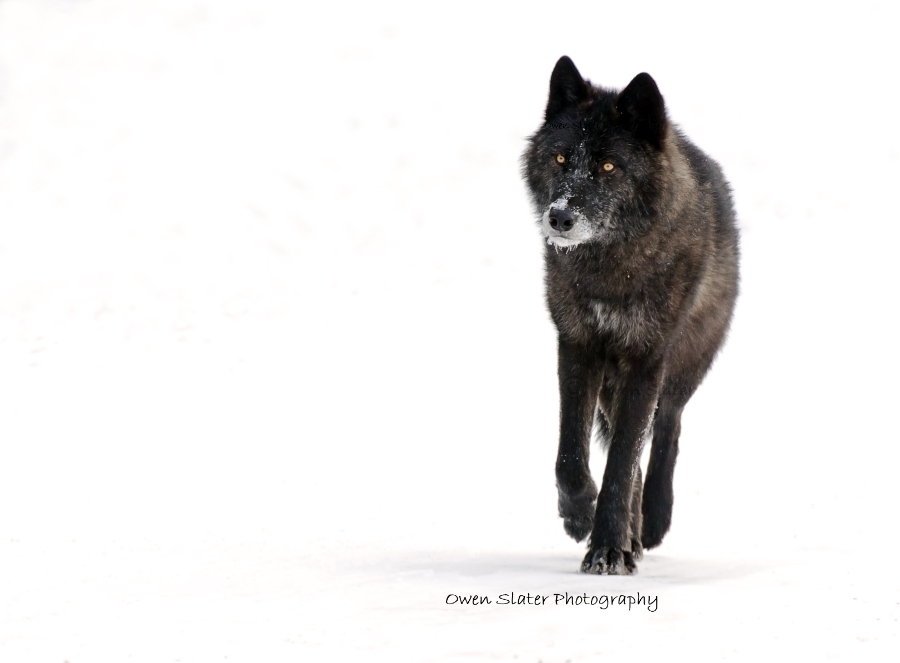 Powerful, intense, resilient and beautiful. To me the wolf symbolizes nature and wilderness as it’s meant to be.
I took this photo on one of my recent trips into the Canadian Rockies!
Feel free to share and/or comment and as always, please click on the image for the full size!
Cheers,
Owen
 I knew after I took this photo that it was going to be my favourite of him, but initially I wasn’t sure if I was going to get it. The marten was moving behind a small hill out of site and I thought he might just disappear into the bushes. But I got lucky and he came up from behind a snow bank, cocked his head back and forth and intently listened for rodents scurrying under the snow. I quickly fired off a few frames and smiled to myself knowing that I had the photo I wanted.
Which of the two marten photos do you like best?
(Please click on the image for the full size)
 While pine martens are relatively common in coniferous forests in western Canada, they aren’t often seen since they’re primarily arboreal and when they do come down to the ground, they rarely stay in one spot for long. These weasels are out all year-long, but are generally not as active in winter. They hunt pretty much anything they can sink their teeth into including ground squirrels, snowshoe hare, fish and birds.
This little guy was out bounding through the deep snow looking for breakfast. He stopped a few times to watch and listen for any prey, which gave me just enough time to get a few photographs of him before he disappeared back into the forest.
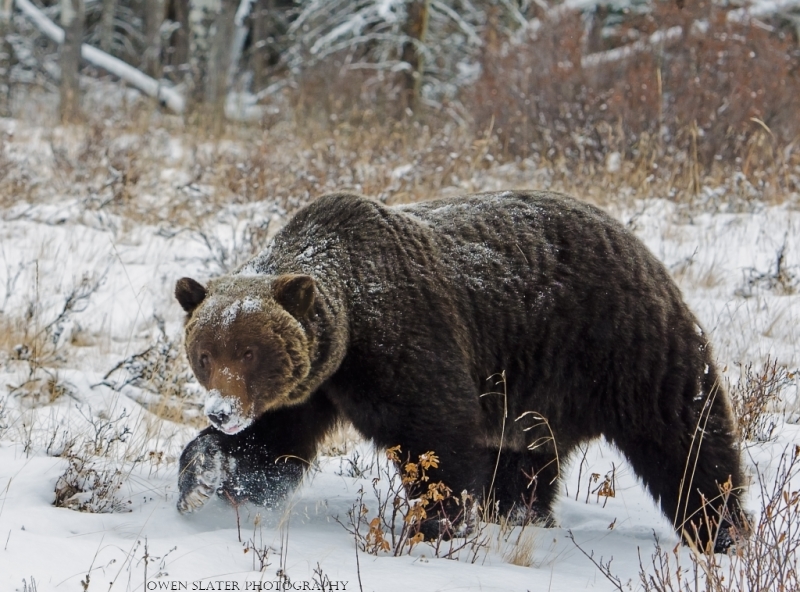 An adult male grizzly bear plows through 10 centimeters of snow in minus 10-15 degree Celsius temperatures. While the females and young cubs are already tucked away in their dens, these big males are still out looking for food to pack on the pounds so they can compete against the biggest males for breeding opportunities in the spring.
For the past several years I have tried in vain to get a good photo of a grizzly bear in snow. I have run into them as late as December, always either really early in the morning or late at night. All of that changed when this bear lumbered out of the forest in the middle of the day. He wander back and forth following the tracks of a pack of wolves that had been in the area earlier in the morning. Most likely he was trying to determine if the wolves had made a kill. Being the biggest predators in the Rockies, they will follow wolves and steal away their kills through brute force but on this day the bear came up empty handed. With his nose covered in snow, he plodded along weaving a route back and forth through the forest before giving up and moving on.

Well not really, more like hungry birds! These two osprey are siblings that successfully fledged this year. They took to the skies to practice their maneuvers and to compete with one another for the best waiting spot. It takes a few more weeks after fledgling before they are proficient at hunting on their own so the parents would return with fresh fish to give to them. It was always first come, first serve and once one had a fish there was no way they were going to share it!
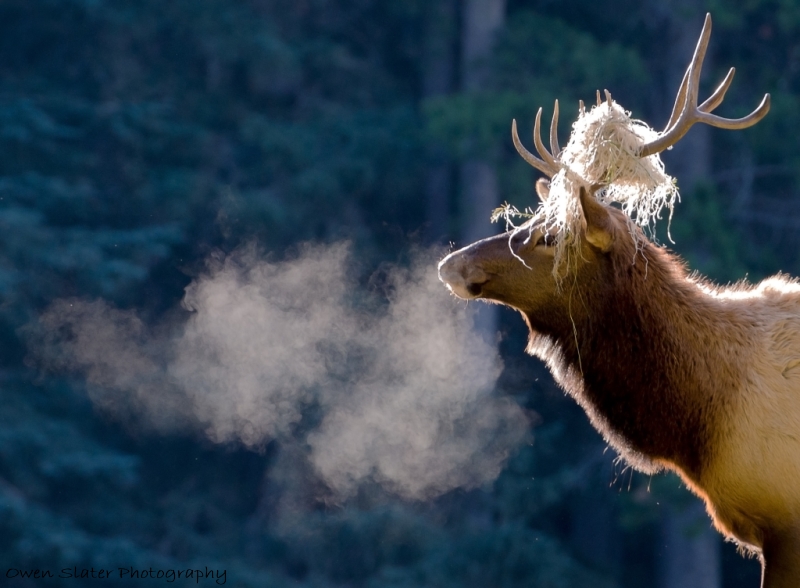 With the annual elk rut in Banff National Park taking place around the town site, many of the elk end up with ropes, plastic bags and other items tangled up in their antlers. Some require sedation to remove the items, while less severe entanglements like this one can be left alone.
The new antler-wear didn’t seem to bother this elk, but he had bigger concerns. Due to his young age and relatively small rack he was relegated to the sidelines and needed to stay out of the way of the larger, much more powerful and battle harden males. After narrowly skirting around one, he took a few minutes to catch his breath before wisely deciding to move off into the forest.
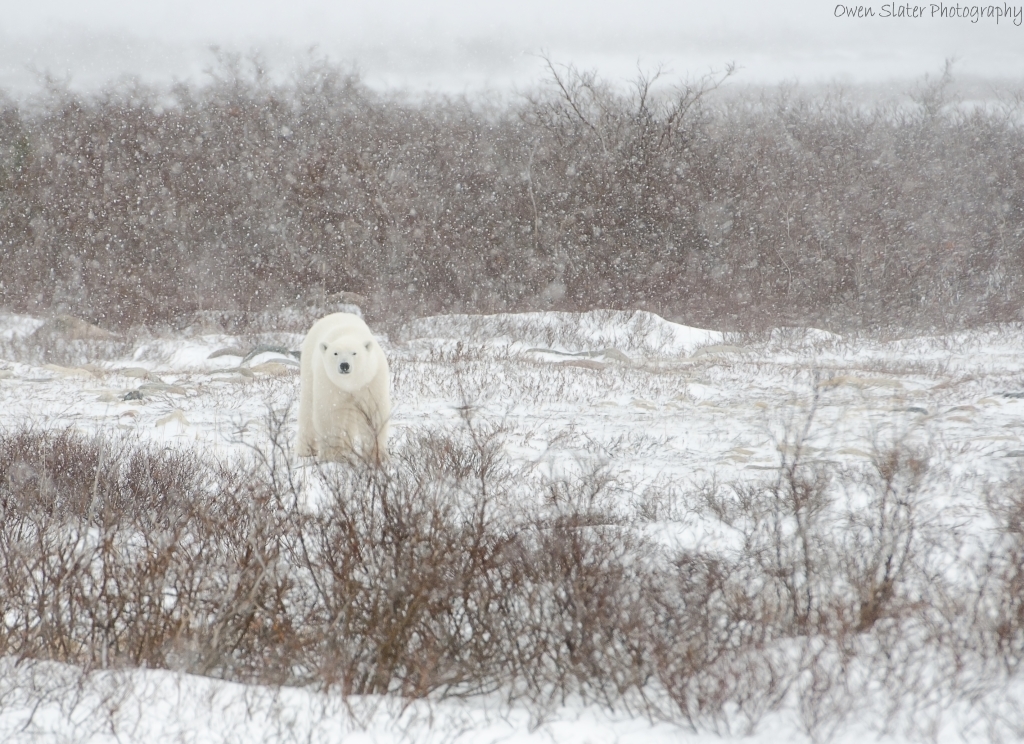
Over the past two weekends I have been a naturalist for Classic Canadian Tours, which provides polar bear safari day trips out of Calgary, Edmonton and Saskatoon to Churchill, Manitoba. Many people who would otherwise never have the opportunity to see these magnificent animals in the wild are able to make this trip and come away with a once in a lifetime experience.
This time every year, tour companies are in full swing as the bears congregate around the Hudson Bay. Due to the influx of fresh water and bay currents, the water in the Churchill area is the first to freeze each year. Over a 2-3 week period between late October and mid-November the bears return to this area to sit on the tundra and wait for the ice to form. Once frozen, the bears have direct access to cross the bay and continue to their winter hunting grounds. This brief window creates a perfect viewing opportunity for wildlife enthusiasts and we were lucky to see several bears including this one as she made her way along the tundra during a snowstorm.
One of my favourite moments from these trips was at the end of the day when we were back in Calgary. An elderly man who had made the trip strolled up to me and we chatted while he waited for his family members. As we shook hands and talked about the great trip, he stated that he only took a brief nap on the morning flight out but was otherwise feeling great even after being up for 16 hours! The adrenalin rush of seeing polar bears was easy to appreciate! As he left he proudly stated he was 87 years old and that he hoped I would be able to do such a trip at his age! I couldn’t have agreed more!
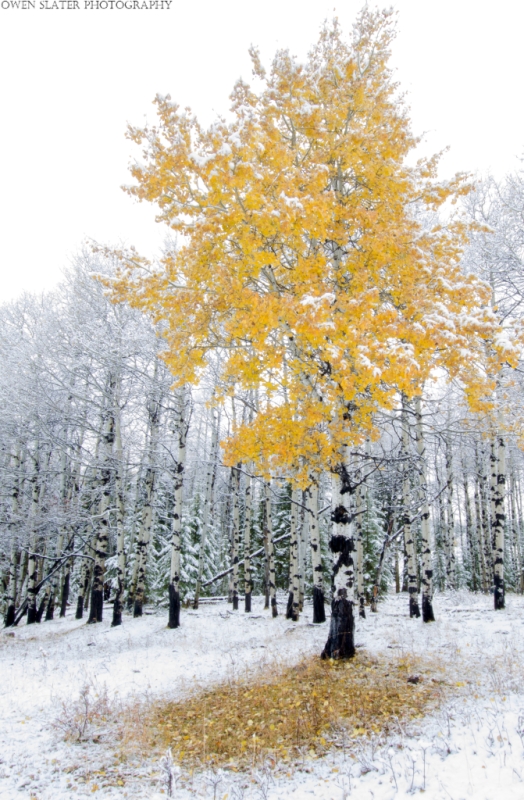
An aspen tree appears to take a stand against winter in Sheep River Provincial Park.
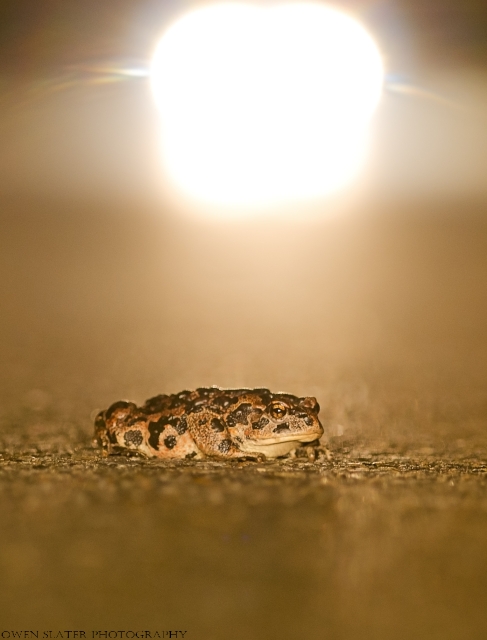 It was the worst of times. With the wet spring and summer it was a very good year for amphibians in Western Canada but it wasn’t all great news for them. Each morning I would find many of them squashed on the roads, particularly in Banff National Park. They were too mutilated to be able to ID, but on one of the late nights returning from photographing the night sky I eventually came across one that was alive and well. It was a western toad; a species of “special concern” under the Species At Risk Act (SARA).
I pulled over to the side of the road and got out to take a few photographs. While laying on the road to get the perspective I wanted, a couple with a truck and camper came around the corner in the opposite direction. I used the opportunity to take a photograph that tells the fate of many of these toads on the roads this year. However, I didn’t anticipate the reaction from the people in the vehicle!
As they passed by they must have looked down and saw me laying on the road directly in front of my parked car. I assumed they saw me photographing something and wondering what it was I assumed they started backing up in my direction to find out what it was. I continued taking photos until they were right beside me, at which point I got up. Almost immediately the driver yelled at me that I had just given him the scare of his life! He explained that he thought there had been an accident, that I had been hit or thrown from my vehicle and that he thought I was dead on the road! I apologized several times, but I think he was still in shock because he kept repeating the same refrain. I apologized once more before he slowly drove off towards the campground shaking his head. Not wanting to cause any more concern, I quickly coaxed the toad off the road, got back in my car and drove away.
Seeing and photographing wild wolves is always a thrill, even more so this year since finding any has been a lot more challenging. On the few occasions when I have been lucky the glimpses were always fleeting or with lots of trees and bushes obstructing my view.
On one day late in August I got my best glimpse this year. Some of the pack was resting deep in the forest near a kill site and the only way I knew they were there was from the periodic howling. After awhile I noticed some movement between the trees and it soon became clear they were on the move. I had a pretty good idea of the path they would take and where they would come out of the forest for a few seconds so I drove ahead a few minutes, parked my car and set up my camera. With the settings dialed in, I didn’t have long to wait. The two year old female emerged from the trees and came trotting along the clearing. She stopped not too far from where I was parked, turned and looked behind her as if waiting for something.
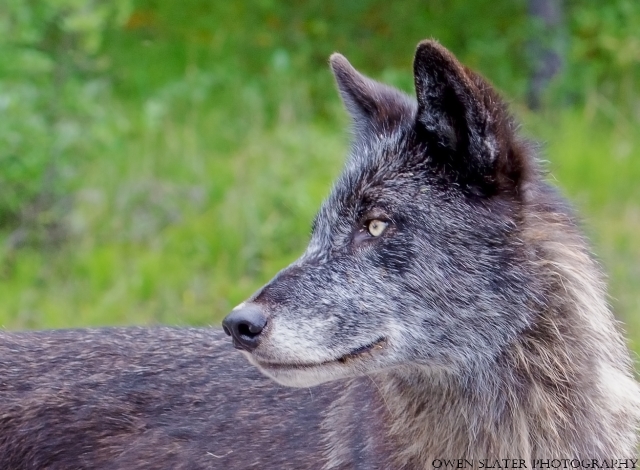
It didn’t take long to see who it was. One grey and one black pup soon appeared and followed in her footsteps through the clearing.
 With the pups close behind I only had a few seconds to get some photos before the adult lead the pups back into the forest and out of sight.
 The famous Morant’s Curve on a beautiful, moonlit night in Banff National Park.
I have been trying to get this photo for some time but finally all the elements came together. Under the light of the moon the colours in the Bow river and on trees were highlighted, while the brightest of the stars and the soft glow of light from Lake Louise became visible in the distance.
It wasn’t hard to just sit and wait for a train that night, but I didn’t have to wait long. As it lumbered along the tracks on its approach to the curve I could see the lights of a car approaching. Was I finally going to get the lights of both in the same frame? As it rounded the curve I started the exposure and for almost a minute I held my breath hoping that I had got the settings correct. Soon I had my answer…a perfect ending to another great day in the Rockies.
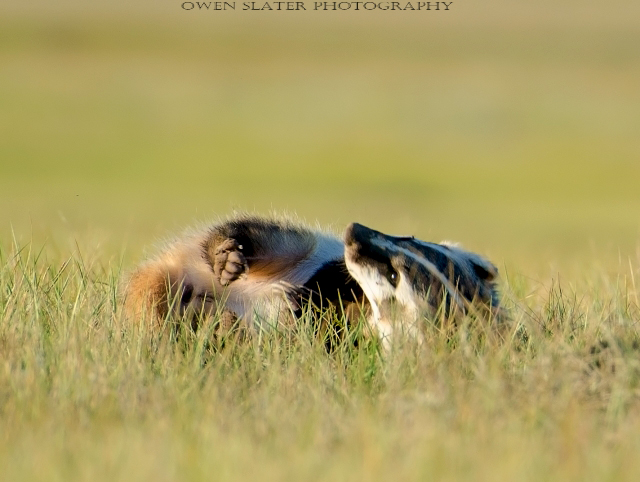 Feeling completely at ease, this young female badger played around in the grass right in front of me on another spectacular evening in Grasslands National Park. Hard not to like badgers when they are this cute!
With that, my trip to Grasslands has come to an end. It was an amazing week with memories to last a lifetime. No doubt I’m sure to be back soon!
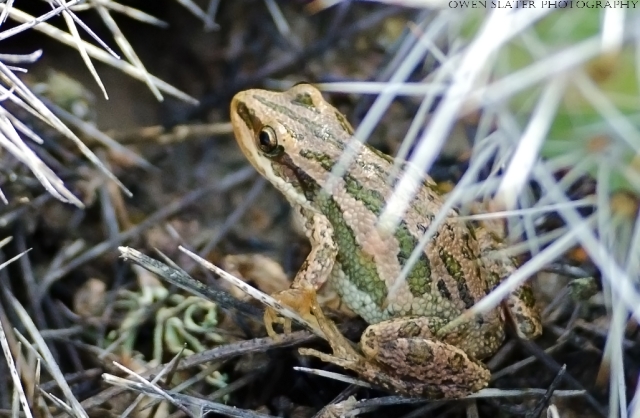 Someone loses an eye!
This little chorus frog (no bigger than a few centimeters) saw me coming while on my search for short-horned lizards and fearing that I might be a predator, headed straight for cover by hopping into a cluster of prickly pear cactus plants. Flirting with disaster, it easily maneuvered itself between the spikes in a perfect defense strategy for most would be predators. I quickly snapped off this photo and then left it be so that it could carefully extract itself from the precarious situation.
 Believe it or not, there are! A grand total of 7 native species of lizard live in Canada so while we won’t win any lizard biodiversity awards we at least have a few hardy species that deserve respect for being able to survive here. Not only that, but the one I was searching for, the greater short-horned lizard, has the unique ability to shoot blood from its eye!
Finding any of these lizards can be challenging at the best of times but compounding things is that this species is a master of camouflage, only a few inches in length and unfortunately, critically endangered due to habitat loss.
Never one to be deterred by long odds, I set out to find one. The searching process involved slowly walking along south-facing, rocky hills in a slow and meticulous manner while keeping my eyes fixed on the ground immediately in front of my feet. Only when the lizard is about to be inadvertently stepped on will it bolt from cover. Thankfully, my good luck that week continued and this one scurried from cover shortly after starting the search.
They don’t view humans as predators so I didn’t have to worry about getting a squirt of blood in my face while I photographed it! They save that secret weapon for foxes, coyotes and other would be predators. By rapidly increasing the blood pressure around their eyes, it’s believed they rupture a small blood vessel causing blood to shoot as far as 2 meters. The would be predator understandably becomes startled and distracted long enough for the lizard to run for cover, or if it was already picked up, the blood is known to be mildly noxious causing the predator to drop it! If that wasn’t enough they also have the ability to inflate their bodies with air to become a sharp, spiky balloon. With these remarkable and effective survival strategies, all they need from us is to curtail the destruction of their habitat and they should be able to survive for generations to come.


 Owen Slater Photography