
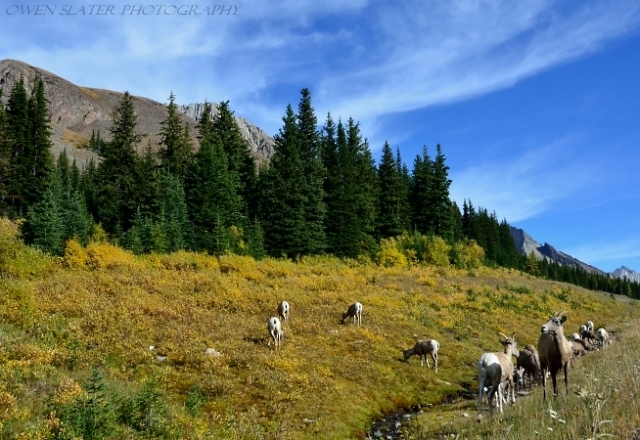
A beautiful day in K-country. Big blue skies, amazing mountains and a herd of big horn sheep near the Highwood Pass.
A beautiful day in K-country. Big blue skies, amazing mountains and a herd of big horn sheep near the Highwood Pass.

With the shorter days and colder nights, the poplar leaves are rapidly changing colour, creating beautiful mountain scenery in Sheep River Provincial Park

The Bow Valley is dominated by human presence and infrastructure that the wolf pack must navigate on a daily basis. Of the 7 pups born into the pack last year, 6 died due to either train or motor vehicle accidents. As the summer has progressed, this years litter of wolf pups are now spending all their time on the go with their parents and the yearling sibling, learning the ropes of the Bow Valley ecosystem. It won’t be easy for them to survive in this environment but so far four have managed to make it past the first few months and are quickly learning the lessons required to survive.

Well, at least it can look that way, but if you were to jump into this water you would likely be jumping out just as quickly! These turquoise waters are glacier fed which results in a fine silt reflecting the blues and greens that give them their distinct colour.
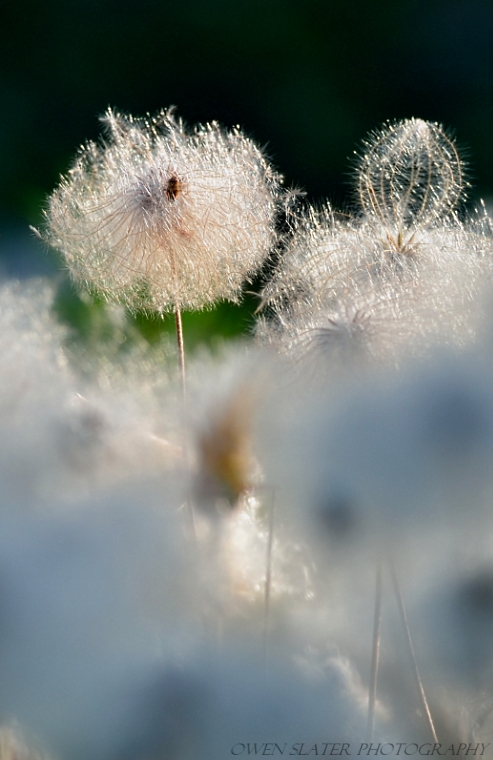
As summer comes to an end in the mountains, a field of anemone flowers turns to seed

Just as I was packing up from photographing osprey one evening I looked up and it was almost like the clouds had formed their own river coursing through the sky that mirrored the bow river below. Add in the beautiful sunset and it was a spectacular sight.

Shortly after the 4 month old pup howled I heard rustling in the bushes just ahead of me. Peering up the avalanche chute, through all the bent aspen saplings I spotted the movements of another wolf. As it entered a clearing it was clear that it was the mother. She was making her way through the trees carrying the back end of a lamb in her mouth! She made her way to the pup hiding in the forest and shortly afterwards I heard the excited cries of the reunion and then growls over the meat. If you look closely you can see the hooves of the lamb near the base of the radio-collar. Survival of the fittest in its purest form.
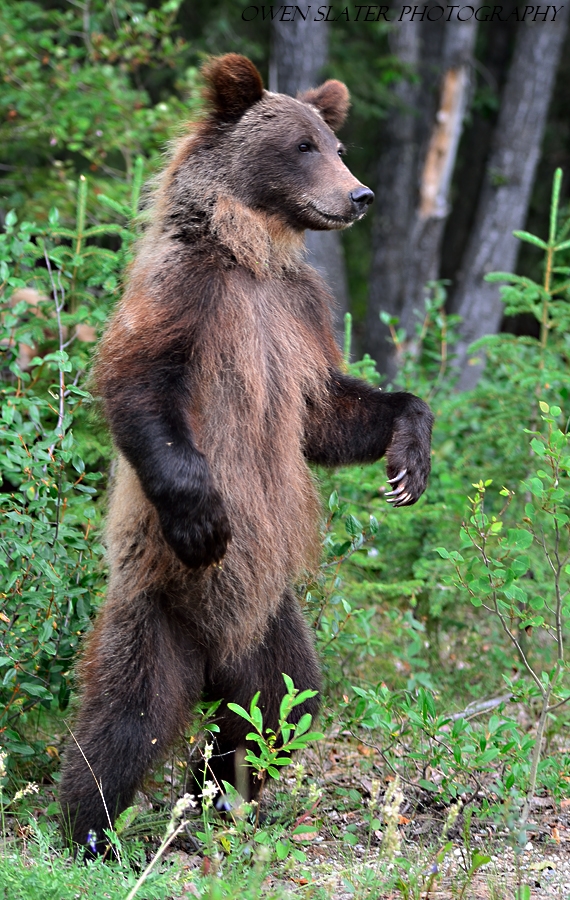
A one and half year old grizzly cub stands up to get a better vantage point of his surroundings. This year has produced a bumper crop of buffalo berries which when coupled with the high snow fall at higher elevations has resulted in the bears staying in the valleys for longer than normal. Having such long and powerful claws is of no use when feeding on the small berries. Instead, they use their very dexterous lips to grasp the berries off the stems. In an average day, an adult grizzly can consume about 200,000 berries!

I have watched this nest periodically over the summer, hoping to catch the fledglings as they take to the air. I lucked out, as I saw each one of them practice their newly discovered flying abilities. This particular bird did a low fly by over the heads of the two others, who ducked to get out of the way as they watched it soar past.
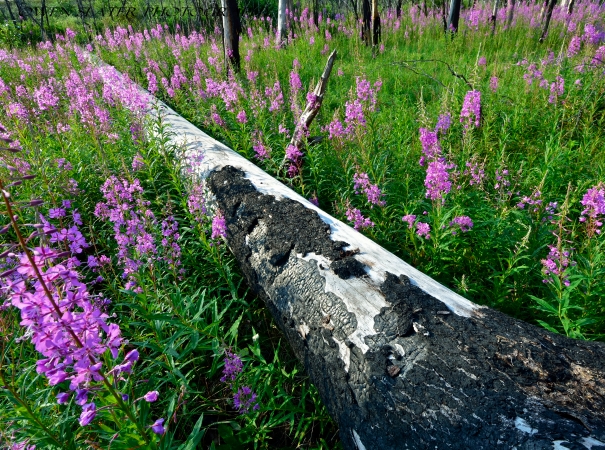
Fireweed blankets the floor of a burnt forest in Kooteney National Park in British Columbia. The plant is not named because of its association with previously burnt landscapes, but because in autumn the leaves turn a brilliant red-orange colour resembling flames.

It is relatively common to see black wolves in North America, but that was not always the case. In fact, the black colouration is actually, in evolutionary time, a recent coat colour inherited from none other then the domestic dog some 10,000 to 14,000 years ago. Genomic studies have shown that prior to this time there were no black wolves. However, this trait was common in dogs and through breeding between the two, this gene has since been incorporated into the North American wolf genome and has provided these wolves with an adaptive advantage. What that advantage is no one really knows. Theories include improved camouflage, which doesn’t hold a lot of weight when you consider that wolves are not ambush predators. Another is that black colouration is linked to other genes that enhance immune function, which would provide these individuals with an obvious advantage. However, this theory has holes as well because there aren’t any black Arctic wolves, which you would expect if black colouration provided such a clear immune advantage but. Whatever the reason, Banff National Park has one of, if not the highest proportion of black wolves anywhere. This black wolf pup is one of six pups born this spring in Banff National Park. Of those six pups, five are black.

Not a particularly great photo due to the light and background but seeing bear cubs this small is pretty rare so I had to share. These three scrambled up a steep, rocky hill, using the exposed tree roots to pull themselves up to rejoin their mother feeding on the plants above. No bigger than a few pounds, they have a lot of growing to do!

A three month old wolf pup peers out from behind a small hill in Banff National Park. This pup is one of six born this spring in Banff National Park. He is one of the bold ones, and as such tends to wander off from the den area without parental supervision to explore his new surroundings. Already, the parents are taking the pups on long hunting excursions, swimming across fast flowing rivers, avoiding grizzly and black bears, navigating the roads and railways all the while searching for their next meal. If the family is lucky, half of the pups will survive through their first year.

The mountain parks have received a tremendous amount of rain this year, resulting in very high rivers and even mudslides that have caused numerous road closures. Here, a huge uprooted tree comes to rest along the banks of the swollen Bow river, as Castle mountain emerges from the clouds in the distance.
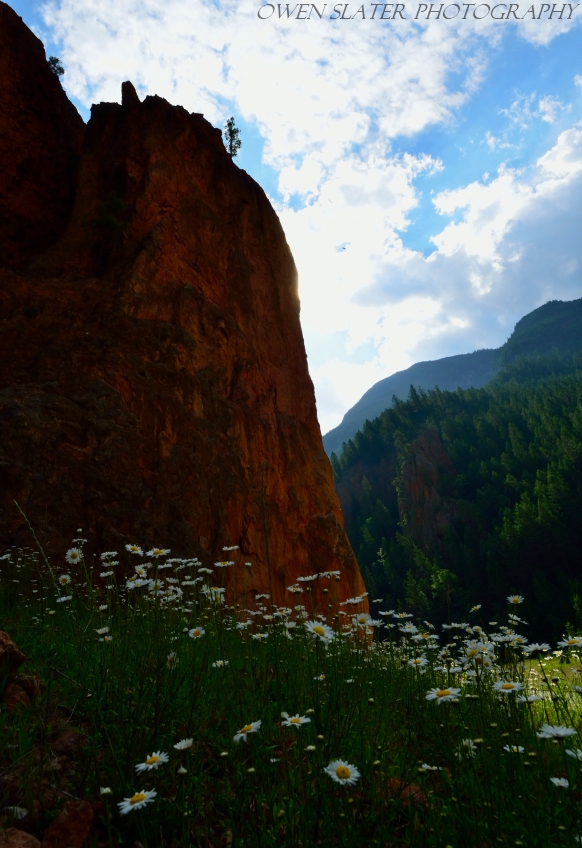
On a recent trip to British Columbia for work, a colleague and I stopped in Radium for a quick pit-stop to take some photos. This was one of my favourites.


 Owen Slater Photography