
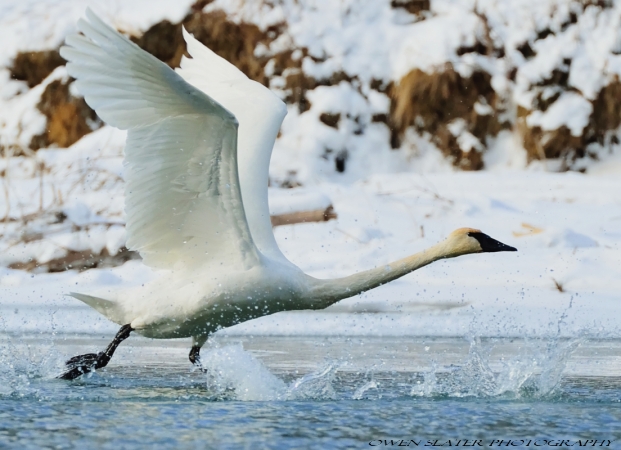
Back in Alberta last weekend, a trumpeter swan propels itself up and out of a narrow section of the Bow river that hadn’t frozen over yet.
Back in Alberta last weekend, a trumpeter swan propels itself up and out of a narrow section of the Bow river that hadn’t frozen over yet.
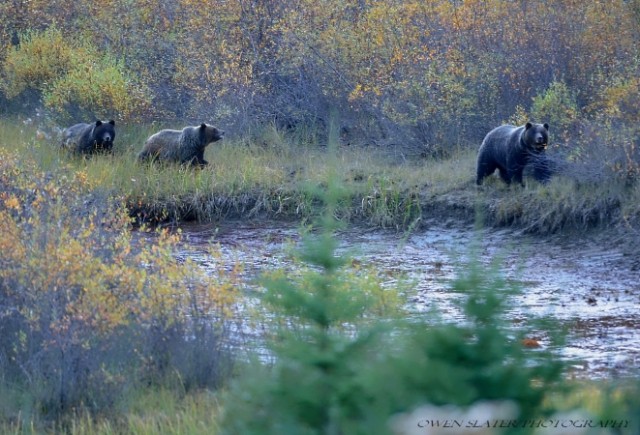
I drove out to Banff last Friday in the hopes of seeing some wildlife. Almost immediately I knew it was going to be a good day for wildlife spotting. Within a few hours I had spotted 12 mountain goats and seven different grizzlies. It was capped off by seeing and photographing the very shy grizzly mom known as bear 130. I had seen her a few times this year and I couldn’t believe how healthy and big her cubs had gotten. Bear 130 was given that name this spring when she was anesthetized to place a GPS collar on her as part of the CP rail and Parks Canada initiative to study grizzly bear mortalities in Banff National Park. Train strikes are the leading cause of death to grizzly bears in the park and every year a few are lost. Up until this weekend, for this year there had not been any known grizzly bear deaths associated with the trains. However, moose, deer, black bears and just last weekend a wolf pup had all been killed by the train, so it seemed like it was only a matter of time before a grizzly would meet the same fate.
Unfortunately, Friday night around 8:45pm was that time. Less than a two hours after taking this photo, these two cubs were hit by a train and instantly killed. Initially it wasn’t know if bear 130 had survived as she wasn’t seen for at least a day afterwards. However, on Sunday morning I was relieved to spot her walking along the tracks and quickly reported the sighting to Parks Canada staff who were thrilled to hear she was alive and well. That morning, she did not stop to feed on grain spilled between the tracks. Instead, she walked back and forth sniffing the rails, likely picking up the lingering scent of her now deceased cubs. She stayed in the area for days on end, and while we can’t know for sure why, I don’t think it is a stretch to assume it was likely because she was searching for her cubs. While the loss of two cubs is horrible, the loss of a reproductively active female would have been devastating, especially seeing as bear 130 is such a good mother that does an excellent job of staying away from high human use areas until people are not present. A testament to her skills were that both cubs were in excellent condition, and seemed to be thriving until they made a mistake.
It’s hard to know why they didn’t get off the tracks when the train approached. At night, the high powered lights of the train can be blinding. That is all they would have seen. They would not have recognized that it was a train and may have actually charged at it in self defense. Hopefully, with the data obtained from her collar, CP and Parks Canada can formulate solutions to this ongoing problem that has plagued all the wildlife in the Bow Valley. Otherwise, it will only be a matter days before the next body is collected. The only question will be, which species will be next…
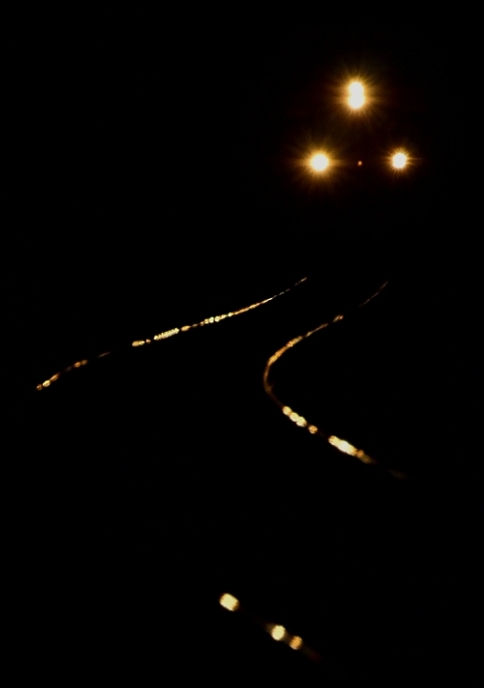
The high powered lights of a train reflect off the tracks as it travels through Banff National Park. This image is likely what the two grizzly cubs observed just before being hit. I took this photo in an effort to replicate what an animal might see when a train is approaching at night. While you would think the sound would be enough to displace the animals off the tracks, the blinding lights conceal the hundreds of tonnes of steel hurtling down the tracks towards them and the animals would not be able to recognize the size of what was approaching. Apex predators such as bears and wolves have very little to fear in their natural ecosystems and as such they often stand their ground to defend themselves. In fact, bears and particularly mothers with cubs, have been known to charge at the trains to try to scare them off. If they did try to run, they usually stick to the path of least resistance. With the headlights only highlighting the tracks directly in front of the train and not much of the surrounding terrain, the animal’s eyes would not be able to adjust and pick up escape routes along the tracts. Instead they tend to run along them in an attempt to escape. The trains move about 60km/hr through the park. At that speed, no animal will be able to outrun them, the conductor doesn’t have enough time to slow the train down, and so invariably they are run down. In rare instances, some animals have survived train strikes. Just this past winter, a juvenile wolf attempted to outrun the train, was clipped and flung into the air. It landed in some hard snow just a few inches away from the rail cars. Remarkably, the following day I watched it walking along a river bed with no obvious injuries.
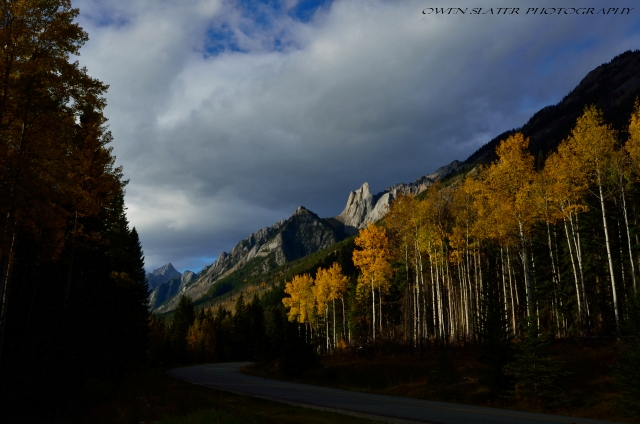
A wonderfully warm fall weekend in the park last week, with many of the aspens reaching their peak colours. Only a few days later we got our first significant snowfall of the season! Thankfully, it has warmed up again, the snow has melted and it will be a nice warm Thanksgiving weekend.
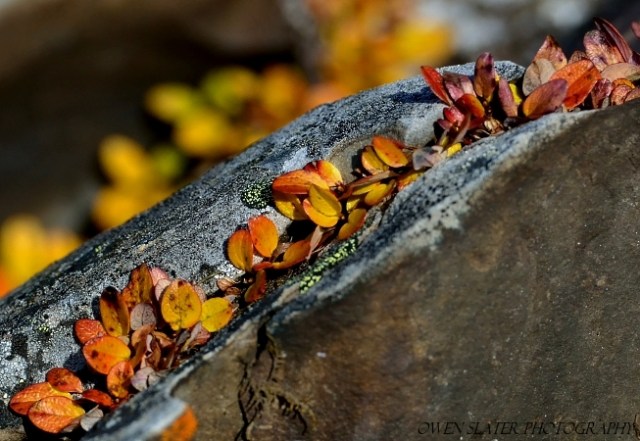 For a plant to eek out a living in the rockies requires a lot of adaptations. With cold temperatures and harsh winds throughout much of the year, they must find suitable micro-climates that can support them. The winds bring with it just enough dust that settles out over time in any nook, including rock crevices. This creates a foothold for the shallow roots, while the small lip in the rock shelters the plant from the harsh winds, radiates the heat from the sun back onto the plant and funnels water to the roots. A perfect spot for a miniature plant.
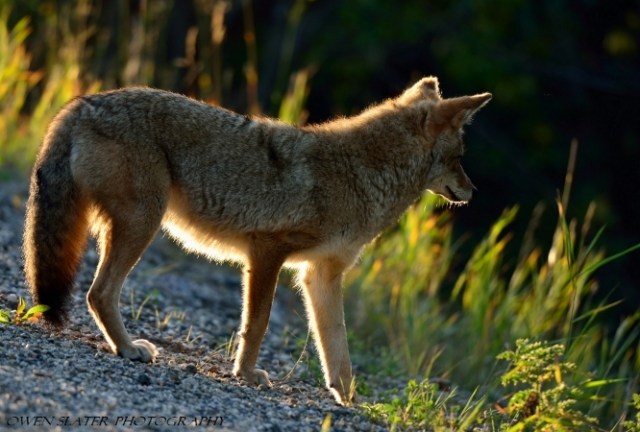
A couple of weekends ago I took some friends out to Banff to try to spot some wildlife. They were hoping to see bears and maybe even wolves, but as luck would have it we had an even rarer carnivore sighting. As I came into Banff I decided to drive up the road to a ski hill as I had seen bears, sheep and coyotes up there throughout the summer. After rounding a corner I spotted a coyote on the road headed in our direction. I quickly pulled over and stopped the car, but surprisingly it paid no attention to us. Instead it ran to the side of the road, raised its hackles and started barking at something down below. For about 10 minutes it continued barking at whatever it was. While my friends excitedly took photos of the coyote, I scanned the ravine as I knew from the coyote’s reaction that it was alarmed at whatever was below and therefore, it had to be a large carnivore! The coyote slowly walked in our direction and stopped every few minutes to bark down into the ravine. After passing my car and paying little attention to us, I turned the car around to face down the road. At this point the coyote must have lost sight of whatever it was, so like us, it sat down and waited. A few minutes later a large light brown object appeared by the side of the road. Before I had time to react it bounded across the road with the characteristic movement and shape of a cougar! A few strides later and it was on the other side of the road, leaping up the bank and disappearing into the forest. Not wanting to disturb it but also not wanting my first wild cougar sighting be so fleeting, I waited until it was in the trees before driving down to where it had entered the forest. I spotted it again as it disappeared behind some trees. Based on its direction of travel I realized it was heading in the direction of a clearing just west of where it was so I quickly drove down to the spot and waited. Sure enough, a few minutes later it appeared at the top of the clearing and walked right out into the open. It stopped and stared at us before slowly walking through the clearing and disappearing out of sight! It was such an impressive animal; a healthy adult male with massive muscles over the limbs and a powerful gait. No wonder the coyote was terrified of it! In fact, the coyote wouldn’t go into the forest for some time afterwards. Instead it patrolled the road and searched the ravines for the cougar to make sure it was gone. An adult cougar can easily catch and kill a coyote and so coyotes always have to be on the lookout for them. Thankfully for us, the coyote not only spotted it but also let me know it was around as otherwise I’m sure we would never have seen it. For those wondering where the cougar photos are, I wish they were good enough to post here, but with such low light at the time of the sighting, even at 2500 ISO the images are blurred. That’s OK for me, as I will never forget experience!

A pika takes a quick break from collecting food for the long winter to scan for predators.
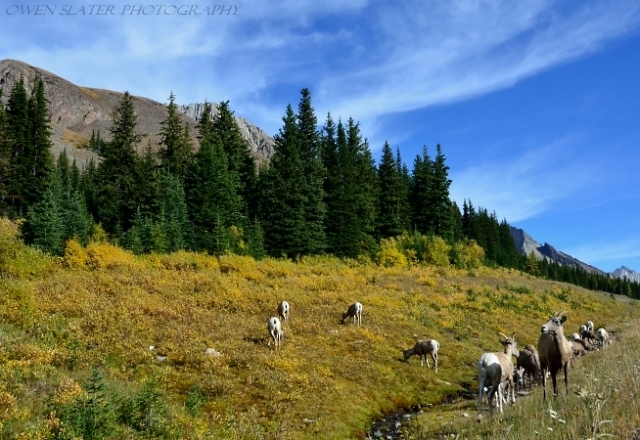
A beautiful day in K-country. Big blue skies, amazing mountains and a herd of big horn sheep near the Highwood Pass.

With the shorter days and colder nights, the poplar leaves are rapidly changing colour, creating beautiful mountain scenery in Sheep River Provincial Park

The Bow Valley is dominated by human presence and infrastructure that the wolf pack must navigate on a daily basis. Of the 7 pups born into the pack last year, 6 died due to either train or motor vehicle accidents. As the summer has progressed, this years litter of wolf pups are now spending all their time on the go with their parents and the yearling sibling, learning the ropes of the Bow Valley ecosystem. It won’t be easy for them to survive in this environment but so far four have managed to make it past the first few months and are quickly learning the lessons required to survive.

Well, at least it can look that way, but if you were to jump into this water you would likely be jumping out just as quickly! These turquoise waters are glacier fed which results in a fine silt reflecting the blues and greens that give them their distinct colour.
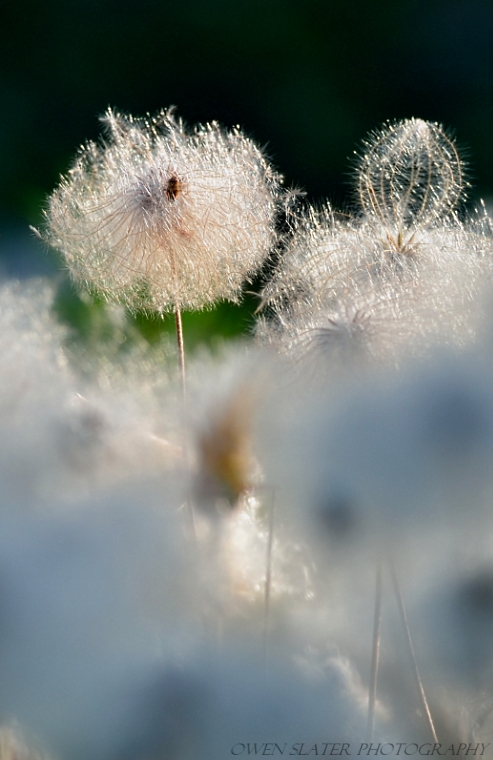
As summer comes to an end in the mountains, a field of anemone flowers turns to seed

Just as I was packing up from photographing osprey one evening I looked up and it was almost like the clouds had formed their own river coursing through the sky that mirrored the bow river below. Add in the beautiful sunset and it was a spectacular sight.

Shortly after the 4 month old pup howled I heard rustling in the bushes just ahead of me. Peering up the avalanche chute, through all the bent aspen saplings I spotted the movements of another wolf. As it entered a clearing it was clear that it was the mother. She was making her way through the trees carrying the back end of a lamb in her mouth! She made her way to the pup hiding in the forest and shortly afterwards I heard the excited cries of the reunion and then growls over the meat. If you look closely you can see the hooves of the lamb near the base of the radio-collar. Survival of the fittest in its purest form.


 Owen Slater Photography