

After a strong downpour, a bushbuck gets his coat back in order with a bit of grooming.
After a strong downpour, a bushbuck gets his coat back in order with a bit of grooming.
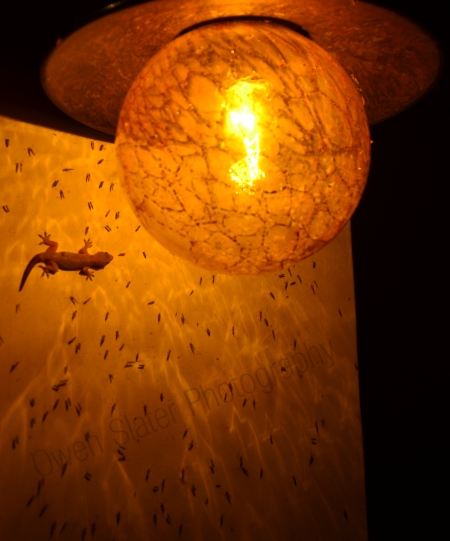
While I enjoyed a four course dinner on the patio of Mweya Safari Lodge, this gecko feasted on a one course meal of lake flies. The flies were so numerous that in some spots, not a single portion of the walls could be seen. Thankfully, they don’t bite and aren’t strong fliers so all in all I would take these any day over mosquitoes or tsetse flies.

After raiding a termite mound and not doing a good job of hiding the evidence, a dwarf mongoose scans for any predators before making a getaway.
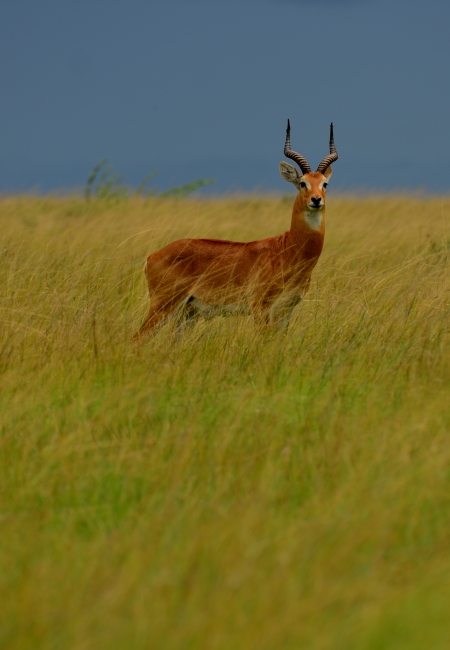
Under threatening skies, a Ugandan kob looks up from grazing on a windy day near Pelican Point in Queen Elizabeth National Park. Kob number in the thousands in QENP and are the main prey species for lions and leopards
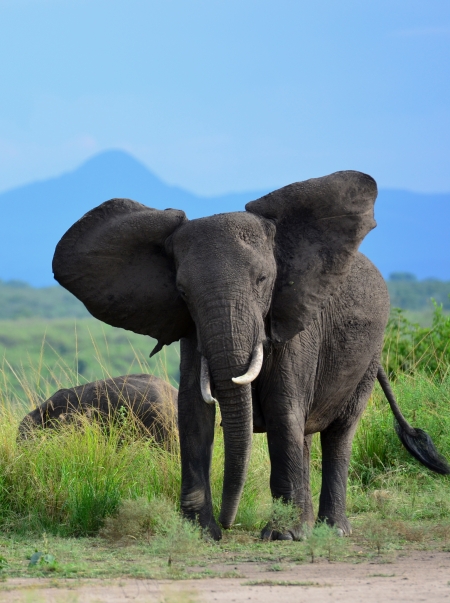
Even from a 50 meters away, this matriarch of the herd was not satisfied and made it known with her ear flapping and trunk waving. I moved further up the dirt road to give her more space to safely cross with her baby and the rest of the herd.
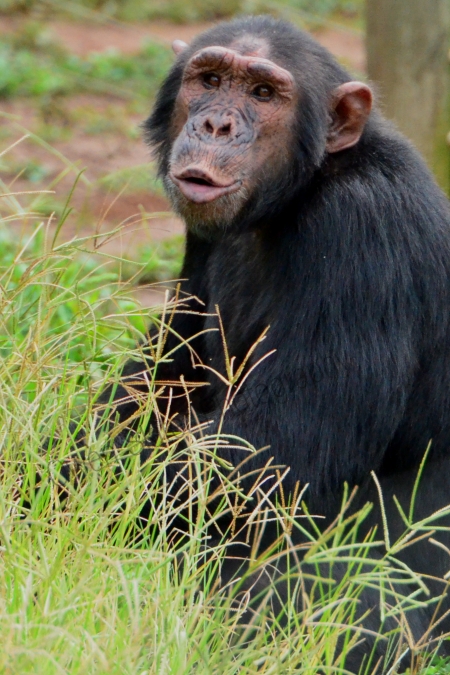
First a disclaimer…this photo was taken in captivity unlike the rest of my wildlife photographs. Baluku was about two years of age when I met him at the headquarters for the Ngamba Island Chimpanzee Sanctuary in Entebbe, Uganda. Like almost all of the chimpanzees at this sanctuary, Baluku was orphaned due to illegal poaching. His family was shot and killed for bushmeat and Baluku was taken into a town in the southeastern tip of the Democratic Republic of Congo where he was to be sold as a pet. Thankfully, he was confiscated and brought to Ngamba Island where he now lives. The sanctuary is on a 100 acre island, with about 97% of the tropical rainforest for the chimpanzees. The sanctuary has done an incredible job at not only improving the welfare of the chimpanzees, but also helping the local communities by providing them with various resources to improve their livelihoods. Outreach programs throughout Uganda educate the public about the threats to chimpanzees and other native wildlife and the need to conserve this endangered species. The sanctuary is a member of the Pan African Sanctuary Alliance (PASA), which is dedicated to animal welfare, including all aspects of primate conservation and health. PASA holds an annual veterinary healthcare workshop, which I have been assisting with for several years. The purpose of this workshop is to train national veterinarians in all aspects of primate health, including veterinary aspects related to reintroductions of great apes back into native habitats. Both of these organizations have done a tremendous amount for great apes in Africa and I encourage you to visit their websites to learn more about what they do and to make a donation.
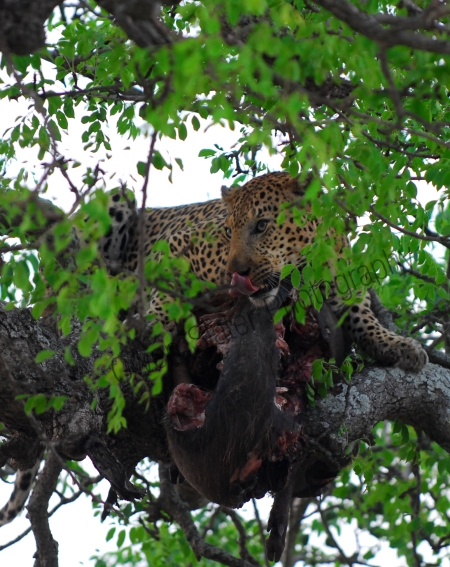
If your options were a pride of half sleeping lions along a riverbed surrounded by buffalo, waterbuck and giraffe or a warthog carcass hanging in the tree next to a major park road with no leopard in sight, where would you choose to park your car? Not a bad decision to make but that was the choice I was facing late one afternoon near the Satara campsite. It was about 4pm, which meant there were only a two hours left before everyone had to be back into campsites for the 6pm curfew. Though I never got an official answer as to why the 6pm curfew, I’m almost certain it is mainly because of poaching within the park. With no other vehicles driving around it would be very easy for park wardens to spot any flashlights, headlights, etc. out in the park and catch any poachers (which unfortunately continue to be quiet a problem within the park). An added benefit is that is gives the animals a night of piece and quiet away from all the tourists. It seemed unlikely that the leopard would come back during the day and so we returned to the pride of lions, which included adult and sub-adult males and females were resting under some large trees adjacent to a river bed. Periodically one would get up, walk a few steps and flop back down into the grass. Buffalo and waterbuck knew they were there but they also wanted to get a drink. A few brave ones kept their eyes on the lions while they quickly grabbed a drink from the opposite side of the bank. Two male giraffe were off in the distance ‘necking’ which is where the males stand side by side and swing their heads out and down until they collide against each other as a way of determining strength and dominance. The lions showed a bit of interest but even though they didn’t look like they had recently fed, they did not make any attempts to go in for a kill. After watching them for some time, it was clear they were not going to go hunting anytime soon so we decided to drive back to check if the leopard had come back to claim it’s prize. While there had been a few cars parked along the road patiently waiting for the leopard to return the first time we passed by, this time there was a traffic jam! Sure enough, a big male leopard was laying overtop of his prize gazing down at all us and periodically licking the hide like a content house cat after catching a mouse. He took a few bites but seemed restless and within a few minutes he got up and jumped down out of the tree. To my surprise a hyena was lopping under the tree gazing up at the fresh meat when the leopard came down but neither of them paid any attention to the other. The leopard walk 20 meters away and laid down in the open savannah and the hyena continued to make circles under the tree. I had lost track of time but when I looked up all the cars were gone and it was 6pm. At that point we were already going to be late to the campsite. While I couldn’t remember exactly what the punishment for being late was, the fine was surely not going to be more than $20 dollars so what was a few more minutes? We watch the leopard as he cleaned off his face and paws and the hyena eventually gave up and wondered off. As the last bit of sunlight vanished from the sky we figured it was time to get back to the campsite and so with great hesitation I turned the car around, took one last glace at the leopard and raced back to the campsite. We were 14 minutes late. The gates were locked and a stern looking guard with a rifle was standing next to the gate. He took down our licence plate in case there were future transgressions and after a stern warning he let us in!
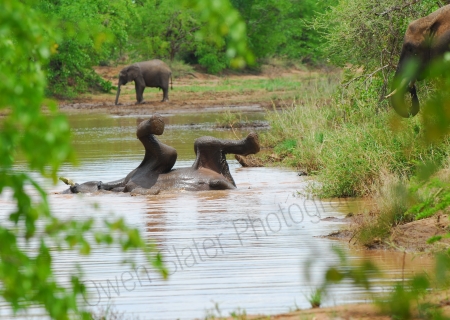
After taking a deep breath the young bull dunked his head under the water and rolled up onto his back. With his feet straight up into the air, he rolled back and forth as if he was using the bottom to scratch his back.
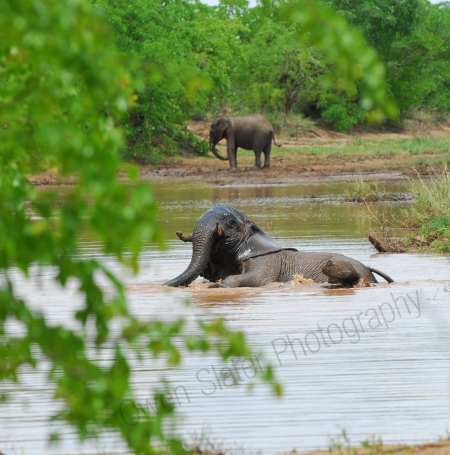
After fully coating himself in mud, this young bull elephant rolled himself up onto his feet before leisurely getting up to rejoin the rest of the bachelor herd. A few minutes later about 10 adult females and their calves emerged from the dense forest to have their turn at the watering whole. In the course of about an hour over 30 elephants stopped by the watering hole for some refreshment and play time. It was amazing to sit and watch them without them having a care in the world that we were there.
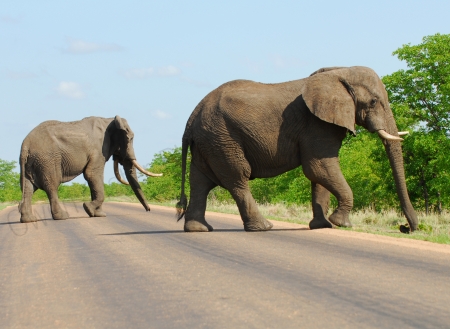 Two huge bull elephants cross the road in front of us. The rental car could have driven between their legs without touching them (although I wouldn’t recommend that you try!). The bull in the back was ancient as you can see by the length of his tusks, which grow throughout their lives. He also had very significant foot problems, especially on the left rear leg. He gingerly made his way across the road and down the slight decline. Foot problems in elephants are well documented in captivity but recent reports indicate that they are also a major cause of disease in wild elephants. In captivity, elephants receive daily foot care to maintain their feet in good condition and to recognize problems early. In the wild minor infections will heal on their own but this male had a deep infection in the left rear inner toe with a significant portion of the tissue missing which was obviously quite painful for him. Over time the infection will reach the bone causing osteomyelitis and could lead to the eventual demise of this magnificent animal.

Cheetah are one of my favorites and I had been on the lookout for them since we entered the park several days previously. On the last day we had a long drive from the Satara campsite to J’burg airport and so it was another early morning. We drove slowly down the road and spotted lots of wildlife, including sable antelope, hyena, and a chameleon. I had all but given up on seeing cheetah but as we came around a bend in the road we spotted two casually walking down the middle of the road. Initially we were the only ones around and slowly followed them along the road. However, within a few minutes another car approached from the opposite direction and instead of stopping and letting the cheetah continue to move along the road, the people drove right up to them to try and get some pictures. The cheetah calmly moved off to the left into the green grass and low laying trees and shrubs that were charred black from a recent fire. Like most of the wildlife in Kruger, they didn’t seem to mind the human attention too much and I was able to get a few decent photos below.

Cheetah jogging along searching for any signs of danger or potential prey
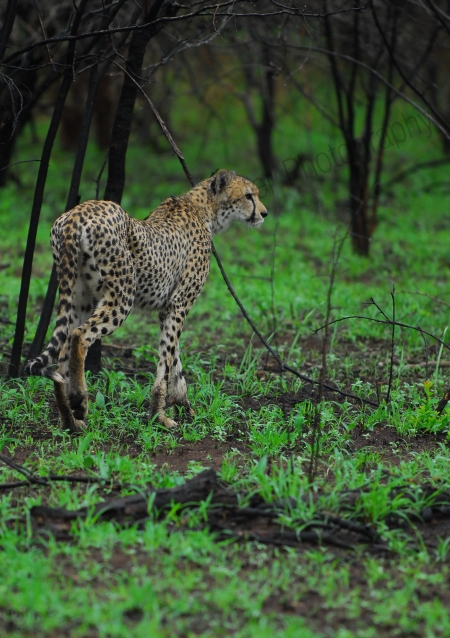
Using it’s keen sight, this young cheetah spots a herd of impala off in the distance. The siblings maneuvered to the be downwind of the herd and slowly crept closer to the herd using the few shrubs as camouflage. However, they still stood out like sore thumbs and the impala easily spotted them in the green grass. The impala emitted their warning calls to the others in the area and casually moved away from the cheetah. Seeing that the had been spotted, the cheetah relaxed and moved off into the bush to regroup. A large percentage of attempted kills by cheetah are unsuccessful and even if they do manage to make a kill, they are routinely pushed off the kill by the much more powerful lions, hyenas and leopards. These two cheetah appeared quiet young and likely just left their mother to try to attempt to establish a territory of their own. Male siblings will stay together to work as a team, while the female siblings will eventually move off to hunt on their own.
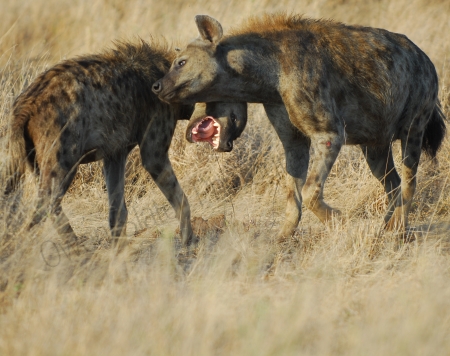
A young hyena bars it’s teeth while assuming a submissive posture to a much larger adult. Female hyena are larger and more dominant than males. Offspring born to the dominant female automatically assume the next highest rank in the group. Their powerful jaws are among the strongest in the animal word and allow them to crush and eat bones.


 Owen Slater Photography