Latest Entries »

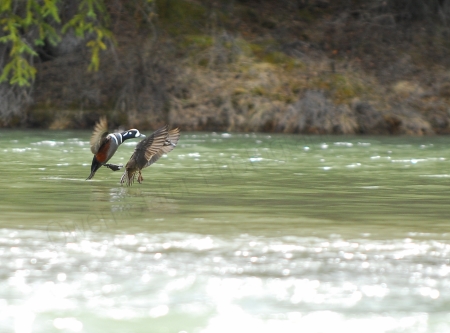
This spring I saw numerous Harlequin ducks which are one of my favourites. These birds fly over the Rocky Mountains each spring to spend a few months in Alberta surfing the fast flowing waters for food and to nest before migrating back to the coast in the fall to spend the winter in the ocean.

This grizzly wandered through the meadow, periodically eating dandelions and digging for tubers. I saw it about an hour later as it strolled through Johnston campground. Thankfully the campground had just opened and so it wasn’t that busy.  However, I was surprised that park staff didn’t go around and alert the campers of the bear walking through the campground so I made a quick loop and let everyone I came across know what was going on. Some just nodded and said thanks, others panic and jumped into their cars .   Luckily the bear just skirted the outside portion of the campground and showed no interest in the occupants or their food.

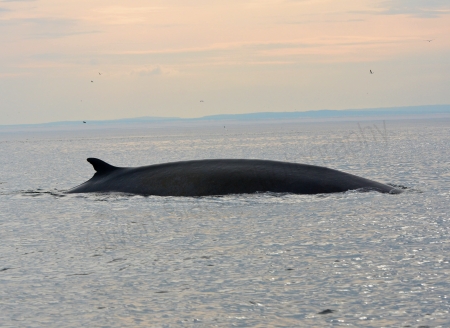
With no other boats around and a quiet, calm morning on the water we were able to slowly drift in the current beside this fin whale while she swam along.  I can still clearly remember the sound of her breaking through the water’s surface and forcibly exhaling before taking another breath and slipping back beneath the water.

This magnificent female fin whale has been returning to the St. Lawrence every year since 1989!  While it’s hard to appreciate the scale in this photo, this whale is huge.  Fin whales are second to only blue whales in terms of length (up to 27 metres or close to 90 feet) and weight (45,000-64,000 kg or 50-70 tons).  You would think with this much mass that they would be very slow swimmers, but they are actually one of the speediest, reaching speeds of up to 37 km/hr or about 20 knots.  This one was taking a bit of a break from feeding on krill and was just lounging around when we visited it.

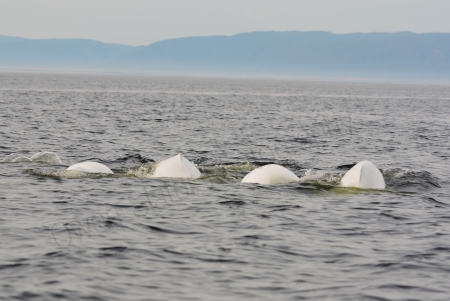
While not a great photo of these belugas, it was still a very neat experience. In addition to the four adults, two infants were present as well. This sub-population is geographically isolated from the populations in the north and has been struggling to survive of late. There are only about 1000 individuals in and around the estuary and despite efforts to protect them over the past decade their numbers have not increased, which is not surprising given that they have some of the highest levels of pollutants (mercury, PCBs, etc.) recorded in marine mammals.  Hopefully with the creation of the marine national park and additional measures (limiting pollutants from factories, reducing the amount of boat traffic in critical areas of their habitat) this population will start to rebound.

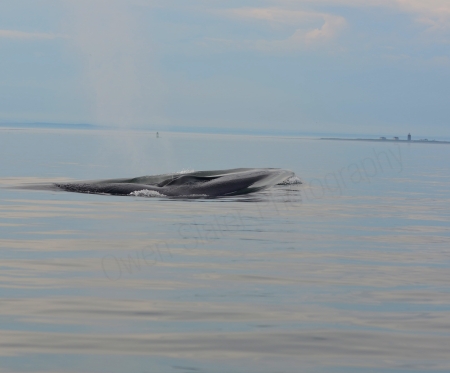
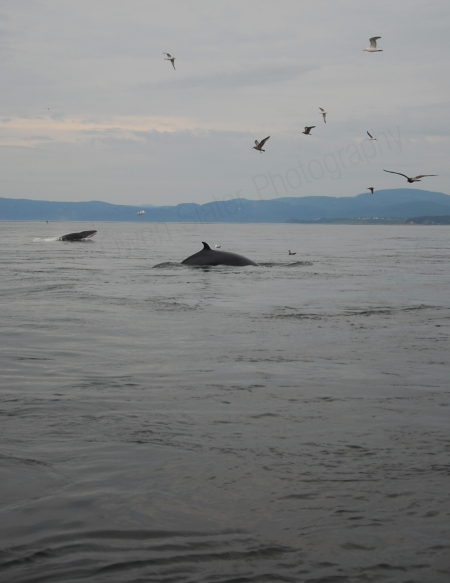
Apparently the St. Lawrence estuary is still a relatively unknown location for whale watching at this time of year (though they get about 1.1 million visitors per year), which is surprising given how numerous the whales are during August through September. A total of 13 different whale species can be seen in the estuary. They come for the abundant food created by the nutrient rich, cold, oxygen saturated waters.  In under two hours we spotted minke, fin, and beluga whales as well as grey seal and harbor porpoise.  With the early morning start (7am) we were the only boat around, the waters were calm and the whales were actively feeding. This photo, as with many, was a bit of good luck.  With the wide angle lens on the camera focused on the closet whale, the one in the background burst through the water just as the photo was taken and captured the head and white chin of these whales.

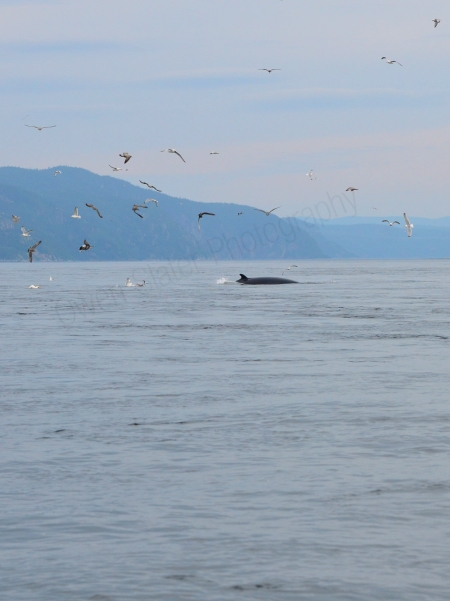
The best way of predicting where the minke whales would surface was by watching the herring gulls. The gulls, initially circling above, would spot concentrations of krill, land and start feeding just before a whale would explode through the water surface and gulp down as many of the invertebrates as they could. The gulls would quickly have to get out of the way or risk being collateral damage from the feeding whales!

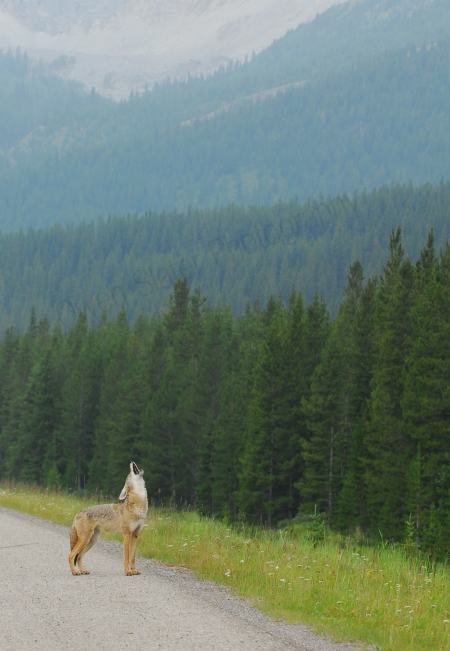
Most wildlife I see outside the national parks almost always runs off into the forest to get a safe distance away from people. Coyotes are no exception.  They are incredibly smart, and so adaptive that some have learned to live exclusively in major cities preying on urban wildlife (and the occasional cat or dog).  Efforts to rid them from the country side have failed and in fact it usually results in the coyotes adapting to the point that their numbers increase. This lone coyote was sleeping on the shoulder of the road.  I slowly approached then stopped my car and turned off the engine. The coyote continued to sit on the road but eventually got up, stretched and yawned and then proceeded to howl.  It did this several times, but without getting a response back, it slowly wandered off in search of some unsuspecting ground squirrels.

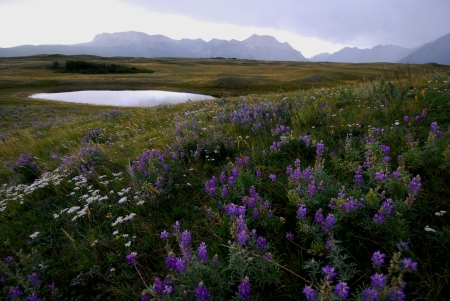
Spring in K-country is one of the most beautiful places I have ever seen! It certainly makes up for the long, harsh winters. Thousands of wildflowers (mostly indian paintbrush in this photo) in the valleys with the backdrop of mountains and coniferous trees.  The best part…only an hour away from where I live.

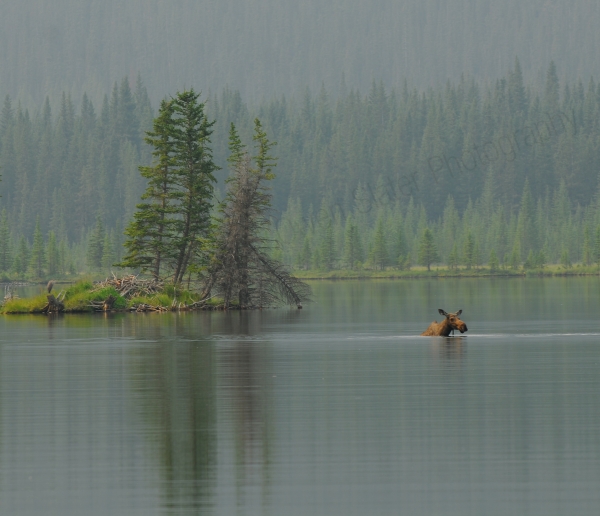
Last year was a very wet summer in southern Alberta and the result was a lot more insects. I have been trying for years to get photos of dragonflies in flight but they are so quick and their flight so erratic that I never managed to get a photo I was happy with. After going down to the shore of a pond to photograph a moose I noticed what seemed like hundreds of dragonflies flying around.  Each dragonfly seemed to have a defined aerial territory that it would defend against if another dragonfly entered it’s airspace.  After chasing off the invaders they would return to the same general area to hover and wait.  After watching the same dragonfly for some time I figured out where along the shore I should sit to have the best chance of photographing it while it was hovering.  One afternoon and hundreds of photographs later I managed to get a few I liked. This photo was taken with the pond and clouds reflecting in the water behind the dragonfly. As for the type of dragonfly, it is either a paddle-tailed or lancet-tipped darner.  Apparently you can ID them based on the tail anatomy but unless you find a dead one it’s pretty hard identifying them in flight even with still photographs.

I took this photo last summer in Banff National Park along the 1A highway. I’m not sure what the flower is but the bumble bee certainly liked it. It went from flower to flower for well over 10 minutes.

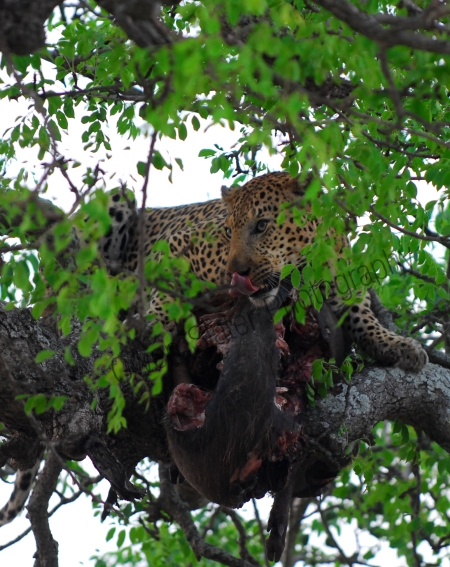
If your options were a pride of half sleeping lions along a riverbed surrounded by buffalo, waterbuck and giraffe or a warthog carcass hanging in the tree next to a major park road with no leopard in sight, where would you choose to park your car?  Not a bad decision to make but that was the choice I was facing late one afternoon near the Satara campsite.  It was about 4pm, which meant there were only a two hours left before everyone had to be back into campsites for the 6pm curfew. Though I never got an official answer as to why the 6pm curfew, I’m almost certain it is mainly because of poaching within the park.  With no other vehicles driving around it would be very easy for park wardens to spot any flashlights, headlights, etc. out in the park and catch any poachers (which unfortunately continue to be quiet a problem within the park). An added benefit is that is gives the animals a night of piece and quiet away from all the tourists. It seemed unlikely that the leopard would come back during the day and so we returned to the pride of lions, which included adult and sub-adult males and females were resting under some large trees adjacent to a river bed.  Periodically one would get up, walk a few steps and flop back down into the grass. Buffalo and waterbuck knew they were there but they also wanted to get a drink. A few brave ones kept their eyes on the lions while they quickly grabbed a drink from the opposite side of the bank. Two male giraffe were off in the distance ‘necking’ which is where the males stand side by side and swing their heads out and down until they collide against each other as a way of determining strength and dominance. The lions showed a bit of interest but even though they didn’t look like they had recently fed, they did not make any attempts to go in for a kill. After watching them for some time, it was clear they were not going to go hunting anytime soon so we decided to drive back to check if the leopard had come back to claim it’s prize.  While there had been a few cars parked along the road patiently waiting for the leopard to return the first time we passed by, this time there was a traffic jam!  Sure enough, a big male leopard was laying overtop of his prize gazing down at all us and periodically licking the hide like a content house cat after catching a mouse.  He took a few bites but seemed restless and within a few minutes he got up and jumped down out of the tree.  To my surprise a hyena was lopping under the tree gazing up at the fresh meat when the leopard came down but neither of them paid any attention to the other. The leopard walk 20 meters away and laid down in the open savannah and the hyena continued to make circles under the tree. I had lost track of time but when I looked up all the cars were gone and it was 6pm.  At that point we were already going to be late to the campsite.  While I couldn’t remember exactly what the punishment for being late was, the fine was surely not going to be more than $20 dollars so what was a few more minutes?   We watch the leopard as he cleaned off his face and paws and the hyena eventually gave up and wondered off.  As the last bit of sunlight vanished from the sky we figured it was time to get back to the campsite and so with great hesitation I turned the car around, took one last glace at the leopard and raced back to the campsite. We were 14 minutes late. The gates were locked and a stern looking guard with a rifle was standing next to the gate. He took down our licence plate in case there were future transgressions and after a stern warning he let us in!