Category: Mammals


My favourite photo from my recent trip up to Jasper. During the trip I saw numerous moose, but usually they were hiding amongst the trees which made getting good photos rather difficult. On the last day, I spotted this female along the shores of Medicine Lake at sunrise.  The lake was at the lowest I have seen with the deepest part of the lake only a few feet deep. This allowed the moose to get to vegetation at the bottom of the lake that it wouldn’t normally have access to.  I spent a few hours photographing this female as she moved along the shore and into the lake. However, it wasn’t until I climbed up and was heading back to my car that I turned around and noticed this great angle and back-lighting.  A few cars drove by as I waited for the moose to turned a bit to allow me to get a profile shot. I figured the other people either had seen a lot of moose before and weren’t interested in stopping, or they thought it was just another rock partly submerged in the lake!   With that in mind I included the foreground rocks in the photo which I think makes it a much more interesting image.

A 2011 pup cautiously crosses the road in front of several vehicles. While the TCH is fenced, the Bow Valley Parkway is not and as a result the speed limit is reduced to 60km/hr. However, lots of people don’t follow the posted limits even with warnings about wildlife being on the roads. Shortly before I took this photo someone raced past me at over 80km/hr. If they had know that they were speeding past a pack of wolves they likely would have kicked themselves.  So if you are lucky enough to travel this road, please follow the speed limits and keep your eyes peeled for wildlife. You may end up seeing something you have never seen before.

This past weekend in Waterton was unseasonably warm with Saturday above 30 degrees Celsius and little to know wind. Excellent weather for enjoying the park, but I knew that the black bears would be suffering from the high heat and lack of wind and would likely be searching out water to cool off. When I first came across this big male black bear he was busy feeding on berries.  However, after about an hour of being in the direct sunlight he was panting heavily and he kept looking over a small ridge in the direction of a  creek. Within a few minutes he lumbered through the Saskatoon berry bushes, through a small cluster of aspen trees before heading  down the rocky shoreline.  I quickly went to the opposite side of the creek and got into position as he descended the bank.  Without hesitation he walked into the creek and laid down, first on one side and then the other making sure to get as much of his body covered in the cool fast running water.  His panting quickly stopped and for several minutes he just laid in the water…the human equivalent of lounging in the pool with a cold drink in hand!  But a bear in the fall has an insatiable hunger.  They need to eat almost constantly to put on enough weight to survive the winter and so I’m sure his hunger for food quickly overrode his temporary relief from the heat.

Sufficiently cooled off, he makes his way across the creek in search of more food.

Having made his way through the grasslands, his powerful sense of smell lead him to a cluster of berry bushes shaded by the the aspen and poplar forests. The large mountain in the background is Mt. Vimy.

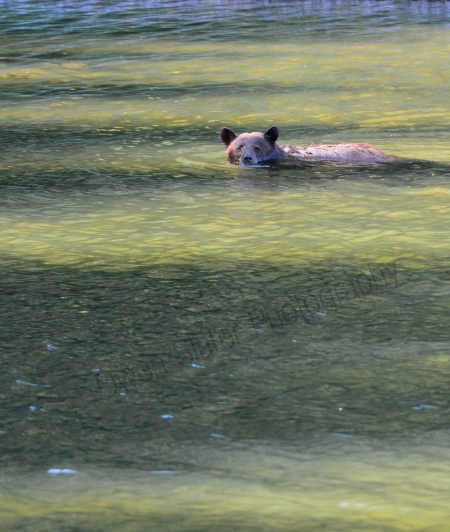
About ten minutes after leaving the big male bear at the base of Mt. Vimy I decided to try my luck at another lake that I have seen black bears swimming in before. Literally within a few minutes of walking along the lake I spotted something swimming on the other side.  From a distance I initially thought it was a beaver because of the distance it was away from the shore and only its head was above the water, but as I got closer and zoomed in with my telephoto lens I realized it was a black bear swimming around the lake!  I couldn’t believe my luck!  It had been 5 years since I last saw a bear in this lake.  I started fumbling with my camera gear hoping that I could capture a few decent photos before she got out of the water. She swam for about 50 meters before she looked in my direction but if she spotted me, she did not care that I was there as she continued along until she reached a shallow point at the tip of the lake.  This photo was taken just prior to that. The dark areas in the water are the shadows cast by the huge pine trees surrounding the lake.

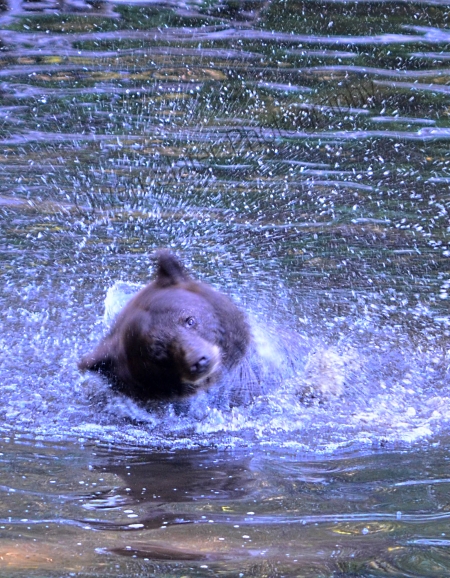
Once she reached the shallow tip of the lake she splashed and rolled around getting her head and ears wet.  I guessed that she would begin to shake her head and so I quickly selected a shutter speed that I hoped would capture the motion of her head shaking and radiating water droplets while keeping her eye in focus. I have been trying for years to get photos of wildlife doing this behaviour but each time I have been a bit off with the shutter speed and aperture with the image either too blurry or too static. This time I got lucky! She turned and faced me before shaking her head back and forth to get the water off her face and ears.  For sure, one of my favourite photos to date.

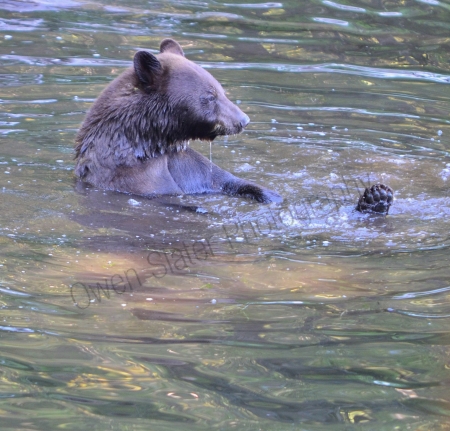
Still not caring that I was nearby, she rolled around in the shallow water playing with sunken sticks like they were bath toys.  She then lifted up her back feet, laid back and surveyed the lake.  A few moments passed before she decided bath time was over. She casually waded over to the shore, walked up the bank and instead of shaking the water off she just drip dried as she disappeared into the pine forest in search of more berries to eat.  Certainly the best few hours of black bear photography that I have had to date and an experience I won’t forget.

I almost stepped on this day old fawn as I made my way along the shoreline of a small pond in Waterton.  It didn’t make a noise or move a muscle even when I was a few feet away. I quickly took a few pictures and continued up the shoreline. I wasn’t more than about 20 feet away when I heard the mother coming back to check on it. I hid in the brush but she must have caught my scent and let out a warning call to make sure the fawn stayed hidden.  When deer and elk fawns are this small they can’t keep up with the adults and so the mother’s routinely leave them for several hours to go feed before coming back to nurse them.  Therefore, if you come across a fawn in the grass don’t assume that it is orphaned. Just leave it be and the mother will return within a few hours.

This grizzly wandered through the meadow, periodically eating dandelions and digging for tubers. I saw it about an hour later as it strolled through Johnston campground. Thankfully the campground had just opened and so it wasn’t that busy.  However, I was surprised that park staff didn’t go around and alert the campers of the bear walking through the campground so I made a quick loop and let everyone I came across know what was going on. Some just nodded and said thanks, others panic and jumped into their cars .   Luckily the bear just skirted the outside portion of the campground and showed no interest in the occupants or their food.

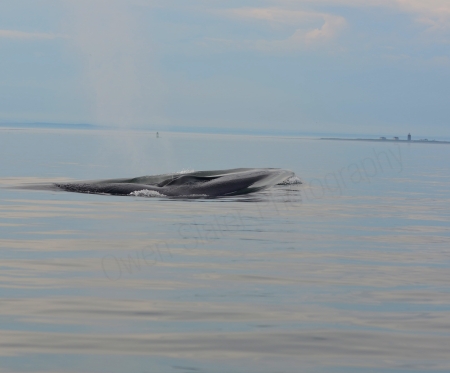
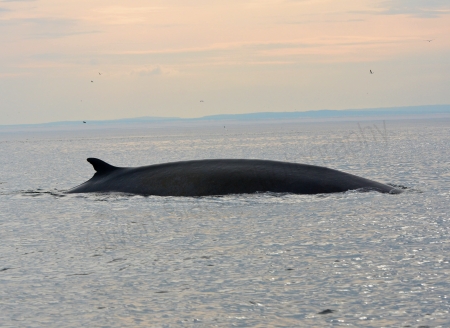
With no other boats around and a quiet, calm morning on the water we were able to slowly drift in the current beside this fin whale while she swam along.  I can still clearly remember the sound of her breaking through the water’s surface and forcibly exhaling before taking another breath and slipping back beneath the water.

This magnificent female fin whale has been returning to the St. Lawrence every year since 1989!  While it’s hard to appreciate the scale in this photo, this whale is huge.  Fin whales are second to only blue whales in terms of length (up to 27 metres or close to 90 feet) and weight (45,000-64,000 kg or 50-70 tons).  You would think with this much mass that they would be very slow swimmers, but they are actually one of the speediest, reaching speeds of up to 37 km/hr or about 20 knots.  This one was taking a bit of a break from feeding on krill and was just lounging around when we visited it.

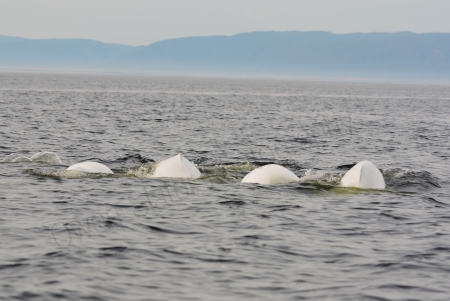
While not a great photo of these belugas, it was still a very neat experience. In addition to the four adults, two infants were present as well. This sub-population is geographically isolated from the populations in the north and has been struggling to survive of late. There are only about 1000 individuals in and around the estuary and despite efforts to protect them over the past decade their numbers have not increased, which is not surprising given that they have some of the highest levels of pollutants (mercury, PCBs, etc.) recorded in marine mammals.  Hopefully with the creation of the marine national park and additional measures (limiting pollutants from factories, reducing the amount of boat traffic in critical areas of their habitat) this population will start to rebound.

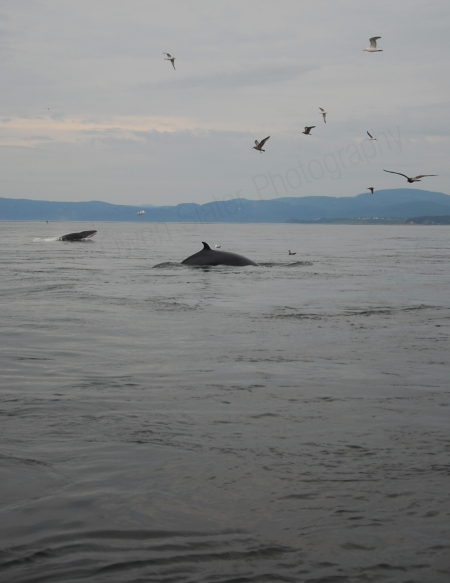
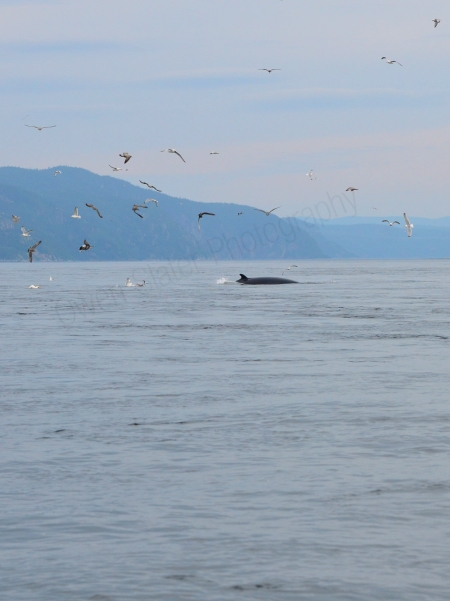
Apparently the St. Lawrence estuary is still a relatively unknown location for whale watching at this time of year (though they get about 1.1 million visitors per year), which is surprising given how numerous the whales are during August through September. A total of 13 different whale species can be seen in the estuary. They come for the abundant food created by the nutrient rich, cold, oxygen saturated waters.  In under two hours we spotted minke, fin, and beluga whales as well as grey seal and harbor porpoise.  With the early morning start (7am) we were the only boat around, the waters were calm and the whales were actively feeding. This photo, as with many, was a bit of good luck.  With the wide angle lens on the camera focused on the closet whale, the one in the background burst through the water just as the photo was taken and captured the head and white chin of these whales.