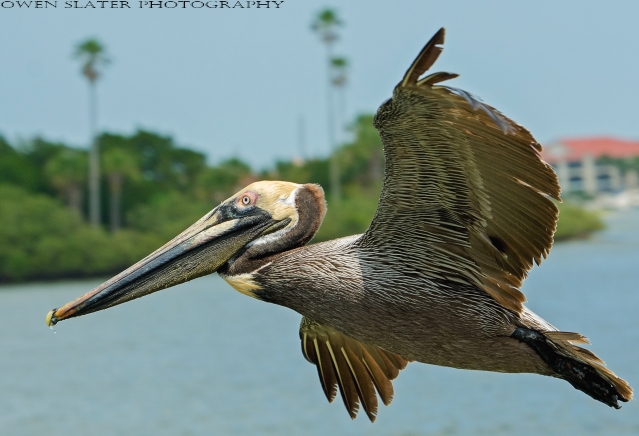
Hard to beat eating the best locally caught, grilled Mahi Mahi steak I have ever tasted, while sipping on a gin and tonic and watching brown pelicans and Atlantic bottlenose dolphins fishing in the inlet next to our table at the Dolphin View restaurant near New Smyrna, Florida.
Archive for May, 2013
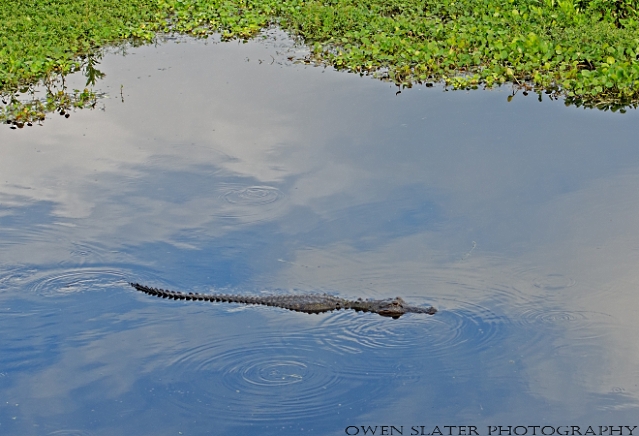
On a recent trip down to Florida to attend a wonderful wedding and visit with some great friends, I was treated to being taken around to some local spots for some wildlife photography. This photo was taken near Gainesville about an hour before sunset. A few alligators were resting along the banks until this one slid into the calm water as fish ripple at the surface. With the sky reflecting off the water and the hyacinth appearing to float above the clouds the photo has a surreal look to me.
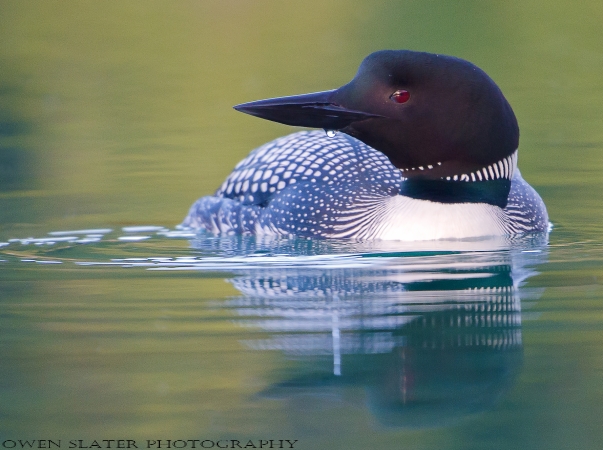
There are few sounds in nature that signify wilderness and pristine waters than that of the song of a loon. They are one of my favourite signs of spring in the mountains and it’s always a thrill to see them! I lucked out with this one as it actually approached me when I noticed it along the river’s edge.
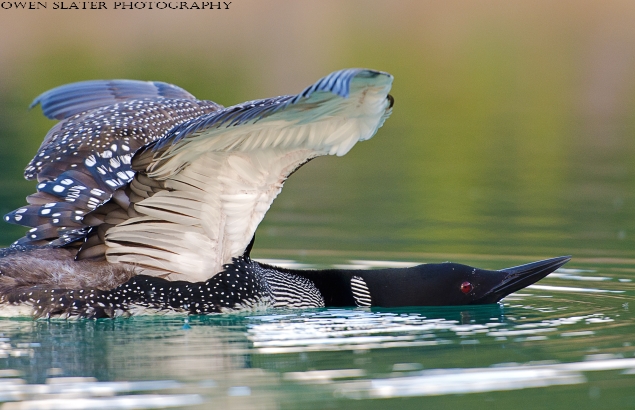
The loon swam closer and closer before it stopped a short distance away. I’m not sure if it saw its reflection in my lens or if he was displaying for some other reason, but whatever the cause he proceeded to give me a wonderful territorial display by stretching out his neck and legs and lifting his wings. After getting a few photos of this interesting behaviour I packed up my gear and left him be as he resumed his fishing nearby.
I had hiked in to a spot beside a river to look for wildlife but nothing was around at the time. Instead of leaving, I decided to lay down and have a nap in a spot that if something did show up I would be a in a good spot to get photos. I quickly drifted off for a light sleep for about an hour. When I woke up I scanned the area before I sat up, but again I didn’t see anything. Figuring I should move on I sat up and almost immediately this grebe popped up in the water about 20 feet away. I waited until it dove back under the water before I moved back into position and waited. My wait wasn’t very long. It surfaced right in front of me and stayed there just long enough for me to get a few photos.
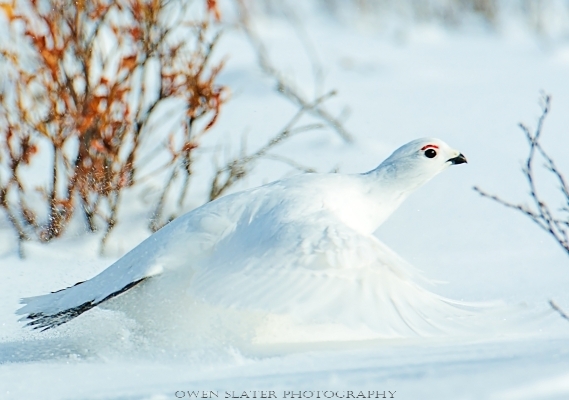
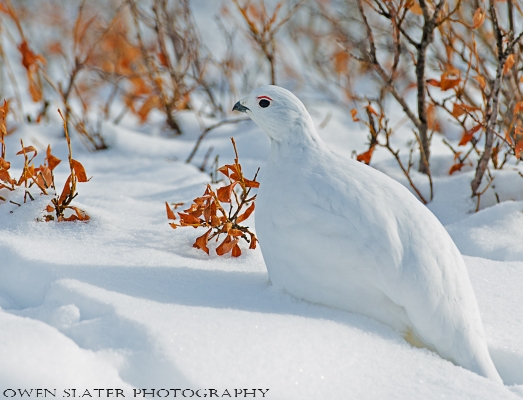
One of the other hardy species I came across on a daily basis in Denali where the willow ptarmigan. With their almost all white feathers apart from the red upper eyelashes and their black tails, they are sometimes hard to find. Fittingly, this one made its way through some willow bushes to browse on the freeze-dried leaves. These birds are quiet adaptable. When storms blow in or when predators are around they will fly into the snow and bury themselves beneath it to either wait out the storm or avoid being seen.
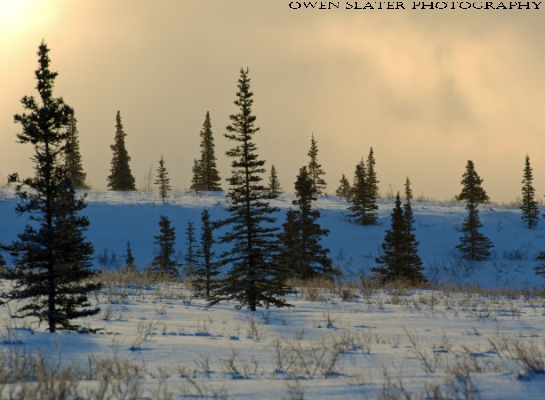
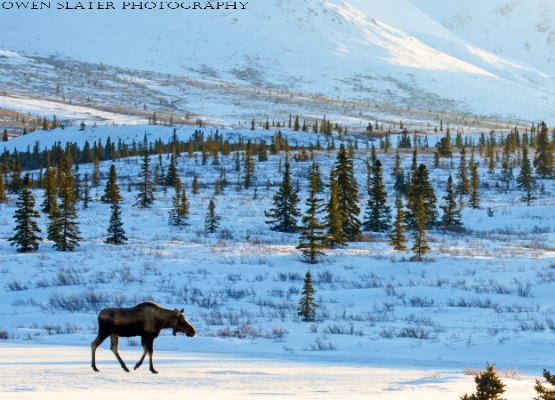
On a recent trip up to Alaska for some work with caribou, I took a quick detour down to Denali National Park to get in a few days of photography before the real work started. It was mid April and the road into the park was still barely even open. Night time temperatures were around -20 Celsius and a balmy -5 during the day! Early on the first morning I came across this cow moose as she made her way across a still frozen pond. Golden eagles had returned. but other than that there were few signs of spring. However, the wonderful sound of silence, the few hardy animals I came across and the amazing surrounding scenery was still well worth the detour.
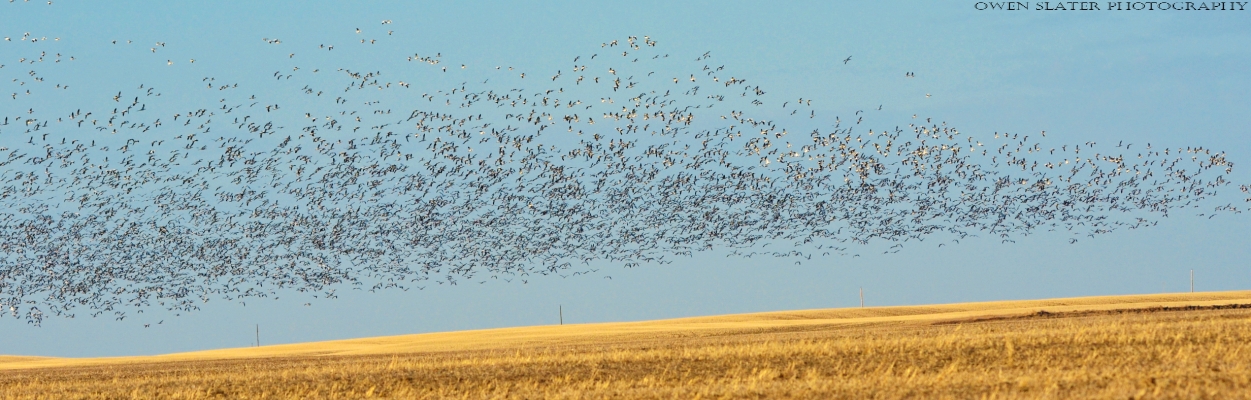
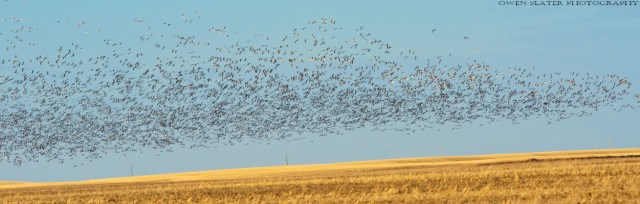
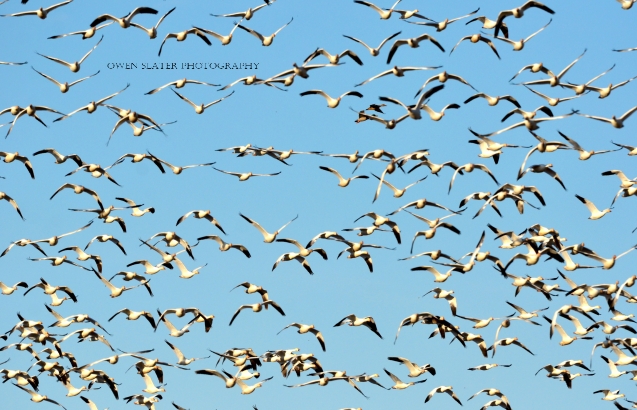
One of the most remarkable wildlife sights I have ever seen happened by chance on the drive back from Yellowstone last month. Initially it started off with a relatively small flock of about 50 snow geese passing overhead. Soon I noticed another flock and then another, but it wasn’t until I glanced west to take in the Rockies on a clear, beautiful day that I saw almost the entire western horizon dotted with these geese! I had heard about the snow geese migration, but I had never witnessed it before. To see hundreds of thousands of birds in the sky at once was so amazing I had a hard time keeping my eyes on the road. As luck would have it, a large majority of them were headed in our direction. No more than a few kilometers up the road, thousands of these birds starting landing in a farmer’s field. This must have been a cue for the rest of the massive flock to land for the night, because within minutes there were thousands upon thousands of snow geese fluttering to the ground while making their distinctive calls along the way. I found a side road to turn off onto and started firing off photos. In the below photo a small fraction of the goose flock flew overhead. See if you can spot another species of bird in with the geese.
A few minutes later, about a 1 kilometer stretch of the field was covered with these geese. They continued to honk as they gobbled up grain, which prompted the geese still in the sky to circle around and start landing as well. Within 10 minutes there were hundreds of thousands of birds on the ground!
There are a few examples of animals that have adapted to living with the billions of us! Snow geese are one of these. Their population has grown to over 5 million breeding birds, a 300 fold increase since the 1970’s! Much of this has been attributed to the rapid agricultural expansion that has occurred in the west, creating a smorgasbord of food for these birds as they make their way to and from the Arctic every Spring and Fall. Other possible factors include rising Arctic temperatures. However, that only partly explains their population expansion. A lot of it also has to do with their behavioural adaptation to a changing environment. Historically they fed in marshes but a few of the smart ones or maybe by chance some stumbled across the fact that people leave tonnes of uneaten food in the fields every year. With the flat rolling prairies it’s also easier to see predators approaching from a distance or from the sky. This new-found migration strategy must have been passed along to the point that almost all the geese stop over in these fields to fuel up before continuing their journey.
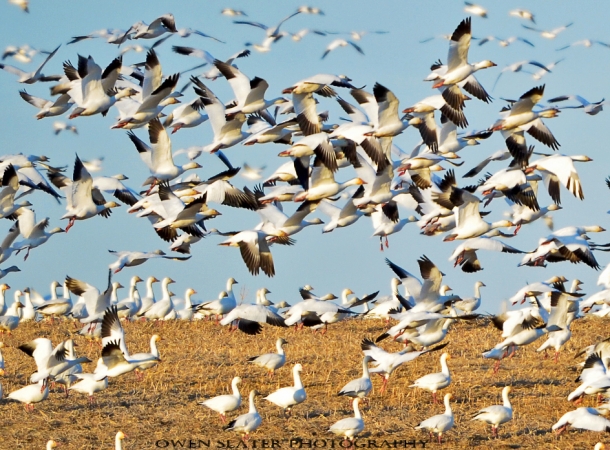
Below is a photo of the organized goose chaos. Multiply this photo hundreds of times and you will get an idea of what it was like to be next to this massive flock. It’s remarkable that they manage to coordinate their movements enough that they are able to land, take off and feed without colliding into each other and plummet to the ground. It certainly is an experience I will never forget.
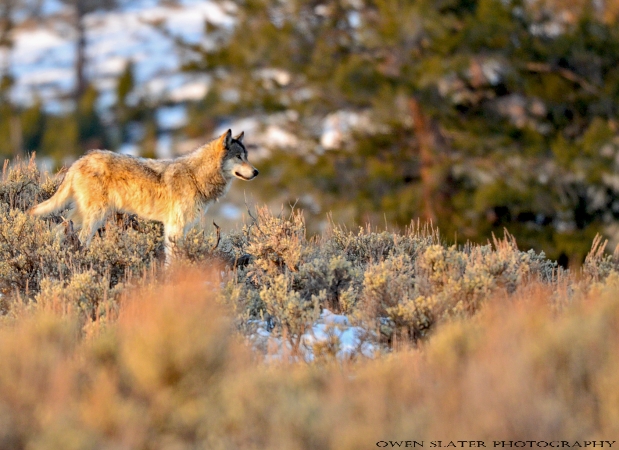
The trip to Yellowstone wouldn’t have been complete if I didn’t get a chance to photograph wolves. On the second morning we lucked out and came across the Junction Butte pack. We had seen them the day before but through a spotting scope since they were a few kilometers from the road. Overnight the pack must have traveled a fair distance, but as luck would have it they were right next to the road. This one was slowly making its way through the sage brush right past a herd of adult bison. The bison clearly knew how to behave around the wolves as they stood their ground and just stared at the wolves who quickly determined that they should keep going. As the sun crested the hill, this wolf paused for a few seconds to see where the rest of the pack had gone giving me the perfect opportunity to get a few photos.
While enjoying a picnic near the Yellowstone river, this Northern flicker flew past and landed on a nearby dead tree. Flickers never stick around for more than a few seconds, so I knew I had to be quick if I wanted to get any photos of it. Thankfully, I had left me camera right beside me so as I grabbed it I rolled onto my stomach, propped the camera against my camera bag and fired off a few frames before it was gone. I find flickers one of the hardest birds to get decent photographs of, so I was pleased that this on turned out OK.
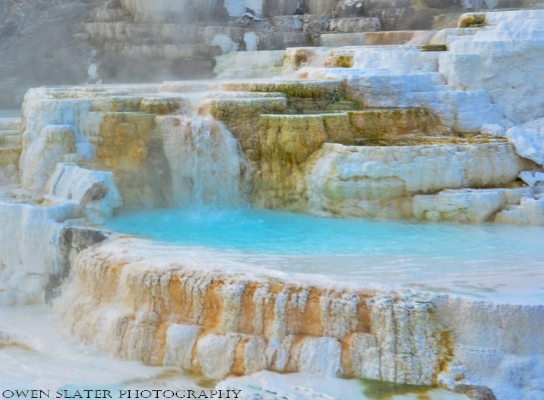
Scalding hot water cascades down a self-made rock feature. The water carries dissolved silica from underground streams. When the water evaporates, the silica is deposited on surfaces, hardens and forms sinter (aka geyserite) that creates these rock formations. Naive animals (including people) will sometimes be tempted to get too close to or actually into these hot pools to escape the extreme cold weather, often resulting in dire consequences.